
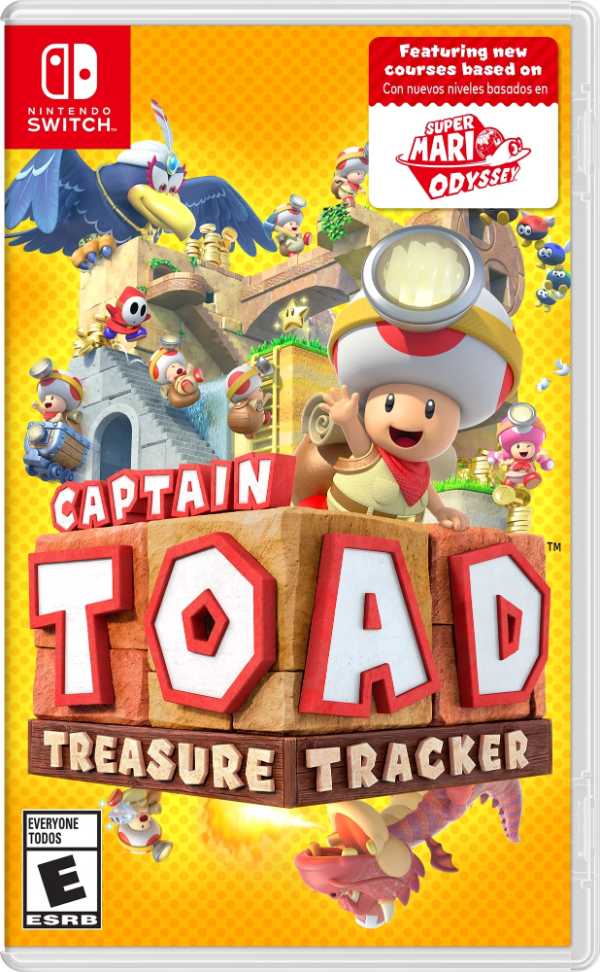
Captain Toad: Treasure Tracker
Overview

Captain Toad: Treasure Tracker is a unique puzzle-platformer developed by Nintendo EPD, originally released on Wii U on 5 December 2014 and ported to Nintendo Switch and Nintendo 3DS on 13 July 2018. The game grew directly out of the popular Captain Toad bonus stages featured in Super Mario 3D World (Wii U, 2013) — the development team noticed how much players enjoyed those self-contained puzzle dioramas and decided to expand the concept into a full game.
The game’s defining innovation is its diorama-style cube stages. Each level is a small, contained 3D environment shaped roughly like a cube or diorama box that the player can rotate the camera around in 360 degrees to discover hidden paths, treasures, enemies, and the Power Star goal. The catch is that neither Captain Toad nor Toadette can jump — a fundamental restriction that forces creative spatial puzzle-solving rather than reflex platforming.
The Headline Features
- 70+ diorama-style cube stages — each a contained 360-degree rotatable puzzle box. The camera can be freely rotated to discover hidden paths, treasures, and enemies on every face of the stage.
- No jumping — Captain Toad and Toadette can’t jump. All progression comes from creative navigation, environmental puzzles, ladder/platform climbing, and exploiting the camera perspective.
- Captain Toad and Toadette — the two playable characters. Originally Captain Toad starred solo; Toadette is unlocked early in the campaign after the first major story beat.
- 3 main episodes across 3 storybook chapters — the campaign is structured like a children’s book, with each episode advancing the Wingo / Toadette storyline.
- Wingo — the campaign’s pelican-like antagonist, a giant tropical bird who steals Power Stars and (eventually) Toadette herself.
- Draggadon — the sub-boss, a dragon-like creature encountered in two unique stages including the Gold Draggadon variant.
- Pixel Toad hunt — every stage hides a single tiny 8-bit Pixel Toad collectible. Finding all of them is a major completionist goal.
- Crown / time trial system — every stage has time-trial challenges with Crown rewards for fast completion.
- Mine Cart segments — specialized stages where Captain Toad rides a mine cart through linear tracks. The first stage of its kind in the Mario series since Donkey Kong Country.
- 2-player co-op (Switch port exclusive) — one player as Captain Toad, the other as Toadette. The most-praised new feature of the 2018 port.
- Super Mario Odyssey-themed stages (Switch port exclusive) — Tostarena Sand Kingdom and New Donk City levels. Recognition that SMO became the new flagship Switch Mario title.
- Touch controls + motion controls — the Switch port supports touch input in handheld mode and Joy-Con motion gestures.
Franchise Origins
Captain Toad: Treasure Tracker has one of the most interesting franchise origin stories in Nintendo history. It is the rare case of a beloved bonus mini-game being expanded into a standalone full-priced retail title.
The Super Mario 3D World Bonus Stages (2013)
In Super Mario 3D World (Wii U, December 2013), the development team included a series of unique bonus stages titled “Captain Toad’s Adventures.” These were small diorama puzzle stages where the player controlled Captain Toad, who couldn’t jump, and had to navigate cube-shaped 3D puzzle environments to find a Power Star.
The bonus stages were a runaway success with players. The combination of restricted movement (no jumping), 3D camera rotation, and intricate environmental design felt distinct enough from the rest of Super Mario 3D World’s platforming that players spent disproportionate time on these segments. Forum discussion, fan demand, and player engagement metrics all pointed to a desire for more of this style of gameplay.
From Bonus to Standalone
- 2013 — Captain Toad bonus stages debut in Super Mario 3D World. Player response strongly positive.
- Early 2014 — Nintendo EPD greenlights a standalone Captain Toad game, building on the Super Mario 3D World engine and design language.
- June 2014 (E3) — Captain Toad: Treasure Tracker officially announced.
- December 2014 — Wii U release. Critical and commercial success.
- July 2018 — Switch + 3DS port released with co-op + Super Mario Odyssey stages added.
Producer & Director
- Koichi Hayashida — Producer. Also produced Super Mario Galaxy, Super Mario Galaxy 2, and Super Mario 3D Land/World. The same creative oversight as the games whose bonus stages spawned Captain Toad.
- Shinya Hiratake — Director. Specialized in Captain Toad’s focused puzzle-platformer design.
- Nintendo EPD Tokyo — The same studio that created Super Mario Galaxy and Super Mario 3D World, ensuring the diorama-cube design language stayed consistent with its origin.
Story
Story Setup
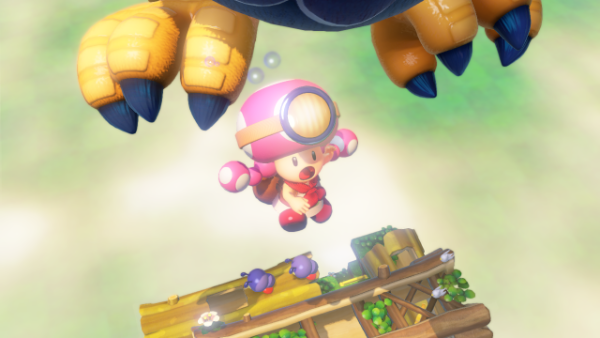
The story opens with Captain Toad and Toadette exploring as treasure hunters. They’re partners and friends with a shared passion for adventure and Power Star collection. While they’re happily examining a recently-discovered Power Star, a gigantic pelican-like bird named Wingo swoops down from the sky, snatches the Power Star — and then, in a shocking moment, also snatches Toadette herself in his beak.
Captain Toad watches in horror as Wingo flies off with both his treasure and his partner. Determined to rescue Toadette, Captain Toad sets off on a journey through 70+ diorama stages, chasing Wingo across themed worlds while collecting Power Stars, finding hidden Pixel Toads, and confronting smaller adversaries along the way.
Toadette’s Episode
Midway through the campaign, the player gets to play as Toadette, whose escape from Wingo enables her own parallel adventure. Toadette’s gameplay is mechanically identical to Captain Toad (no jumping, diorama puzzles) but has its own narrative arc and unique character moments. Players experience the full journey from both perspectives.
The Wingo Confrontation
The campaign builds toward multiple Wingo encounters, each more elaborate than the last. The final confrontation involves a multi-phase Wingo boss fight where Captain Toad must outmaneuver the massive bird across an elaborate cliff-top diorama. Defeating Wingo rescues Toadette and resolves the campaign’s central narrative.
Characters
Captain Toad: Treasure Tracker has a focused cast of 4 named characters — the two playable heroes, the main antagonist, and the sub-boss. This focused scope contrasts with the sprawling ensemble casts of most other Mario universe games.

Captain Toad
Player 1The leader Toad with the iconic head-lamp, backpack, and explorer outfit. Cannot jump.

Toadette
Player 2Captain Toad’s adventure partner. Playable starting in Episode 2.

Wingo
Main AntagonistGiant pelican-like bird who steals Power Stars and kidnaps Toadette. Final boss.

Draggadon
Sub-BossDragon-like creature encountered in special chase stages. Has a Gold variant.
Featured Character Visuals


Diorama Cube Stages

The Diorama Cube Concept
The defining feature of Captain Toad: Treasure Tracker is its diorama-style cube stages. Each level is a small, contained 3D environment roughly the size of a cube or diorama box. The player can rotate the camera 360 degrees around the entire stage to view it from every angle, discovering hidden paths, enemies, treasures, and the Power Star goal that wouldn’t be visible from a fixed perspective.
How Diorama Stages Work
- Compact 3D environments — stages are typically 8–20 cubic units in size. Small enough to view comprehensively but dense enough to hide multiple secrets.
- Full camera rotation — the camera can be freely rotated around the stage in 360 degrees, both horizontally and vertically. The player’s view of the stage changes constantly as they play.
- Hidden paths discovered through rotation — many stages have paths or treasures that are only visible from specific camera angles. The puzzle is partly about finding the right viewing perspective.
- Cubic-box visual style — stages are often presented with visible “borders” — like literal cardboard boxes containing 3D worlds. This emphasizes the diorama aesthetic.
- Power Star goal in every stage — each stage has a single Power Star somewhere within it. Reaching the Star completes the stage. Stars are often visible but obstructed, requiring puzzle-solving to access.
- 3 challenge bonuses per stage — every stage has 3 collect-everything or speed-run bonus challenges that earn Crown rewards.
Stage Variety
The 70+ stages span an enormous variety of themed environments:
- Lava worlds with bubbling magma and rocky platforms.
- Ice worlds with snow, frozen surfaces, and slippery mechanics.
- Sand/desert worlds with pyramids and dust storms.
- Forest worlds with overgrown vegetation and hidden grottoes.
- Underground worlds with cave systems and tunnels.
- Mushroom Kingdom worlds with classic Mario-style environments.
- Ghost mansion worlds with haunting atmospheres and Boo enemies.
- Mountain worlds with vertical climbing puzzles.
- Carnival worlds with colorful ferris wheels and ride-themed mechanics.
- Switch port exclusives — Sand Kingdom Tostarena Ruins and New Donk City stages from Super Mario Odyssey.
No-Jump Mechanics

No-Jump Movement
The fundamental mechanical restriction in Captain Toad: Treasure Tracker is that neither Captain Toad nor Toadette can jump. This single design choice transforms the entire gameplay loop — puzzle-solving rather than platforming becomes the primary challenge.
How Characters Navigate Without Jumping
- Ladder climbing — most stages feature ladders that characters can climb vertically.
- Slope walking — gentle slopes can be walked up. Steep slopes cannot be ascended.
- Platform pushing — some platforms can be physically pushed by the character to reach new locations.
- Lift activation — stage-specific lift mechanisms that elevate characters when activated.
- Falling damage — characters take damage from significant falls. Death from falls is common in difficult stages.
- Bubble Shield — a stage-specific defensive power-up that protects from projectiles.
- Turnip-pulling — Toadette’s signature ability to pull large turnips from the ground for throwing.
- Mine Cart riding — special stages where Captain Toad rides linear mine cart tracks.
Camera Rotation as Mechanic
The 360-degree camera rotation isn’t just visual flavor — it’s a core gameplay mechanic. Many stages require the player to actively rotate the camera to:
- Discover hidden paths obscured by stage geometry from the default angle.
- Find Pixel Toads tucked in corners only visible from specific angles.
- Spot enemies approaching from blind spots in the player’s view.
- Solve perspective puzzles where stage elements align differently from different angles.
- Track moving objects across the stage as they pass through camera dead zones.
3-Episode Book Structure
Captain Toad: Treasure Tracker’s campaign is structured like a children’s storybook — with 3 main “Episodes” across 3 storybook chapters. Each Episode advances the Wingo / Toadette narrative through themed stage progressions.
The 3 Episode Structure


Episode 1: Captain Toad’s Chase
- Playable character: Captain Toad.
- Story arc: Wingo has captured Toadette. Captain Toad chases Wingo across themed environments to rescue her.
- ~24 stages spanning forests, caves, ghost mansions, lava worlds.
- First Wingo boss encounter at episode’s climax.
- Tutorial-heavy early stages — the game teaches mechanics progressively.
Episode 2: Toadette’s Perspective
- Playable character: Toadette.
- Story arc: Toadette has escaped Wingo and is on her own parallel adventure. The campaign reveals Toadette’s independence.
- ~24 stages covering different themed environments to Episode 1.
- Toadette-specific mechanics — her turnip-pulling ability and other unique interactions.
- Second Wingo encounter — their first confrontation with the bird from Toadette’s side.
Episode 3: The Final Confrontation
- Playable character: Both Captain Toad and Toadette (selectable in some stages, others have predetermined characters).
- Story arc: The heroes converge to defeat Wingo once and for all.
- ~22 stages including the most difficult puzzle designs.
- Final Wingo boss fight — multi-phase climactic encounter.
- Post-game content unlocks after Episode 3 completion — hidden stages, Crown challenges, etc.
Featured Stages
Three featured diorama stages showcase Captain Toad’s design variety — the touch-rotate puzzle, spinwheel verticality challenge, and Touchstone Trouble (the touch-interaction showcase).

Touch-Rotate Fortress Stage
A fortress-themed stage that demonstrates the touch-screen rotation mechanics central to the GamePad / Switch portable controls. Players physically rotate the diorama box using touch input to reveal hidden paths through the fortress walls. The stage is one of the game’s clearest demonstrations of how the touch + camera-rotation systems combine to create unique puzzle gameplay.
Touchstone Trouble
The name-and-concept “Touchstone” puzzle stage — a fortress where touchstones must be activated in specific sequences to unlock paths. Combines the diorama-rotation system with sequential puzzle-solving. Players rotate the camera to find touchstones placed on various faces of the diorama, then activate them in the right order to progress.
Spinwheel
A vertical-themed stage with rotating spinwheel platforms. Captain Toad must time movement onto and off of rotating wheels at the right moment to progress upward. The stage demonstrates Captain Toad’s focus on timing-based environmental puzzles rather than jump-based skill challenges.
Enemies
Captain Toad: Treasure Tracker features a focused enemy roster — mostly variants and classic Mario enemies, reimagined for the diorama-puzzle context.
Original CTTT Enemies

Mole
Original

Shy Guy
Classic

Light-Blue Shy Guy
Variant

Goomba
Classic

Goomba Tower
3DW Heritage

Floaty Goomba
3DW Heritage

Mummy-Me
Original

Bizarre Doors of Boo Mansion
Original
Notable Enemy Mechanics
- Goomba Towers — stacked Goombas where defeating the bottom collapses the whole tower. A 3D World mechanical heritage.
- Mummy-Me — a shadow-clone enemy that mimics Captain Toad’s movements with a delay. Players must out-think their own reflections. A unique CTTT original.
- Bizarre Doors of Boo Mansion — ghostly doors that shift positions between rotations. Stage-specific enemy mechanic.
- Cat Goombas — 3D World heritage variants with the cat costumes.
- Floaty Goombas — Goombas in balloons that drift through the diorama. Cannot be jumped on.
- Mole — original CTTT enemy. Underground enemies that emerge from dirt patches.
Super Mario 3D World Heritage

The Super Mario 3D World Connection
Captain Toad: Treasure Tracker shares deep mechanical and aesthetic DNA with Super Mario 3D World. Beyond the literal franchise origin (Captain Toad bonus stages from 3D World became the foundation), the game shares engine, art style, enemy designs, and design philosophy with its parent title.
3D World Heritage Visible Throughout

Conkdor
3DW Origin

Cat Goomba
3DW Origin

Chargin’ Chuck
3DW Origin
Shared Design Elements
- Engine and physics — Captain Toad uses the Super Mario 3D World engine, with similar character movement, physics, and visual fidelity.
- Diorama aesthetic — the diorama-cube visual style was pioneered in 3D World’s Captain Toad bonus stages.
- Enemy reuse — Conkdors, Cat Goombas, Chargin’ Chucks, Ant Troopers, Spike Tops, Stingbys, and other 3D World enemies appear throughout CTTT.
- Power-up restraint — like 3D World, Captain Toad uses a focused set of power-ups rather than the sprawling kit of mainline Mario games.
- Theatrical world design — the chapter-and-act presentation style is shared with 3D World’s world structure.
- Same producer/director collaboration — Koichi Hayashida produced both games, ensuring stylistic continuity.
Bosses: Wingo & Draggadon
Captain Toad: Treasure Tracker features two major boss types — Wingo, the main antagonist confronted in multiple stages, and Draggadon, the dragon sub-boss in specialized chase stages.
Wingo

The giant pelican-like bird who steals Power Stars and kidnaps Toadette. Wingo appears in 3 boss encounters across the campaign — once in Episode 1, once in Episode 2 from Toadette’s perspective, and the climactic Episode 3 final boss fight. Each encounter involves outmaneuvering Wingo across an elaborate cliff-top diorama while collecting items to weaken him.
Draggadon

The dragon-like sub-boss. Encountered in specialized chase stages where Captain Toad must outrun Draggadon’s lava-breath attacks through linear corridor segments. A “Gold Draggadon” variant appears in post-game challenge stages with increased difficulty and unique rewards.
Gold Draggadon

The post-game variant of Draggadon — same chase mechanics but with faster speed, more aggressive attacks, and a golden visual treatment. Defeating Gold Draggadon is among the campaign’s most challenging accomplishments.
Pixel Toad Collectibles

The Pixel Toad Collectible System
Pixel Toad is the campaign’s signature collectible mechanic. Every single one of the 70+ stages hides a tiny 8-bit-style “Pixel Toad” — a pixelated little Toad sprite tucked away in some corner of the diorama. Finding all Pixel Toads is the major completionist goal.
Pixel Toad Mechanics
- One Pixel Toad per stage — every stage has exactly one Pixel Toad to find. Some are obvious; most are deeply hidden.
- Visible via camera rotation — most Pixel Toads are only visible from specific camera angles. The player must rotate the camera methodically to spot them.
- Often tucked in corners or behind objects — Pixel Toads are typically partially obscured, requiring patient observation.
- Pixelated 8-bit aesthetic — a deliberate visual contrast to the diorama’s 3D environments. The pixel-art style is a callback to retro Mario sprites.
- Total of 70+ Pixel Toads across the campaign. The completionist goal demands a thorough exploration of every stage.
- Rewards for completion — finding all Pixel Toads unlocks post-game content, achievements, and unique rewards.
Mine Cart Segments

Mine Cart as Stage Type
A subset of Captain Toad stages feature Mine Cart segments — specialized stages where Captain Toad rides a mine cart through pre-determined linear tracks rather than navigating a diorama-cube. These stages are notable for being the first Mine Cart segments in a Mario universe game since the classic Donkey Kong Country titles.
Mine Cart Stage Mechanics
- Linear track movement — Captain Toad rides the cart along predetermined rails. No camera rotation; the camera follows the cart’s motion.
- Tilt-based aim — Captain Toad can throw projectiles (typically turnips) by tilting controls. Aim is via stick or motion input.
- Coin and gem collection — the linear tracks are lined with coins, gems, and Pixel Toads to collect during the ride.
- Enemy combat — enemies appear along the track; Captain Toad must shoot them with thrown projectiles before they’re reached.
- Touch-screen aim alternative — on the Switch port (and original Wii U), players can use touch input for cart-segment aiming.
- Reduced camera control — unlike standard stages, players have minimal camera-rotation freedom during cart segments.
Why Mine Cart Stages Matter
Mine Cart stages provide gameplay variety within the 70+ stage library. They are mechanically distinct enough from standard diorama stages to serve as set-piece breakaways. The first Mario-universe Mine Cart segments in 25+ years made them a critical-press talking point at launch, with reviewers noting Nintendo’s willingness to revive forgotten mechanics for new contexts.
Controls Overview
Switch Port Control Options
The Switch port of Captain Toad: Treasure Tracker offers the most comprehensive control options in the franchise. The original Wii U version was designed around the GamePad’s touch screen + motion control; the Switch port adapts those mechanics across multiple input methods.
Available Control Schemes
- Standard Joy-Con / Pro Controller — stick movement for character, analog or D-pad for camera. Buttons for special actions (Pixel Toad highlight, etc.).
- Touch screen (handheld mode) — tap to interact with stage elements. Camera rotation by swiping. The closest analog to the original Wii U GamePad experience.
- Motion controls — Joy-Con gyroscope-based aim for projectile throwing in Mine Cart stages and other targeting situations.
- Mixed-input flexibility — some controls can mix touch + buttons in handheld mode. Stick-controlled movement + touch-based interaction.
- Cooperative two-controller setup — each player uses their own Joy-Con in co-op mode.
- 3DS port differences — the 3DS port uses the bottom touch screen for camera rotation by default.
Switch Port New Features
The 2018 Switch port of Captain Toad: Treasure Tracker added two major new features over the 2014 Wii U original: 2-player co-op mode (the most-praised addition) and Super Mario Odyssey-themed stages (Tostarena Ruins + New Donk City).
Major Additions Summary
- 2-Player Co-op Mode — Captain Toad and Toadette playable simultaneously by two players. The most-anticipated and most-praised addition.
- Super Mario Odyssey-themed stages — Tostarena Ruins (Sand Kingdom) + New Donk City stages exclusively in the Switch port.
- 1080p docked / 720p portable visuals — improved visual fidelity over the original Wii U presentation.
- Joy-Con motion control support — enhanced motion-control options for Mine Cart and aiming.
- Touch screen support (handheld mode) — the Switch’s touch screen mirrors the original Wii U GamePad experience.
- Re-released on 3DS simultaneously — the same content also released on Nintendo 3DS with handheld-specific adaptations.
Co-op as Killer Feature
The 2-player co-op mode is the Switch port’s clearest justification for re-release. The original Wii U game was singleplayer-only — the Switch port turns it into a Switch-era party game perfect for couches and shared play sessions. The co-op mechanics are integrated thoughtfully (both players occupy the same diorama and must coordinate movement) without requiring stage redesigns.
Mario Odyssey Cross-Pollination
The addition of Super Mario Odyssey-themed stages is a clever cross-pollination. SMO (released October 2017, ~8 months before the Captain Toad Switch port) was Switch’s flagship Mario title at the time. Bringing SMO’s iconic locations (Sand Kingdom + New Donk City) into Captain Toad gave fans of both games a unique crossover experience and signaled Nintendo’s commitment to making the port more than a simple re-release.
2-Player Co-op (NEW)

The Switch Port’s Killer Feature
2-Player Co-op Mode is the Switch port’s most-praised new feature. Two players control Captain Toad and Toadette simultaneously in the same diorama stage, working together to solve puzzles, defeat enemies, and collect items. The mode was added specifically for the Switch port — the original Wii U version was singleplayer-only.
Co-op Mechanics
- Both characters in the same stage simultaneously — both Captain Toad and Toadette occupy the same diorama. Co-op is local-only.
- Shared lives and collectibles — lives and gem-collection are shared between players. Cooperation rewards both.
- Independent character control — each player can move their character independently. Splitting up to cover more of the stage is a viable strategy.
- Single Joy-Con per player setup — the standard configuration. Both players hold one Joy-Con each.
- Co-op only on Switch, not 3DS — the 3DS port omits co-op due to handheld-specific hardware constraints.
- Same stage library — all 70+ stages work in co-op. No stages are co-op-exclusive.


SMO Themed Stages (NEW)

Super Mario Odyssey Crossover Content
The Switch port adds Super Mario Odyssey-themed stages as exclusive new content. Two distinct locations from SMO are reimagined as Captain Toad diorama-cube puzzle stages: Tostarena Ruins (Sand Kingdom) and New Donk City.
Tostarena Sand Kingdom Stage
Tostarena Ruins (Sand Kingdom)
Captain Toad explores the Tostarena Ruins zone from Super Mario Odyssey’s Sand Kingdom — the sandy desert with ancient ruins, pyramids, and the iconic Sphinx-like Knucklotec architecture. The stage features both day and night variants, with the night version showcasing the kingdom’s starry desert sky and distinct ambient lighting. Distinct from any regular Captain Toad stage, this brings SMO’s vivid environmental design into the diorama-cube format.

New Donk City Stages (5 variants)
New Donk City (Metro Kingdom)
Captain Toad explores the iconic urban metropolis of New Donk City from SMO’s Metro Kingdom. The Switch port includes 5 different New Donk City stage variants, each highlighting different parts of the city: rooftops, alleys, plazas, etc. The juxtaposition of Captain Toad’s diorama-puzzle aesthetic with SMO’s big-city skyscraper environments creates a uniquely scaled-down version of the bustling metropolis.


Visual Style
The Diorama-Cube Visual Identity
Captain Toad: Treasure Tracker has one of the most distinctive visual identities in the Mario universe — the diorama-cube aesthetic that defines its gameplay also defines its art direction.
- Diorama-style stage framing — stages often have visible “borders” reminiscent of cardboard diorama boxes. The world feels deliberately compact and contained.
- Vivid saturated color palette — reds, blues, greens, golds dominate. Each stage has its own distinct color theme appropriate to its themed environment.
- 3D anime-influenced character models — Captain Toad and Toadette have warm, expressive character designs in the franchise’s signature style.
- Detailed environmental modeling — despite stages being compact, the environmental detail is meticulous. Every face of the diorama has thoughtful design.
- Switch port enhancements — 1080p docked / 720p portable, with improved lighting and shaders over the Wii U original.
- Storybook framing — chapter intros are presented as illustrated storybook pages.
- Atmospheric lighting — each stage has carefully designed lighting that emphasizes the diorama atmosphere.


Videos & Trailers
Four verified official Nintendo trailers covering Captain Toad: Treasure Tracker from E3 2014 announcement through Wii U launch.
Reception
Captain Toad: Treasure Tracker launched on Wii U on 5 December 2014 to highly positive reviews (Metacritic ~81 Wii U). The 2018 Switch port maintained those positive scores (~82 Metacritic Switch). The game has been consistently praised for its mechanical originality and tight design.
Acclaim
- Innovative no-jump puzzle design — universally praised as a fresh take on the Mario universe formula. The restriction of jumping forced creative gameplay design that reviewers found refreshing.
- Diorama-cube aesthetic — the visual identity received special mention as distinctive and charming.
- Tight stage design — the 70+ stages are described as expertly-curated. Each stage feels carefully designed rather than padding.
- Pixel Toad collectible system — the completionist hook is praised as one of the cleverest collectible mechanics in any Mario game.
- Switch port co-op mode — universally hailed as the killer addition to the 2018 port.
- Super Mario Odyssey themed stages — the cross-franchise content added genuine value to the re-release.
- Accessible to all ages — the simple controls, storybook narrative, and forgiving difficulty curve made it ideal for family play.
- Replay value via Crowns — the time-trial Crown system gave skilled players reasons to revisit stages.
Criticisms
- Short campaign length — the main story can be completed in 8–12 hours. The Pixel Toad / Crown completionism extends this significantly, but the base story is brief.
- Linear puzzle design — some reviewers found the puzzles feel guided rather than open-ended. Solutions are typically singular rather than emergent.
- Repetitive late-game stages — some critics noted that the late-game stages don’t innovate as significantly as the early stages.
- Limited boss variety — only 2 main boss types (Wingo + Draggadon) limits the boss-fight variety relative to other Mario games.
- Switch port price — at launch, the Switch port’s $40 USD pricing was criticized as steep for a 4-year-old Wii U title, even with the co-op + SMO stage additions.
Legacy & Sales
Sales Performance
- Wii U launch (Dec 2014) — strong launch given Wii U’s installed base. ~150k week one in Japan, top 10 US.
- Wii U lifetime — approximately 1 million copies sold worldwide. Solid for a Wii U title.
- Switch + 3DS port launch (Jul 2018) — #2 UK launch week, top 5 US. Strong response from the expanded Switch audience.
- Combined lifetime estimate — around 3+ million copies across all platforms (Wii U + Switch + 3DS).
- Continued Switch sales — the Switch version continues to sell as one of the platform’s evergreen first-party puzzle titles.
Legacy
- Established Captain Toad as franchise character — prior to this game, Captain Toad was a minor recurring Toad with the explorer outfit. After Treasure Tracker, he became a recognized franchise mainstay with his own identity, mannerisms, and design language.
- Promoted Toadette to playable starring role — Toadette’s playable role in Captain Toad was an important step in her franchise elevation. She later starred prominently in New Super Mario Bros. U Deluxe and other Switch-era titles.
- Validated bonus-to-game expansion strategy — the success of Captain Toad as a standalone expansion of a 3D World bonus mode demonstrated Nintendo could mine its franchise mini-games for full retail titles.
- Established diorama-cube design as Nintendo template — the design philosophy has influenced other Nintendo titles since 2014.
- Set up potential sequel — no direct Captain Toad sequel has been announced as of mid-2024, but the franchise remains positioned for future expansion.
- Pixel Toad collectible became iconic — the 8-bit hidden Pixel Toad has become a recognized Captain Toad branding element.
- Switch port format influenced re-release strategy — the practice of adding meaningful new content (co-op, themed stages) to ports has become Nintendo’s preferred re-release approach.
Reference / Information
Related coverage on Super Luigi Bros.