
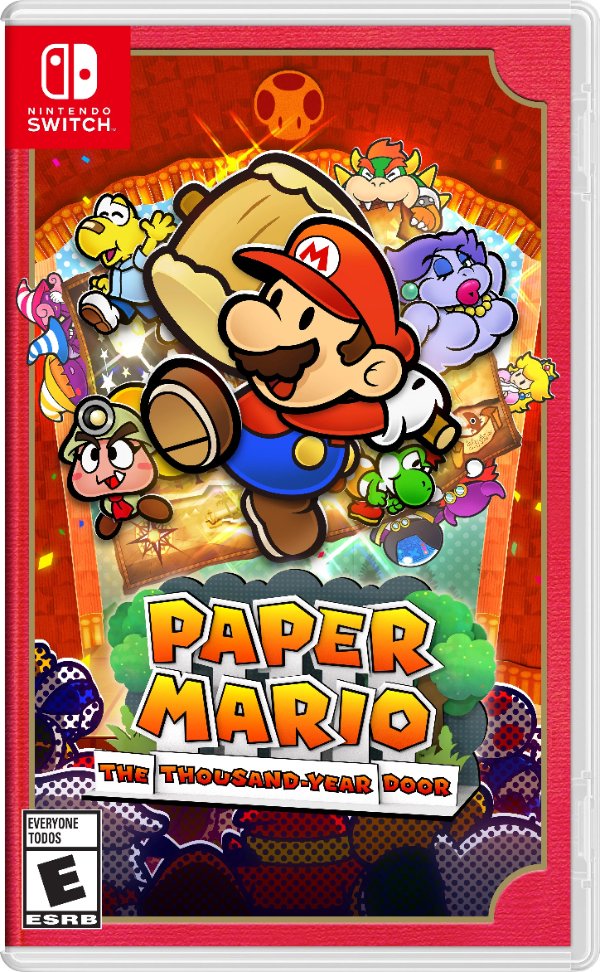
Paper Mario: The Thousand-Year Door (2024 Switch Remake)
Overview

Paper Mario: The Thousand-Year Door is the legendary second entry in the Paper Mario series — originally released for the Nintendo GameCube in 2004, and remade for the Nintendo Switch on 23 May 2024. Twenty years after its debut, the game is still routinely cited as one of the greatest role-playing games of all time, and the Switch remake gave it a new generation of players, a full HD visual remaster, a re-recorded orchestral soundtrack, and a generous slate of quality-of-life improvements.
The story sends Mario to the ramshackle port town of Rogueport, chasing a treasure map sent to him by Princess Peach. The map points to the Thousand-Year Door beneath the town — an ancient seal that long ago was used to imprison a malevolent demon called the Shadow Queen. The only way to open the door is to gather the seven Crystal Stars scattered across the world, and the X-Nauts (a secret society led by Sir Grodus) want them just as badly. Each chapter sends Mario to a new destination — a dragon’s castle, a sentient tree, a wrestling promotion, a cursed steeple, a pirate island, an opulent train, the moon — and pits him against unforgettable boss after unforgettable boss, all while gradually revealing the deeper conspiracy beneath Rogueport.
Mechanically, TTYD is the peak of classic Paper Mario combat: turn-based, with timing-based Action Commands for every move, a deep badge customisation system, and the legendary Audience mechanic — a crowd of NPCs that fills theatres and stadium seats around every battle, lobs items at Mario, throws garbage when he’s boring, and powers up his Star Power when he’s stylish.
Remake Changes

The 2024 remake is built on a fully new 3D engine — the original GameCube engine could not have rendered the new visuals — but the gameplay structure, dialogue, and music remain remarkably faithful. Here’s what changed.
Visuals
- Full HD remaster at 30fps with new paper-texture materials, modern lighting, and refined animations — every character looks like they’ve been hand-cut from premium cardstock.
- Reworked particle effects for paper transitions — plane Mario, boat Mario, tube Mario, and paper Mario all look better than ever.
- New battle stage backgrounds that reflect each chapter’s region (Glitz Pit lights, Twilight Town dim, etc.)
Quality of Life
- Partner Ring — swap partners in battle without using a turn. This is the biggest mechanical change and removes one of the original’s biggest frustrations.
- Quick-travel pipes — fast-travel pipes spread through Rogueport for skipping the long sewer-pipe traversal sequences.
- More frequent save blocks in dungeons.
- In-game journal tracking active quests, partner moves, and badge effects.
- Toggleable HD/CRT visual filter for nostalgia buffs.
Audio
- Fully re-recorded orchestral soundtrack — every track re-arranged using modern instrumentation, by composer Yoshito Hirano (returning from the GameCube original).
- Option to toggle the classic 2004 soundtrack for purists.
Dialogue & Script
- Vivian’s identity — her dialogue acknowledging she is trans, present in the original Japanese script but removed from the 2004 English localisation, is fully restored across all language versions. This change earned the game a GLAAD Media Award nomination in 2024.
- Refined English script — over a thousand individual dialogue lines were revised for clarity, comedy timing, or modern sensibility, while preserving the game’s sharp wit.
- Expanded localisations — the remake supports Korean, Simplified Chinese, Dutch, and Latin American Spanish for the first time.
Story — Prologue
A Rogue’s Welcome
Mario receives a mysterious letter from Princess Peach containing a strange treasure map she bought from a shadowy merchant in the port town of Rogueport. He arrives at the docks expecting a vacation — only to find Peach has already vanished, and a young Goomba named Goombella is being interrogated by the X-Naut general Lord Crump right in the town plaza.
After Mario rescues her, Goombella explains she is studying at the University of Goom under Professor Frankly, who is the world’s leading expert on the legend of the Thousand-Year Door. They visit the professor, who reveals the map is genuine: it shows the location of the seven Crystal Stars, which together can open a vast sealed door hidden beneath Rogueport — supposedly hiding a treasure beyond imagination. With Peach missing and the X-Nauts hunting the stars themselves, Mario’s quest begins.


Quest accepted
Story — Chapter 1
Petalburg & Hooktail
The first Crystal Star lies in Hooktail’s Castle, somewhere in Petal Meadows. Mario and Goombella enter through the Rogueport sewers, defeating a Blooper to reach the warp pipe to Petal Meadows. They arrive in the peaceful village of Petalburg, where the mayor explains that the village has long lived in fear of the dragon Hooktail, who guards a sparkling treasure in her castle.
To enter the castle, Mario must retrieve two stone keys from the nearby Shhwonk Fortress. Along the way, he recruits Koops — a shy young Koopa who has long planned to climb the castle and avenge his father, supposedly eaten by Hooktail. Inside the castle, the trio navigates spike mazes and platform puzzles before facing Hooktail herself — a roaring red dragon who breathes fire and curse-stuns Mario’s partners. After her defeat, the Diamond Star is claimed, and the door beneath Rogueport responds with the first carved star slot now lit.


Diamond Star claimed
Story — Chapter 2
Punies, Jabbies & the Shadow Sirens
The second Crystal Star lies within the Great Boggly Tree — a colossal sentient tree deep inside Boggly Woods, home to the tiny race of Punies. The X-Nauts have invaded the tree, imprisoning most of the Punies and allying with their enemies the Jabbies.
Along the way, Mario meets the legendary actress Madame Flurrie, who can blow open the tree’s secret entrance with her wind powers — she joins as the third partner. Inside the tree, the team navigates puzzles to rescue the imprisoned Punies one by one. Meanwhile, Mario encounters the Shadow Sirens for the first time: Beldam, Marilyn, and a third sister named Vivian, who is being relentlessly bullied by Beldam and treated as the household drudge. The chapter culminates when Lord Crump and his X-Naut squad ambush the team and seize the Emerald Star — only for the Punies, all 100 of them, to overwhelm Crump and let Mario reclaim the star.


Emerald Star claimed
Story — Chapter 3
Glitzville & the Glitz Pit
The third Crystal Star is in Glitzville — a floating sky city famous for its wrestling promotion, the Glitz Pit. The star is mounted on the championship belt held by the reigning champ, Rawk Hawk. Mario signs up under the stage name The Great Gonzales, recruits a newborn Yoshi (who hatches in his locker and lets the player name him) as a partner, and battles up through the ranks.
As Mario climbs the ladder, an anonymous figure known only as “X” begins emailing him cryptic warnings: the championship belt’s star is a fake, the real Crystal Star is held by the Glitz Pit’s promoter Grubba, who has been secretly draining the energy of fighters to keep himself young and powerful. After Mario defeats Rawk Hawk in the title match, Grubba reveals himself as the true villain, transforming into the monstrous Macho Grubba. The Gold Star is claimed.


Gold Star claimed
Story — Chapter 4
Twilight Town, Creepy Steeple & Doopliss
The fourth Crystal Star is in the Creepy Steeple, near the dreary Twilight Town. Mario arrives to discover that the townsfolk are being transformed into pigs whenever the steeple’s bell rings — the work of a mysterious shape-shifting monster called Doopliss.
The chapter is the game’s narrative high point: Doopliss steals Mario’s name and body, leaving Mario as a shadowy nameless silhouette. Mario’s own partners abandon him, thinking Doopliss is the real Mario. Returning to the steeple alone, Mario stumbles into Vivian, who is hunting for the Shadow Sirens’ lost weapon. After Mario shows her kindness, she leaves her abusive sisters and joins Mario’s party — in the remake’s restored script, openly confirming her trans identity for the first time in any English version of the game. Together they confront Doopliss, force him to reveal his name, and reclaim Mario’s identity along with the Ruby Star.


Ruby Star claimed · Vivian joins
Story — Chapter 5
Keelhaul Key & Captain Cortez
The fifth Crystal Star lies in a pirate lair on the southern island of Keelhaul Key. To reach the island Mario gathers a crew of misfits: the boastful merchant Flavio, the cleric Pa-Patch, several Toad sailors, and the retired pirate captain Admiral Bobbery — a melancholy Bob-omb mourning his late wife. A disguised Lord Crump also sneaks aboard as “Four-Eyes.”
Their ship is wrecked en route by spectral pirates known as Embers. Stranded on the island, Bobbery is hit by an Ember’s attack defending the crew and falls into apparent death — but it turns out he was only sleeping. Restored, he joins Mario’s party as the sixth partner. The team enters Pirate’s Grotto, solving puzzles and acquiring the Boat-Mode paper ability, before confronting the long-dead pirate king Captain Cortez on his haunted galleon. After defeat, Cortez willingly hands over the Sapphire Star and even agrees to give Mario’s crew a lift back. Lord Crump’s disguise drops and he’s defeated again — setting up the X-Nauts’ endgame plans.


Sapphire Star claimed · Bobbery joins
Story — Chapter 6
The Excess Express & Poshley Heights
The sixth Crystal Star resides in the ritzy mountain town of Poshley Heights, only reachable via the Excess Express — a famous luxury train carrying nobles, detectives, ghosts, businessmen, and (unwittingly) a Doopliss in disguise. Mario boards as a ticketed passenger, with all his partners now riding along for what becomes a three-day mystery aboard the train.
Over the journey, the team investigates a series of mysterious thefts and threats: missing items, a “Smorgs” infestation in the back carriages, a bomb threat from a passenger called Zip Toad, romantic crises among the staff, and finally a sabotaged drawbridge at Riverside Station. The penguin detective Pennington joins forces with Mario to crack the cases, and the fake Zip Toad is exposed as Doopliss again. After the train finally reaches Poshley Heights, Mario claims the Garnet Star from the town’s Poshley Sanctum — but soon discovers that Bowser, also hunting Crystal Stars, has been stealing fakes elsewhere.
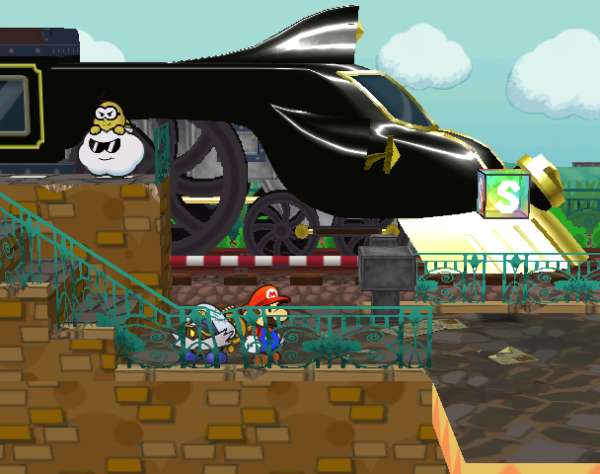

Garnet Star claimed
Story — Chapter 7
Fahr Outpost & the X-Naut Fortress
The final Crystal Star is on the moon itself. Mario travels to the snow-covered town of Fahr Outpost in the far north, home to a colony of Bob-ombs and the location of a giant cannon — the only way to reach the moon. With the blessings of Goldbob and the legendary General White, Mario fires himself out of the cannon and lands at the X-Naut Fortress on the moon’s surface.
Inside the fortress, Mario battles deeper into Sir Grodus’ base, learns that Princess Peach has been held there the entire game (and has been emailing him secretly as the mysterious “X”), and finally confronts Lord Crump at the fortress’s core. Crump unveils his new battle mech — Magnus von Grapple 2.0 — a colossal upgrade of his previous machine. After Crump’s defeat the Crystal Star is reclaimed, and Mario’s journey to all seven is complete. Bowser, meanwhile, learns that Mario has every star and prepares his own assault on the Thousand-Year Door.


Crystal Star claimed · All 7 collected
Story — Chapter 8
Palace of Shadow & the Shadow Queen
With all seven Crystal Stars gathered, the time has come. Mario and his partners gather at the Thousand-Year Door beneath Rogueport. The seven stars rise into the air, fly into the carved slots above the door, and the door grinds open for the first time in a thousand years — revealing the immense Palace of Shadow below.
The palace is a final-dungeon gauntlet of puzzles, enemies, and bosses. Mario battles the dragon Gloomtail (Hooktail’s older brother), solves a tower puzzle to unlock the deeper sanctum, and defeats the Shadow Sirens (Beldam and Marilyn) one final time. Beneath the palace he confronts Sir Grodus himself in a long, difficult fight — and just as Grodus is beaten, he reveals a captive Peach as his hostage.
But Grodus has unwittingly served a far greater evil. Princess Peach’s body is taken over by the Shadow Queen, the ancient demon that has been sealed below Rogueport for a thousand years. She kills Grodus, dismisses the X-Nauts as fools, and turns her power on Mario. The final battle is a multi-phase showdown against the Shadow Queen — first her possessed-Peach form, then her true demonic form. With the help of his seven partners, the Crystal Stars, and the cheering of every NPC in the world (broadcast directly into the battle as Star Power), Mario finally defeats her. Peach is restored, the demon banished, and the Thousand-Year Door closes for good.


The Shadow Queen falls
Gameplay

TTYD is a classic turn-based RPG with platform-game exploration in between battles. Mario explores Rogueport (the central hub) and travels by warp pipe and ship to each of the eight chapter regions, recruiting partners, solving puzzles, and engaging in battles where every move requires precisely-timed inputs.
Paper Abilities (overworld powers)
Mario gains five “paper” traversal forms across the game, each unlocked from a black chest in a different region:
- Paper Mode — slip sideways through narrow openings (Prologue)
- Plane Mode — fold into a paper plane to cross gaps (Chapter 1, Hooktail Castle)
- Tube Mode — roll into a tube to fit under low ceilings (Chapter 2, Boggly Woods)
- Boat Mode — fold into a boat to cross water (Chapter 5, Pirate’s Grotto)
- Mario’s naked paper-thin form for puzzles — sliding through grates and slots
Stats & Equipment
- HP, FP (Flower Points for battle moves), BP (Badge Points for equipping badges) — raised each level by choosing one of the three.
- Boots and Hammer upgradeable at story moments — Super Boots/Super Hammer (mid-game) and Ultra Boots/Ultra Hammer (late-game) deal more damage and unlock new attack types.
- Badges — the deepest customisation system in any Paper Mario, with over 80 badges granting passive effects, new attacks, or stat boosts. Equip what you can within your BP budget.
- Shine Sprites — used to upgrade partners. Spend three on Merlon to advance a partner from Normal → Super, or with the Ultra Stone, Super → Ultra.
Princess Peach & Bowser Intermissions
Between every chapter, the camera cuts away to Peach, held at the X-Naut moon base — secretly emailing Mario and gathering intel from TEC-XX, the X-Nauts’ sentient computer. Other intermissions cut to Bowser, who is wandering the world having his own (mostly comedic) attempts to gather Crystal Stars, in side-scrolling Super Mario Bros.-style segments. The intermissions are short, charming, and add huge tonal variety to the campaign.
Battle System

Battles are turn-based, taking place on a theatrical stage with Mario and his active partner facing the enemy lineup, and an audience filling the rows above. Each turn, Mario and his partner each get an action.
Actions
- Attack — for Mario, split into Jump and Hammer (each with multiple upgrade tiers); for the partner, two–four moves depending on their rank.
- Items — mushrooms, syrups, status removers, and special items like Honey Syrup, Tasty Tonic, and Zess T.’s cookbook recipes.
- Special — Crystal Star moves powered by Star Power. Sweet Treat heals, Earth Tremor hits all grounded enemies, Power Lift boosts Mario and partner, Showstopper can instantly KO, and so on — each Crystal Star adds one move.
- Tactics — swap partners (now free in the Switch remake via the Partner Ring), defend, appeal to the audience, or charge stylish.
Action Commands
Every attack and every defense requires a real-time button input. Press A at the right moment to power up Jump, hold and release for Hammer, time button presses to fill a gauge for special moves. Guarding (press A as a hit lands) reduces damage by 1; Superguarding (press B with a tighter window) reduces damage to 0 and reflects part of it. Mastering these inputs is the difference between a hard fight and a trivial one.
Stylish moves
Press the right inputs at the right times during attacks and Mario performs flourishes — Stylish moves — which excite the audience and grant bonus Star Power. The audience is itself a mechanic.
The Audience

Every battle in TTYD takes place on a theatre stage, with rows of seated NPCs cheering, booing, throwing items, and getting involved. The audience is one of the most unique combat mechanics in any RPG.
How the Audience works
- Star Power regenerates each turn based on how exciting Mario’s actions are — successful Action Commands, Stylish moves, and finishing enemies stylishly all build it faster.
- Appeals — Mario can spend a turn appealing directly to the crowd, gaining a burst of Star Power.
- Audience interactions — helpful spectators throw items (mushrooms, flowers, coins) onto the stage for Mario; troublemakers throw rocks, garbage, or even Bob-ombs at him.
- Stage hazards — some audience members may climb onto the stage, accidentally drop props from the rafters, or hide combatants in dust clouds.
- Boss interactions — Hooktail, Cortez, and the Shadow Queen all eat audience members to restore their own HP. Magnus von Grapple 2.0 launches them as ammunition. Some enemies fear the crowd and flee if Mario plays to it well.
Bingo!
Successful Action Commands also trigger a slot machine above the Star Power gauge. Match three icons and trigger a Bingo! bonus — multiplied damage, free coins, free HP, free FP, or a full Star Power refill depending on the icons matched.
The 7 Partners
TTYD has seven recruitable partners — the deepest partner roster in the series. Each has their own backstory, side-quest, overworld ability, and four battle moves. The Switch remake’s Partner Ring lets you swap between them mid-battle without spending a turn.
Goombella
Goomba · Tattle, Headbonk
A sassy junior at the University of Goom, studying archaeology under Professor Frankly. The first partner to join Mario in Rogueport. Her signature ability is Tattle — her notes on every enemy and NPC are the in-game encyclopaedia.
Prologue
Koops
Koopa · Shell Toss, Power Shell
A shy young Koopa from Petalburg whose father supposedly was eaten by Hooktail. Joins Mario to avenge him. His Shell Toss attacks enemies at a distance, and his overworld ability lets him hold position to activate switches.
Chapter 1
Madame Flurrie
Cloud spirit · Body Slam, Gale Force
A legendary actress who lives in seclusion in Boggly Woods. Her wind powers blow open hidden paths, and in battle her Gale Force can sweep enemies clean off the stage.
Chapter 2
Yoshi (player-named)
Baby Yoshi · Ground Pound, Gulp
A newborn Yoshi who hatches in Mario’s locker at the Glitz Pit — the player names him. The Switch remake adds colour variants (default green, black, blue, orange, pink, red, white) selectable on hatch. His overworld ability lets Mario ride him to skip across gaps.
Chapter 3
Vivian
Shadow Siren · Shade Fist, Veil
The youngest of the three Shadow Sirens, mistreated by her elder sister Beldam. After bonding with Mario she defects to his party. Her Veil hides Mario in shadow to dodge attacks entirely. The Switch remake fully restores her openly trans dialogue from the original Japanese.
Chapter 4
Admiral Bobbery
Bob-omb · Bomb, Bomb Squad
A retired pirate captain mourning his late wife Scarlette. Convinced to sail one last voyage to Keelhaul Key, he joins Mario after a fake-death scare. His bombs are the most powerful overworld destruction tool and clear cracked walls.
Chapter 5

Ms. Mowz
Squeek · Love Slap, Kiss Thief
The seventh and optional partner — a flirty thief mouse who runs a side quest at the Trouble Center. Her Kiss Thief steals items from enemies, and her overworld ability sniffs out hidden badges.
Optional
The 7 Crystal Stars
The seven Crystal Stars are the game’s primary collectibles — each unlocks a new Star Power move for use in battle, and together they open the Thousand-Year Door.
 Chapter 1
Diamond Star
Hooktail’s Castle
Earth Tremor — damages all grounded enemies
 Chapter 2
Emerald Star
The Great Boggly Tree
Clock Out — freezes enemies in time
 Chapter 3
Gold Star
Glitz Pit
Power Lift — boost Mario’s ATK and DEF
 Chapter 4
Ruby Star
Creepy Steeple
Art Attack — draw circles around enemies to deal damage
 Chapter 5
Sapphire Star
Pirate’s Grotto
Sweet Feast — heal a huge amount of HP and FP
 Chapter 6
Garnet Star
Poshley Sanctum
Showstopper — chance to instantly KO any enemy
 Chapter 7
Crystal Star
X-Naut Fortress (Moon)
Supernova — ultimate finisher; obliterates all enemies
Villains
TTYD’s villain roster is one of the deepest in any Mario game — dragons, wrestlers, ghosts, conspiracies, and an ancient evil sealed for a thousand years.
The X-Naut Conspiracy
Sir Grodus
Mastermind of the X-Nauts. Wants the Crystal Stars to unleash the Shadow Queen and rule the world. Killed by his own demon.
Lord Crump
Grodus’s top general and recurring comic-relief antagonist. Pilots the Magnus von Grapple mechs.
Magnus von Grapple 2.0
Lord Crump’s upgraded battle mech, fought atop the X-Naut Fortress.
The Shadow Sirens
Beldam
Eldest Shadow Siren. Abusive to Vivian. The Shadow Queen’s loyal servant from a thousand years ago.

Marilyn
Middle Shadow Siren. Speaks only in “Guuuuh”s but hits very hard.
Chapter Bosses
Hooktail
Cowardly red dragon. Ch 1 boss. Has eaten Koops’s father (or so it seems).
Grubba
Corrupt Glitz Pit promoter. Drains fighters’ youth using the stolen Gold Star. Ch 3.
Rawk Hawk
Glitz Pit champion. Loud, ridiculous, oddly endearing. Ch 3.
Doopliss
Identity-stealing duplighost. Ch 4 main villain; later returns as Zip Toad on the Excess Express.
The Final Foe
Shadow Queen
The ancient demon sealed beneath Rogueport for a thousand years. Possesses Peach in the finale and tries to destroy the world.
True Shadow Queen
Her demonic true form in the climactic battle. One of the most dramatic Mario RPG finales ever made.
Videos & Trailers
Official Nintendo trailers for the Paper Mario: The Thousand-Year Door 2024 Switch remake.
Reception
The 2024 remake received universal acclaim from critics and fans alike — one of the most warmly received Nintendo remakes of the Switch era, and a vindication of the long-running fan campaign to bring the GameCube classic to modern hardware.
Critical Reception
- Metacritic 86 for the Switch remake — with most outlets scoring 9/10 or higher.
- The original 2004 GameCube release remains one of the highest-rated Paper Mario games ever, with IGN scoring it 9.1/10 and many retrospective rankings placing it among the greatest video games of all time.
- The Switch remake was singled out for its extraordinary visual fidelity, re-recorded orchestral score, and respectful preservation of the original’s dialogue, structure, and battle system.
- The Partner Ring and quick-travel pipes were widely praised as much-needed quality-of-life additions without compromising the original feel.
Cultural Impact
- The remake earned a GLAAD Media Award nomination in 2025 for its restoration of Vivian’s trans-identity dialogue across all language versions — dialogue present in the original 2004 Japanese script but cut from the international localisations until now.
- Multiple retrospective polls (Nintendo Life, IGN, Famitsu) ranked TTYD as the best Paper Mario game, with the remake re-igniting the long-running fan debate about whether Nintendo should return the series to its classic RPG roots.
- Speedrunners embraced the remake quickly, with the Partner Ring opening new strategies and previous skips/glitches receiving renewed analysis.
Criticisms
- 30fps cap — the remake locks at 30fps rather than the 60fps many modern players expected. Defended by Nintendo as a deliberate choice to preserve the original’s animation timing.
- Story unchanged — some critics argued for new chapters or expanded content; the remake is structurally identical to the original.
- Premium pricing — the full £49.99/$59.99 launch price drew some complaint, given the remake nature.
Trivia & Facts
- Released 23 May 2024 — twenty years after the original 2004 GameCube release.
- Developer: Intelligent Systems, the original creator of the GameCube version, returned to lead the remake.
- Composer: Yoshito Hirano, who co-composed the original 2004 score with Saki Haruyama, returned to re-record the soundtrack with orchestral arrangements.
- The Magical Map on Mario’s screen tracks the Crystal Stars — it’s the one item that never leaves your inventory.
- Vivian’s dialogue from the original Japanese script openly identifies her as trans (e.g., “I’m really a man” / “Boys are best when they’re a little girlish”). The 2004 English localisation removed this; the 2024 remake restores it across all languages and earned a GLAAD nomination.
- The Partner Ring — the biggest mechanical change in the remake — was inspired by feedback that swapping partners in the original cost a precious battle turn.
- Yoshi colour variants — the player can choose between 7 Yoshi colours (green default, plus black/blue/orange/pink/red/white) by feeding the egg different items before it hatches.
- Ms. Mowz remains the only fully optional partner — the game can be finished without her, but she has the best item-stealing in the game.
- The Pit of 100 Trials is one of the most beloved post-game challenges in any RPG — a 100-floor dungeon ending in the secret superboss Bonetail (Hooktail and Gloomtail’s youngest sister).
- Hooktail family — the game features all three of the dragon siblings: Hooktail (Ch 1), Gloomtail (Ch 8 inside the Palace of Shadow), and Bonetail (post-game, bottom of the Pit of 100 Trials).
- Multiple endings — the ending credits show what happened to every named NPC in the game (over 100 of them), each in their own little post-credits vignette.
- The Bingo system in battle is rumoured to have been inspired by Japanese pachinko culture, though Intelligent Systems has never confirmed.
- Korean and Simplified Chinese localisations appear for the first time in the Switch remake.
- Achievement-style “Star Pieces” are scattered across every chapter — over 80 in total, exchangeable at the Lovely Howz of Badges in Rogueport for the rarest badges.
Box Art & Key Visuals
Box art and key visuals for the Paper Mario: The Thousand-Year Door 2024 Switch remake.

Reference / Information
Related coverage on Super Luigi Bros.
Media / Downloads
Screenshots and artwork appear throughout the sections above. For Nintendo trailers, see the Videos section.