
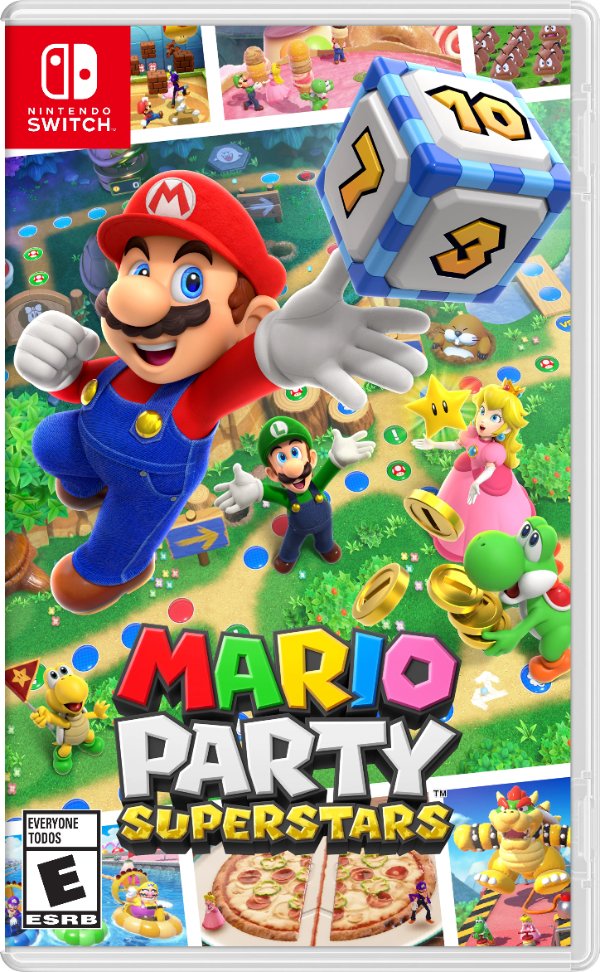
Mario Party Superstars
Overview

Mario Party Superstars is the twelfth main entry in the Mario Party franchise and the second Mario Party for Nintendo Switch (after 2018’s Super Mario Party). Released worldwide on 29 October 2021, it was developed by NDcube and published by Nintendo. Where Super Mario Party (2018) introduced new mechanics and original content, Mario Party Superstars takes the opposite philosophical approach — it is a deliberate greatest-hits compilation, a remaster collection celebrating 23 years of Mario Party history.
The game features 5 boards remastered from the Nintendo 64 era (the original “golden age” of Mario Party from 1998–2001), 100 minigames curated from across the entire mainline franchise (Mario Party 1 through Mario Party 10), and the classic Mario Party rule set restored — most notably the iconic 20-coin star pricing that Super Mario Party had controversially halved. It is, by design, a love letter to long-time Mario Party fans.
The Headline Features
- 5 classic remastered boards — Peach’s Birthday Cake and Yoshi’s Tropical Island from MP1 (1998), Space Land and Horror Land from MP2 (1999), Woody Woods from MP3 (2000). Each board faithfully recreated in HD with the original layouts, events, and themes intact.
- 100 minigames from MP1–MP10 — the largest curated collection in series history. Every minigame is a remaster of a beloved classic, not a new creation.
- 20-coin stars restored — the classic Mario Party star price returns, undoing Super Mario Party’s controversial 10-coin reduction.
- Full online play with friends — 4-player online matches on all 5 boards, the most ambitious online Mario Party experience to date.
- Standard controller support — Joy-Con (button-only, no motion required) or Pro Controller. Reverses Super Mario Party’s motion-only limitation, removing a major accessibility barrier.
- 10-character roster — the core Mario cast, including Birdo (returning to Mario Party after a long absence from Super Mario Party where she was omitted).
- Stamps for online play — a custom chat-replacement system letting players send themed reaction images during online matches.
- Mt. Minigames mode — a dedicated minigame mode separated from the board game, with its own leaderboards, free play, and tournament options.
Classic Revival
Mario Party Superstars represents the deliberate nostalgia compilation approach to franchise revival — a strategy that had been successful elsewhere in Nintendo’s portfolio (Super Mario 3D All-Stars, Super Mario Bros. 35) and that Nintendo applied directly to Mario Party.
The “Greatest Hits” Pitch
Where Super Mario Party (2018) had to justify its existence as a “new” Mario Party with fresh content (80 new minigames, the Ally system, Character Dice), Mario Party Superstars made no such claim. The pitch was simple: the boards and minigames you remember from N64 Mario Party, in HD, online, with friends.
This approach addressed a longstanding fan complaint — that the franchise’s 1998–2001 N64 trilogy (MP1, MP2, MP3) was its undisputed peak, and that every Mario Party since had failed to recapture that magic. Nintendo could not technically remake those games one-by-one, so Mario Party Superstars became their compilation remaster — picking the most beloved boards from each and combining them with the franchise’s best minigames.
What Was Remastered
- Mario Party (N64, 1998) — Peach’s Birthday Cake and Yoshi’s Tropical Island, two of the original 8 boards.
- Mario Party 2 (N64, 1999) — Space Land and Horror Land, the most popular MP2 boards.
- Mario Party 3 (N64, 2000) — Woody Woods, the standout from MP3’s 6-board roster.
Conspicuously omitted: any boards from MP4 (GameCube), MP5–10, the handheld Mario Party DS/Top 100/Star Rush titles, or the GameCube/Wii sub-series. The clear curatorial bias was N64-trilogy nostalgia. Minigames came from across the broader franchise, but boards were strictly first-three-only.
Gameplay
Mario Party Superstars’ gameplay is a faithful recreation of the classic N64-era Mario Party formula — the rule set fans had been requesting since 2007.
The Classic Turn Structure
- Rolling phase — each player in turn order rolls a standard 1–6 dice block. No character-specific dice (a key difference from Super Mario Party).
- Movement phase — player moves their character along the board’s linear path by the rolled number, landing on a space.
- Space effect — the space triggers its effect (+3 coins, -3 coins, item, star purchase, etc.).
- Star purchases — if you reach the Star space and have 20+ coins, exchange for one star.
- End-of-turn minigame — after all 4 players move, everyone competes in a randomly chosen minigame. Coin rewards depend on placement.
Key Differences from Super Mario Party
- No Character Dice Blocks — all characters roll the standard 1–6 dice. No probabilistic character-selection layer.
- No Ally system — each player moves alone. No multi-dice rolls from recruited allies.
- 20-coin star price — classic pricing restored (Super Mario Party used 10 coins).
- Linear board paths — boards follow the classic single-path-with-branches structure of N64 Mario Party. No grid format.
- Standard controller support — button-only Joy-Con or Pro Controller. No motion required.
- Items system — classic N64-era item shop returns (Mushroom for extra dice, Magic Lamp to teleport to star, Skeleton Key, etc.).
20-Coin Star Restoration
The 20-Coin Star Restoration
One of Mario Party Superstars’ most-discussed design decisions is the restoration of the 20-coin star price. From Mario Party 1 (1998) through Mario Party 8 (2007), stars consistently cost 20 coins. Super Mario Party (2018) reduced this to 10 coins, intending to speed up matches and reduce the “tedium” of saving up.
Why 20 Coins Mattered
Veteran Mario Party players argued that the 20-coin price was central to the franchise’s tension. The 20-coin threshold meant:
- Stars feel earned, not given — saving 20 coins requires real strategic decisions about minigame entry, item purchases, and space landings.
- The “almost there” tension — reaching 19 coins and rolling badly is one of Mario Party’s most iconic emotional beats.
- Coin-stealing items matter — a Magic Lamp or coin-steal item is devastating when the opponent has 18 coins. With 10-coin stars, coin theft is less impactful.
- Late-game comebacks are bigger — a single 20-coin star buy in the final turn can dramatically shift standings.
The Restoration
Mario Party Superstars restored the 20-coin price unconditionally. There is no toggle, no setting, no “classic mode” — stars cost 20 coins, full stop. This single design decision was a clear signal to long-time fans that NDcube was prioritizing the classic Mario Party experience over the modernized one Super Mario Party had attempted.
Roster
Mario Party Superstars features a 10-character roster drawn from the franchise’s mainstays. All characters roll the standard 1–6 dice block (no Character Dice Blocks). The notable inclusion is Birdo, returning to Mario Party after being conspicuously omitted from Super Mario Party.
The 10-Character Roster

Mario
Series mainstay

Luigi
Series mainstay
Peach
Series mainstay

Daisy
Since MP3

Yoshi
Series mainstay

Wario
Series mainstay

Waluigi
Since MP3

Rosalina
Since MP9

Donkey Kong
Series mainstay

Birdo
Returning since MP6
Roster Notes
- 10 playable characters at launch — half the size of Super Mario Party’s 20-character roster, but every character is a series mainstay.
- Birdo returns — her omission from Super Mario Party was controversial. Her inclusion here was specifically highlighted in pre-release marketing as a fan-service decision.
- No “obscure” characters — Goombas, Shy Guys, Koopa Troopas, Boos, Monty Moles, Hammer Bros, Dry Bones, and Pom Pom are all not playable (despite being in Super Mario Party). They return to NPC status.
- No Donkey Kong family beyond DK himself — Diddy Kong, who was playable in SMP, is omitted.
- No Bowser, Bowser Jr., or Koopa Kids — Bowser is restricted to his classic antagonist role (Bowser spaces, Bowser minigames), not a playable character.
- All characters share the same dice — every character rolls the standard 1–6 dice block. Character choice is purely cosmetic.
The 5 Boards
Mario Party Superstars features 5 boards remastered from the Nintendo 64-era Mario Party trilogy (1998–2000). Each board is faithfully recreated in HD with the original layout, special spaces, themed events, and music intact. No new boards were added — the entire board selection is a curated nostalgia tribute.
The 5 Boards at a Glance
Peach’s Birthday Cake

Peach’s castle gardens with a giant birthday cake at center. Featured the original Mario Party’s most iconic visual moment — Bowser literally eats slices of cake. Notorious for the Piranha Plant attack mechanic.
Yoshi’s Tropical Island

A 2-island board connected by bridges. The original’s most strategic board — only one of the 2 stars at any time is “the real one,” teaching players the franchise’s love of mid-board chaos.
Space Land

A sci-fi space station with Bowser Beam events that destroy multiple players’ coins at once. MP2’s most visually distinctive board — and home to the iconic Bowser Coin Beam space.
Horror Land

A haunted board with day-night cycle mechanics. By night, King Boo emerges; by day, Whomps and Boos roam freely. The most thematically dynamic of the 5 boards.
Woody Woods

A forest board with the iconic walking Mushroom Tree mechanic. Players must navigate around tree shifts that change board topology mid-match. Famous for the Galoomba enemies and tree-shift events.
Peach’s Birthday Cake
Peach’s Birthday Cake
From Mario Party (N64, 1998)
Peach’s Birthday Cake is the most iconic board of the original Mario Party (1998). The board is a giant outdoor cake landscape, with Peach’s castle in the background and a multi-tiered birthday cake at the geographic center. The signature visual moment of the board is when Bowser literally eats slices of the cake — a memorable in-game animation that has remained iconic for 27+ years.


Board Mechanics
- Piranha Plant attack — the signature mechanic. Each turn, a player might be attacked by a Piranha Plant, losing 5–10 coins. Strategic Piranha Plant placement is a key risk-vs-reward decision.
- Cake-slicing event — when a player passes through a specific space, Bowser cuts a slice of the cake, dealing damage to players within range.
- Linear pathway — a single winding path with one branch near the cake. Beginner-friendly layout.
- Star movement pattern — the Star alternates between 6 fixed locations around the cake perimeter.
- Item-friendly economy — frequent item spaces; the board rewards item-stacking strategies over coin-hoarding.
Why This Board Made the Cut
Peach’s Birthday Cake is the most visually iconic and most beginner-friendly board in the original Mario Party (1998). Its inclusion in Mario Party Superstars is a clear “this is what Mario Party looks like” statement — the cake imagery has been associated with the Mario Party brand for over two decades. For newcomers, it serves as the natural starter board.
Yoshi’s Tropical Island
Yoshi’s Tropical Island
From Mario Party (N64, 1998)
Yoshi’s Tropical Island is widely considered the most strategic board in the original Mario Party (1998). The board consists of two distinct islands connected by bridges, with two Star locations — but at any given moment, only one is the real Star. The other is a Bowser fake-star trap that costs coins to interact with. The genius of the board is in deducing which Star is real, and how to reach it before opponents.


Board Mechanics
- Two-island layout — the board has two separated landmasses, with bridges connecting them. Each island has its own micro-economy and item shops.
- The Star deception — two stars are always visible, but only one is real. Bowser’s fake-star trap costs 30 coins if you interact with it expecting a real star.
- Bridge crossings — traveling between islands requires crossing the bridges, which take 2–3 turns from any starting position. Lock-in commitment is required.
- Star location swaps — the real Star’s location can swap between the two visible options mid-match, making timing crucial.
- Yoshi-themed events — fruit-collection events and Yoshi-character cameos throughout the board.
Why This Board Made the Cut
Yoshi’s Tropical Island represents MP1’s strategic depth. The deception mechanic teaches players that Mario Party rewards observation, prediction, and risk-taking — themes that define the franchise. It is the board most often cited by veterans as “the moment I understood what Mario Party really is.”
Space Land
Space Land
From Mario Party 2 (N64, 1999)
Space Land is the most visually distinctive board of Mario Party 2 (1999). A sci-fi space station setting with the iconic Bowser Coin Beam mechanic — a board-wide event where Bowser fires a giant laser beam down a corridor of the board, destroying all coins of players in its path. The board’s aesthetic is the rare “non-fantasy” Mario design.


Board Mechanics
- Bowser Coin Beam — the signature event. When triggered, Bowser fires a laser down a specific corridor of the board. All players in that corridor lose all their coins. Avoiding the beam path is a constant strategic consideration.
- Spaceship layout — multiple zones connected by airlock-style doors. Each zone has its own item shop and event distribution.
- Sci-fi event spaces — “Alien Encounter” spaces that swap items, “Teleporter” spaces that warp players to random locations, “Asteroid Field” spaces that randomize coin counts.
- Star movement pattern — the Star moves between 5 fixed locations across the spaceship’s zones.
- Coin-aggressive design — Space Land has the most coin-loss events of any of the 5 boards. Coin management is critical.
Why This Board Made the Cut
Space Land represents MP2’s aggressive risk-vs-reward design philosophy. The Bowser Coin Beam is the most dramatic, most cinematic single event in any Mario Party board. The sci-fi setting also provides visual variety — it’s the only non-fantasy board in the compilation.
Horror Land
Horror Land
From Mario Party 2 (N64, 1999)
Horror Land is Mario Party 2’s most thematically dynamic board. A haunted woods setting with a full day-night cycle — by day, the board feels safe (Whomps and Boos are dormant); by night, the board transforms (King Boo emerges, Whomps move aggressively, and a different set of events become active). The day-night transitions are triggered by specific event spaces, making time-management a strategic layer.


Board Mechanics
- Day-night cycle — the board alternates between day and night phases. Triggered by specific event space landings.
- King Boo — appears at night. Landing on a King Boo space (only active at night) costs 30 coins for a coin-steal favor or other dark deals.
- Whomp aggression — by night, Whomps actively block paths, forcing detours.
- Time-pressure decisions — players must decide whether to use night-only events (risky but high reward) or wait for day (safer but slower).
- Atmospheric design — lighting, ambient sound, and character behavior all shift dramatically between day and night. The board feels like two different boards.
Why This Board Made the Cut
Horror Land represents MP2’s thematic ambition. The day-night cycle is the franchise’s most creative single-board mechanic from the N64 era — a feature no later Mario Party has matched. The board’s atmosphere (haunted woods, King Boo, twilight aesthetic) makes it the seasonal favorite for autumn/Halloween game nights.
Woody Woods
Woody Woods
From Mario Party 3 (N64, 2000)
Woody Woods is the standout from Mario Party 3 (2000). A forest board with the iconic walking Mushroom Tree mechanic — trees physically migrate around the board mid-match, changing the board topology and forcing players to constantly re-evaluate routes. Coupled with the Galoomba enemies and Snifit shop owners, Woody Woods has the most unique aesthetic and mechanics of the 5 boards.


Board Mechanics
- Walking Mushroom Trees — the signature mechanic. Specific trees physically migrate around the board between turns, changing which paths connect and which spaces are accessible.
- Galoomba encounters — Galoombas roam the woods. Landing on Galoomba spaces triggers coin-stealing minigames.
- Snifit shops — the board’s item shops are run by Snifits with unique pricing structures.
- Multiple Star locations — the Star can appear at 5 different forest locations, with the tree-movement mechanic affecting which routes connect.
- Day-night ambient shifts — not as dramatic as Horror Land, but lighting shifts add atmosphere.
Why This Board Made the Cut
Woody Woods represents MP3’s mechanical creativity. The walking Mushroom Tree mechanic is unmatched in the franchise — no other Mario Party board has board-altering elements that change topology between turns. Its inclusion ensures the compilation has at least one board with truly dynamic geometry, complementing the more static layouts of the MP1 and MP2 selections.
100 Minigames
Mario Party Superstars features 100 minigames curated from across the Mario Party franchise. Every minigame is a remaster of a classic from a previous entry — not a single original minigame appears in the launch lineup. The curation spans MP1 through MP10, with a clear bias toward N64-trilogy fan favorites.
Minigame Source Distribution (Approximate)
- ~40 minigames from MP1–MP3 (N64 trilogy) — the largest single source bucket. The N64 era’s most iconic minigames are heavily represented.
- ~25 minigames from MP4–MP7 (GameCube era) — the GameCube era contributes a significant portion, especially MP4 and MP6.
- ~20 minigames from MP8 (Wii) — the most recent “classic format” Mario Party before the car-era divergence.
- ~15 minigames from MP9–MP10 (Wii/Wii U) — a smaller selection, focused on the standout minigames from the otherwise-controversial car-era entries.
Minigame Categories
4-Player Free-For-All
Standard 4-player competitive minigames. Coin rewards by placement. The bulk of the 100-minigame library (~50 minigames).
2-vs-2 Team
2v2 cooperative team minigames triggered by VS spaces or board events. ~20 minigames.
1-vs-3 Asymmetric
One player vs three. The solo player has stronger abilities to balance the numerical disadvantage. ~15 minigames.
Coin Battle
All-pay-in coin minigames — each player contributes coins to a prize pool, the winner takes most. Classic Mario Party tension.
Duel Minigames
1v1 duels triggered by board encounters. Often stake coins or items.
Item Minigames
Skill-based minigames at item shops to earn discounted or rare items.
Coin-Lucky
Pure luck minigames with low input requirements. Often appear at Chance Time events.
Survival
Last-one-standing minigames where elimination determines order. Tension-heavy late-match favorites.
Minigame Highlights
Three highlighted minigames in detail — showcasing the variety of styles and sources represented in the 100-minigame compilation.


Notable Returning Classics (Selected Highlights)
- Tug O’ War (MP1) — the franchise’s most-recognized minigame. 2v2 rope-pulling. Original MP1 button-mashing returns with rumble feedback.
- Pipe Maze (MP1) — 4-player path-planning. The “thinking minigame” of the original Mario Party.
- Hot Rope Jump (MP1) — 4-player jump-rope endurance test. Often cited as the franchise’s most accidentally-difficult minigame.
- Look Away (MP1) — 1v3 mirror-game where the solo player must look the opposite direction of the trio.
- Crazy Cogs (MP2) — 4-player co-op cog-spinning. The most cooperative minigame in the lineup.
- Speed Hockey (MP3) — 4-player air-hockey. Direct, intense, fast-paced action.
- Coin Block Blitz (MP3) — 4-player coin-grab. The franchise’s most-played warm-up minigame.
- Bumper Balloons (MP4) — GameCube-era physics-based jousting on inflatable balls.
Game Modes
Mario Party Superstars features five distinct modes, each serving a different play context.
Mario Party
The classic 4-player board game mode using one of the 5 N64-era boards. Local and online play, AI fills empty player slots. Match length 10/15/20/25 turns selectable. The headline mode — every other mode supports this one.
Mt. Minigames
The dedicated minigame mode — 100 minigames available without the board game wrapper. Includes Free Play, Tag Match (head-to-head tournament), Survival, and Sports & Puzzles sub-modes. Full leaderboards.
Online Play
The headline new feature — full 4-player online board game support on all 5 boards. Both random matchmaking and play-with-friends modes. Stamps system for in-match communication.
Data House
The collectibles and progress hub. Track minigame play counts, collect stickers/stamps, view player stats, and unlock cosmetic items. The “achievement system” of Mario Party Superstars.
Tag Match (Single Player)
Single-player tournament mode against AI opponents. Choose minigame categories, fight through brackets. The solo progression mode (no Challenge Road equivalent).
Modes Comparison: SMP vs MPS
- Super Mario Party had 7 distinct modes (Mario Party, Partner Party, River Survival, Sound Stage, Toad’s Rec Room, Challenge Road, Online Mariothon).
- Mario Party Superstars has 5 modes — a smaller variety, but each is more deeply integrated with the board/minigame core.
- SMP’s emphasis was on variety of experiences; MPS’ emphasis is on depth in fewer experiences.
- MPS lacks SMP’s headline modes (no River Survival, no Sound Stage, no Tabletop Mode minigames) but adds full online board play, which SMP lacked.
Online Play
Online Play is Mario Party Superstars’ most significant new feature compared to its 2018 predecessor. The game offers full 4-player online board game support on all 5 boards — the most comprehensive online Mario Party experience to date.
What Online Play Supports
- 4-player random matchmaking — join a global queue and get matched with 3 other players for a full board game match.
- 4-player friends matches — invite specific friends via Nintendo Switch Online to a private match. Standalone “play with friends” lobbies.
- All 5 boards available online — unlike Super Mario Party (which had only Online Mariothon minigame play), every board game match can be played online.
- All 100 minigames available online — full minigame rotation including the asymmetric 1v3 and 2v2 formats.
- Reconnection support — if a player drops, the match continues with an AI replacement. Disconnections don’t end the game.
- Cross-region matching — matchmaking is global, not regional. Some lag, but accessible from anywhere.
Why Online Was a Big Deal
For 23 years, Mario Party had been a local-only franchise. The series’ entire identity was built around in-person competitive play. Online support, when finally added, required NDcube to solve unique problems: handling 4-player low-latency minigame timing, managing turn-order with asynchronous moves, designing reconnection flows for dropped players, and replacing the in-person banter that defined the franchise’s social DNA.
Mario Party Superstars’ solution was elegant: the board game phase is turn-based (handles latency naturally), the minigame phase has built-in synchronization buffers, and the Stamp system (see next section) replaces voice chat with curated reaction images.
Stamps System
The Stamps System
The Stamps system is Mario Party Superstars’ in-match communication feature. Instead of voice chat (which would have been a moderation nightmare in a family-friendly Nintendo product), players communicate via curated reaction images called Stamps.
How Stamps Work
- Tap to send — each player has a Stamp wheel accessible via a controller button. Selecting a Stamp displays it over your character for all players to see.
- Curated content — all Stamps are Nintendo-approved Mario-themed images (Mario thumbs-up, sad Mario, “Yahoo!” Mario, etc.). No user-created content.
- Unlockable — the Stamp library expands as players progress through minigames and modes. ~150+ unlockable Stamps in total.
- Spam-protected — there’s a cooldown between Stamps to prevent spam-stamping. Some Stamps are flagged as “cooldown extra long” for the most aggressive options.
- Quick selection — the Stamp wheel UI is designed for split-second selection during the few seconds between minigame events.
Featured Stamps


NPC Cast
Mario Party Superstars features a deep cast of non-playable characters populating the boards as shop owners, event hosts, enemies, and decoration. The NPC roster pulls heavily from Mario series tradition.
Featured NPCs


Board-Specific Encounters


Videos & Trailers
Five verified official Nintendo trailers covering Mario Party Superstars from E3 2021 reveal through launch and accolades.
Other Official Marketing
- Nintendo Direct September 23, 2021 — the major pre-launch showcase featuring extended gameplay footage and the reveal of Birdo as a playable character.
- Regional launch trailers — Japanese, German, French, Italian, Spanish, and Portuguese variants of the main launch trailer were released for individual markets.
- Treehouse Live deep-dives — multiple developer-led demonstration sessions throughout E3 and the run-up to launch.
- Nintendo Switch Online tournaments — weekly Mt. Minigames tournaments hosted by Nintendo throughout late 2021 and 2022 with cosmetic rewards.
Reception
Mario Party Superstars launched on 29 October 2021 to generally positive reviews — Metacritic 80, IGN 8/10, Game Informer 8.5/10, Nintendo Life 9/10, GameSpot 7/10. The reception was notably warmer than Super Mario Party (76 Metacritic) thanks to the restored classic format, full online play, and the nostalgia premium of the remastered boards.
Acclaim
- Classic format restoration — universally praised. The 20-coin star price, classic 1–6 dice, linear board paths, and item shop system were all noted as wins.
- Faithful board remasters — the 5 N64-era boards were called “lovingly recreated” by virtually every reviewer. Visual upgrades preserve the original layouts perfectly.
- 100 minigames curation — the breadth of the minigame library was a frequent compliment. Reviewers cited specific minigames they were thrilled to see return.
- Full online play — the headline feature. After 23 years of local-only Mario Party, the addition of online board play was treated as a major franchise milestone.
- Standard controller support — removing Super Mario Party’s motion-only Joy-Con limitation was widely celebrated, especially by reviewers who play with the Pro Controller.
- Birdo’s return — specifically highlighted in multiple reviews as a fan-service victory.
- Stamps system — praised as a clever solution to family-friendly online communication.
Criticisms
- Only 5 boards — the franchise high (MP3 had 6, MP7 had 6) wasn’t matched. Reviewers wanted more boards.
- Only 10 playable characters — a step back from Super Mario Party’s 20-character roster. Reviewers wanted Daisy, Bowser, Bowser Jr., or more obscure characters.
- No original content — every board and minigame is a remaster. Some reviewers wanted at least one original new board.
- Single-player mode is shallow — Tag Match against AI is the only solo-progression option. No Challenge Road equivalent.
- No DLC or expansion — unusual for a major Nintendo Switch title. Players hoped for additional boards added over time, but none were delivered.
- Some minigame omissions — specific fan-favorite minigames (varying by reviewer) were missing from the curated 100.
Sales
Sales Performance
- Launch week (Oct 29–Nov 4, 2021) — #1 in Japan launch week (133k physical); UK debut #1; US debut top 3.
- End of December 2021 — 5.43 million copies sold worldwide in the first 2 months. Strong holiday-period performance.
- End of March 2022 — 6.88 million copies. Continued steady sales.
- End of March 2023 — 8.55 million copies. Sustained long-tail.
- End of March 2024 — 9.83 million copies. Continued growth.
- Lifetime (2024 Nintendo reports) — over 10 million copies sold. The third-best-selling Mario Party ever, behind only Super Mario Party (21M+) and Mario Party DS (~9M).
Context
Mario Party Superstars’ ~10M lifetime sales places it as the franchise’s third-best performer historically (after Super Mario Party and Mario Party DS). It outsold every GameCube-era Mario Party (none of which reached 5M lifetime) and every Wii/Wii U-era Mario Party (MP9 and MP10 both stalled around 2M each).
Within the Switch console specifically, Mario Party Superstars’ ~10M places it alongside Splatoon 2 (~13M), Pokemon Sword/Shield (~26M combined), and Super Mario Maker 2 (~7M). It outperformed similar nostalgia compilations like Super Mario 3D All-Stars (~9M) and Super Mario Bros. 35 (free promotional title).
Trivia & Facts
- Twelfth main Mario Party and the second on Nintendo Switch, following Super Mario Party (2018).
- NDcube developed Mario Party Superstars — the same studio behind every Mario Party since Mario Party 9 (2012).
- 5 boards from 3 different N64 Mario Party games — the only Mario Party to draw boards from multiple historical entries simultaneously.
- 100 minigames is the largest curated library in any Mario Party — even larger than Super Mario Party’s 80 original launch lineup.
- First Mario Party with full 4-player online board play — 23 years after the franchise debuted, and after Super Mario Party offered only online minigames (Mariothon).
- The 20-coin star price restoration was the single most-discussed design decision — a reversal of Super Mario Party’s controversial 10-coin reduction.
- Standard controller support (Joy-Con button-only or Pro Controller) reversed Super Mario Party’s Joy-Con-only motion-control limitation. A major accessibility improvement.
- 10-character roster — half the size of Super Mario Party’s 20-character launch lineup, but every character is a series mainstay.
- Birdo returns to Mario Party — her omission from Super Mario Party was controversial; her inclusion here was specifically marketed as a fan-service decision.
- Stamps system replaces voice chat — ~150+ curated reaction images for in-match communication. Nintendo’s family-friendly approach to multiplayer chat.
- No new boards or minigames added — every piece of content is a remaster. The first Mario Party to ship without original content.
- No DLC ever released — like Super Mario Party before it, NDcube did not add additional boards or characters via DLC.
- The 5 boards represent 3 different design generations — MP1 (1998), MP2 (1999), MP3 (2000). Together they showcase the N64 trilogy’s creative arc.
- October 29, 2021 release — specifically chosen to align with Halloween (Horror Land is one of the 5 boards).
- Generally positive reception (80 Metacritic) vs Super Mario Party (76). Course-correction worked.
Reference / Information
Related coverage on Super Luigi Bros.
- Super Mario Party (Switch, 2018)
- Super Mario Party Jamboree (Switch 2, 2024)
- Mario Party 10 (Wii U)
- Mario Party 9 (Wii)
- Mario Party 8 (Wii)
- Mario Party 7 (GameCube)
- Mario Party DS
- Mario Party 3 (N64) — Woody Woods origin
- Mario Party 2 (N64) — Space Land & Horror Land origin
- Mario Party (N64) — Peach’s Cake & Yoshi’s Island origin