
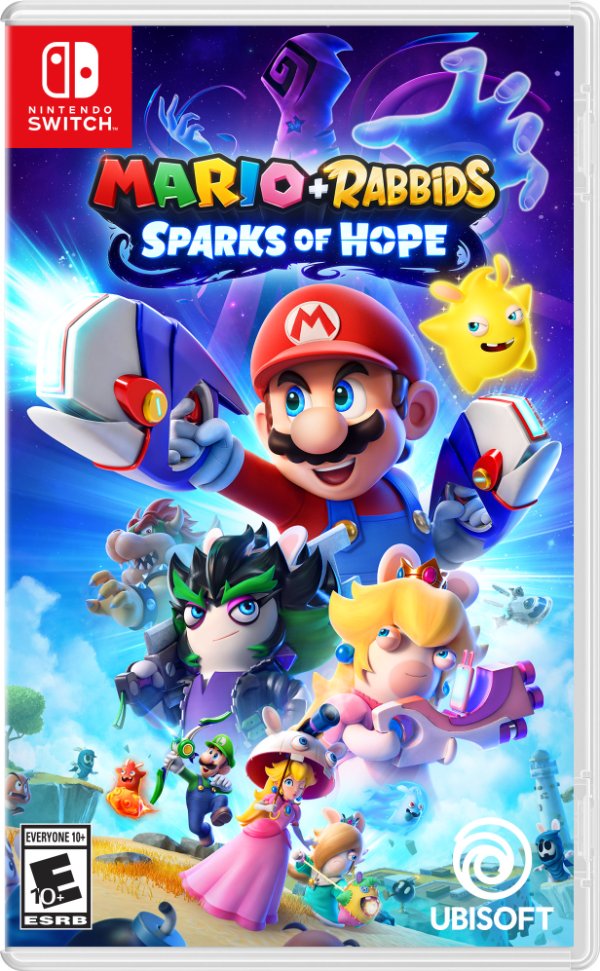
Mario + Rabbids Sparks of Hope
Overview

Mario + Rabbids Sparks of Hope is a tactical RPG developed by Ubisoft Milan and Ubisoft Paris, published by Ubisoft (and by Nintendo in Japan), released on 20 October 2022 as a Nintendo Switch exclusive. The game is the direct sequel to 2017’s Mario + Rabbids Kingdom Battle, continuing the unlikely Mario × Rabbids crossover under returning director Davide Soliani. Where Kingdom Battle was a relatively contained Mushroom Kingdom adventure, Sparks of Hope expands the franchise into a galactic-scale tactical RPG spanning 5 distinct themed planets, real-time exploration zones, free-form grid combat, and a fundamentally evolved roster of 9 heroes including the franchise debut of playable Bowser and the all-new sword-wielding Rabbid Edge.
The game received generally positive reviews (Metacritic 84) with praise for the improved combat system, expanded exploration, soundtrack from Grant Kirkhope alongside Yoko Shimomura and Gareth Coker, and the daring redesign that moved away from Kingdom Battle’s grid-XCOM template. Three substantial DLC expansions released throughout 2023 (Tower of Doooom, The Last Spark Hunter, Rayman in the Phantom Show). However, Ubisoft reported the game commercially underperformed compared to Kingdom Battle’s 10M+ — a sales disappointment that contributed to the franchise’s post-Sparks pause.
The Headline Features
- 9 playable heroes — the returning core (Mario, Luigi, Peach, Rabbid Mario, Rabbid Luigi, Rabbid Peach) plus three new additions: Rabbid Rosalina (cosmic Rabbid mystic), Edge (sword-wielding warrior Rabbid — the game’s breakout new character), and Bowser (Mario’s arch-nemesis now playable as a tactical hero for the first time in his franchise history).
- 5 themed planets — Beacon Beach (tropical), Pristine Peaks (snowy mountain), Palette Prime (artistic colored), Terra Flora (forest), Barrendale Mesa (desert wasteland). Each planet has its own visual identity, music theme, and exploration zone.
- 30 collectible Sparks — Star-Rabbid hybrid creatures (the literal “Sparks of Hope”) that hero teams equip for combat. Each Spark grants unique elemental abilities (fire, water, electric, motion, etc.) and is a collectible/recruitable mini-character.
- Real-time planet exploration — a major evolution from Kingdom Battle. Each planet is a free-roam zone with puzzles, treasure caches, side-quests, and combat encounters triggered at specific points. Beep-0 returns as the player guide.
- Free-form grid combat — the grid-XCOM template of Kingdom Battle is replaced with movement zones (a circular tile-free area each turn). More forgiving than strict grids, while preserving tactical depth.
- Cursa — the new main antagonist, a corrupted force seeking to drain the Sparks of their energy. Replaces Megabug as the campaign’s final villain.
- 3 DLC expansions — The Tower of Doooom (Rabbid Peach focus), The Last Spark Hunter (Daphne villain arc), and the franchise-defining Rayman in the Phantom Show (the legendary Rayman returns!).
- Soliani returns as director — the auteur force behind Kingdom Battle continues his oversight. The “Davide cried at E3 2017” moment paid forward into a continued partnership.
Sequel Evolution
Mario + Rabbids Sparks of Hope was specifically designed to evolve Kingdom Battle’s formula rather than simply iterate on it. Director Davide Soliani emphasized in pre-release interviews that the team had viewed the original as a “proof of concept” and the sequel as the chance to break free from XCOM-derivation and find their own tactical RPG identity.
What Stayed
- Turn-based tactical combat — still the core genre. Heroes still move, attack, and use special skills in a turn-based structure.
- Mario × Rabbids fusion identity — the chemistry between the Mario cast and their Rabbid counterparts still drives character interactions.
- Beep-0 — the robotic guide returns, leading exploration sequences.
- Davide Soliani directing — the auteur direction continues.
- Grant Kirkhope soundtrack lead — Kirkhope returns, joined this time by Yoko Shimomura and Gareth Coker.
- Tactical depth — the genre is still serious about its mechanics. Cover, dashes, team jumps, and skill-tree builds all return.
What Changed
- From grid to movement zone — the strict cell-based grid is gone. Each turn, heroes move within a circular movement zone (defined by their stats) rather than fixed tile distances. More forgiving, more dynamic.
- From hub-and-spoke worlds to free-form planets — instead of linear world chapters, each planet is a navigable hub with multiple parallel objectives.
- From 4-Mario + 4-Rabbid roster to 9 heroes — the strict symmetry is broken. Rabbid Rosalina, Edge, and Bowser break the original 4+4 pattern. Yoshi notably does not return as playable.
- Sparks replace weapon-ability variants — the 30 collectible Sparks become the primary customization layer. Each hero equips 2 Sparks per battle.
- From 4 worlds + DLC island to 5 planets + 2 DLC planets — a slightly larger scope.
- From single composer to triple — Grant Kirkhope leads, with significant contributions from Yoko Shimomura (Mario & Luigi RPG, Kingdom Hearts) and Gareth Coker (Ori, Immortals Fenyx Rising).
- Tone shift — a slightly more serious, more emotionally-grounded tone. Edge’s arc, Bowser’s motivation, and the Sparks’ plight give the game more genuine narrative stakes than Kingdom Battle.
Story

Story Setup
The story opens in a peaceful Mushroom Kingdom — some unspecified time after the events of Kingdom Battle. The merged-world status quo of the original has stabilized, and Mario, Princess Peach, and the Rabbid heroes have settled into a relatively peaceful existence. The arrival of the Sparks — small Star-Rabbid hybrid creatures who have fled an unknown threat — marks the inciting incident.
The Sparks reveal that the entire galaxy is under threat from Cursa, a malevolent entity that drains Sparks of their energy and corrupts whole planets in its wake. With Beep-0’s help, the heroes board a spaceship and embark on a galactic journey to defeat Cursa, save the remaining Sparks, and restore peace to the corrupted planets.
The Heroes’ Quest
Mario assembles the team: Princess Peach, Luigi, Rabbid Mario, Rabbid Peach, and Rabbid Luigi join immediately. Across the journey, additional heroes are recruited:
- Rabbid Rosalina — the cosmic Rabbid mystic, joined first. Has prophetic insight into Cursa’s nature.
- Edge — a mysterious sword-wielding Rabbid encountered on Pristine Peaks. His backstory is the game’s most-developed character arc.
- Bowser — reluctantly joins forces with the heroes after Cursa corrupts his Bowser Jr. minions on Barrendale Mesa. The franchise’s longest-standing villain becomes a playable hero in his first sustained tactical-RPG appearance.
Story Memories
The campaign uses “Memory” cutscenes to reveal character backstories and Spark origin tales throughout the journey:


New Combat Style
Sparks of Hope’s combat overhaul is the most-discussed gameplay change from Kingdom Battle. The strict cell-based XCOM grid is replaced with a free-form movement zone system that fundamentally changes tactical positioning.
The Movement Zone System
- Each hero has a circular movement zone — defined by their movement stat. They can move anywhere within this zone during their turn, not just to specific tiles.
- Dashes still cost AP — dashing through enemies still deals damage and applies status effects. But the dash path is now free-form rather than tile-locked.
- Team Jumps from any teammate — the team-jump mechanic now works from any teammate within range, with the jump distance defined by the heroes’ stats.
- Cover system simplified — still 50% and 100% cover variants, but the cover is now world-object-based rather than grid-tile-based.
- Overwatch removed — the Hero Sight overwatch attack mechanic is gone. Replaced by character-specific reactive abilities.
Sparks-Driven Combat
Each hero equips 2 Sparks in combat, contributing the Sparks’ abilities to their kit. Sparks have unique elemental effects (Fire, Water, Electric, Motion, Movement, Light, Defense, etc.) and modify the hero’s primary attack or grant a new active skill. The 2-Spark loadout becomes the primary build customization, with skill trees secondary.
Real-Time Planet Exploration
Outside of combat, each planet is a free-roam exploration zone. Heroes move in real-time, solve puzzles with Beep-0’s guidance, discover hidden Sparks, find weapon upgrades, and trigger combat encounters at specific points. Planets are designed as compact navigable spaces (not full open-worlds) but offer 3–5 hours of exploration content each.
The 9-Hero Roster
Sparks of Hope features a 9-hero roster — the largest in the Mario + Rabbids franchise. The classic 6 (Mario, Luigi, Peach, Rabbid Mario, Rabbid Luigi, Rabbid Peach) return from Kingdom Battle, joined by three significant new additions. Notably, Yoshi is absent from the playable roster.
Returning Heroes (6)

Mario
HeroTwin pistols + Hero Sight — the balanced anchor

Luigi
HeroSniper rifle + Steely Stare — long-range threat eliminator
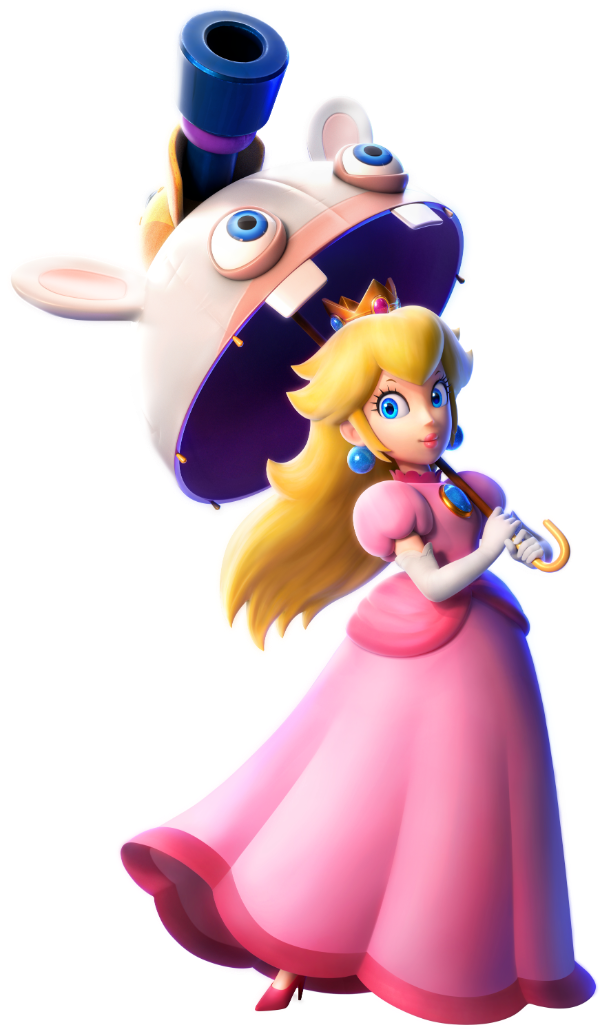
Peach
HeroTriple-shot shotgun + Royal Gaze — the support healer

Rabbid Mario
HeroDual shotguns + Magnet Dance — close-range bruiser

Rabbid Luigi
HeroBworb + Status Hex — the debuff specialist

Rabbid Peach
HeroSelfie shotgun + Heal Aura — the breakout-star healer
New Heroes (3)

Rabbid Rosalina
HeroCosmic-power scepter + Ennui — the new cosmic mystic

Edge
HeroTwo-handed sword + Vampdash — the franchise-redefining warrior

Bowser
HeroMecha-arm Mecha-Flamethrower + Bow Bow Brigade — PLAYABLE for the first time!
The Absence: Yoshi
Yoshi’s absence from the playable roster is the most-discussed roster decision. The Kingdom Battle Yoshi (Yoshimite weapon + Boomshot) is not playable in Sparks of Hope. Yoshi has no narrative explanation for the absence; the game simply does not include him. Many fans speculated this was due to character design priorities favoring the new heroes, but Davide Soliani did not provide a public explanation. Yoshi remains absent in all DLC.
Edge Spotlight

Edge — The Breakout New Hero
Edge is the standout new addition to the Mario + Rabbids cast — a mysterious sword-wielding Rabbid with a tragic backstory, a dramatic visual design, and the most-developed character arc of any Sparks of Hope hero. His introduction on Pristine Peaks (Planet 2) reveals him as a wandering swordmaster who has been searching for redemption from a past failure.
Tactical Role
- Sword-wielding melee specialist — unique among the cast. Other heroes use ranged weapons; Edge is the only dedicated melee fighter.
- Vampdash signature ability — dashes through enemies dealing damage and stealing HP. The vampire-inspired mechanic gives Edge a hit-and-run playstyle.
- Two-handed sword combat — his primary attack is a sword swing with high single-target damage. He pairs well with cover-breaking strategies.
- Bowser-Edge bond — surprisingly, Edge and Bowser develop a strong narrative bond as both are outsiders to the original Kingdom Battle team. Player-controlled cutscenes between them are a highlight.
Character Design
Edge’s visual design — dark purple-hood, two-handed sword, scarred Rabbid face — is intentionally more “gritty” and atmospheric than other Rabbids. Davide Soliani described him as the character “who proves the Rabbids can be more than comedic relief.” His debut in Pristine Peaks (a snowy mountaintop) intentionally evokes a wandering warrior arrival sequence.


Playable Bowser

Bowser — The First-Time Playable
Sparks of Hope marks the first time in Mario franchise history that Bowser is a sustained playable hero in a tactical RPG — not as a one-off “extra” character but as a fully-developed campaign hero with his own kit, story arc, and unique gameplay role. Bowser has appeared as a playable character in Mario Party titles, Mario sports games, Mario Tennis Aces and similar, but never before as a tactical-RPG hero with a dedicated story arc.
The Recruitment Arc
Bowser joins the heroes’ team on Barrendale Mesa — the Mario + Rabbids cast’s fourth planet. The story setup: Cursa’s corruption has affected Bowser Jr.’s minions, and Bowser — reluctantly — must team up with Mario’s team to defeat the corruption affecting his “kingdom” on the planet. The team-up is initially adversarial; only by mid-campaign does Bowser become a true ally.
Tactical Role
- Mecha-Flamethrower weapon — ranged AOE fire attack. Hits multiple enemies in a cone.
- Bow Bow Brigade summon — unique signature ability: summons goombas that absorb enemy attacks. The defensive minion-summoning ability.
- High HP / heavy hit — Bowser is the tankiest hero in the roster. His high-HP / high-damage build makes him the team’s “frontline tank.”
- Slow movement zone — the only tradeoff. Bowser’s tactical movement is slower than other heroes, requiring careful positioning.
Cultural Significance
Bowser becoming playable is a major franchise milestone. Davide Soliani specifically lobbied Nintendo for this inclusion, and the approval represents Nintendo’s growing comfort with extending the Mario franchise into unexpected directions. The combination of Bowser-as-hero and the Edge-Bowser bonding narrative gives Sparks of Hope an emotional weight Kingdom Battle never attempted.

Sparks System

What Are Sparks?
Sparks are the title creatures of Sparks of Hope — small, glowing, star-shaped beings that are themselves Stars (from Super Mario Galaxy) that have fused with Rabbids. The Sparks each have unique elemental personalities, special abilities, and tactical effects. There are 30 collectible Sparks across the campaign, recruited as the heroes save them from Cursa’s corruption.
How Sparks Work in Combat
- 2 Sparks per hero per battle — each hero equips 2 Sparks in their combat loadout. The Spark abilities supplement the hero’s base kit.
- Active and passive abilities — some Sparks grant active skills (use during turn), others grant passive bonuses (always active).
- Elemental affinity — Sparks have elemental tags (Fire, Water, Star, Cosmic, Defense, Motion, etc.). Heroes don’t have inherent elements; the Sparks provide them.
- Loadout swapping outside battle — between fights, heroes can swap Sparks freely. Encourages experimentation and team rebuilds for specific encounter types.
- Sparks level up — collected Sparks gain XP as their bonded hero gains XP. Higher-level Sparks become more powerful.
- Skill tree for each Spark — in addition to the heroes’ skill trees, each Spark has its own progression path of upgrades.
Collecting Sparks
Sparks are acquired through varied gameplay routes:
- Story progression — some Sparks are gifted automatically as the story advances.
- Spark-rescue missions — dedicated combat encounters where Sparks are captured by enemies. Defeating the encounter releases the Spark to your team.
- Hidden in the world — Spark-collectible side-content scattered across each planet’s exploration zones.
- Cursa-corrupted Sparks — some Sparks are themselves corrupted and must be cleansed before joining your team.
Featured Sparks
Six featured Sparks from the 30-Spark collection — the standouts that became fan-favorites and signature characters of the game’s elemental combat system.

Pyrogeddon
FireRabbid Peach’s signature Spark — fire-elemental AOE

Aquanox
WaterWater-elemental damage + targeted accuracy

Starburst
StarStar-elemental burst + powerful damage

Glitter
CosmicStatus-effect specialist + accuracy buff

Reflector
DefenseDamage-reflect shield + cover-cracking

Vortex
RaymanRayman-exclusive DLC Spark — motion-vortex pull
Hero-Spark Iconic Pairings


The Full 30-Spark Roster (Selected Highlights)
- Pyrogeddon — Fire elemental, Rabbid Peach’s signature pairing.
- Aquanox — Water elemental, targeted accuracy boost.
- Starburst — Star elemental, high-damage burst attack.
- Glitter — Cosmic / status, accuracy buff.
- Reflector — Defense, damage reflection.
- Voltgeist — Electric elemental.
- Toxidor — Poison status specialist.
- Frostlight — Ice + cold elemental.
- Stoneblade — Earth + cover-crack specialist.
- Capricorn — Goat-themed star Spark.
- Vortex — Motion-vortex pull (Rayman DLC exclusive).
- Aquadance — Water-based mobility Spark.
- Justice — Counter-attack passive specialist.
- Earthquake — AOE ground attack.
- …and ~16 more, each with unique abilities, names, and elemental affinities.
The 5 Planets
Sparks of Hope is structured around 5 main planets, each a free-roam exploration zone with unique themes, music, enemies, and characters. Two additional DLC planets (Melodic Gardens, Space Opera Network) extend the campaign post-launch.
The 5 Planets at a Glance
- Planet 1 — Beacon Beach — tropical coastal paradise. The introductory planet, beginner-friendly.
- Planet 2 — Pristine Peaks — snowy mountain range with ice mechanics. Edge’s introduction.
- Planet 3 — Palette Prime — surreal artistic colored zones inspired by classic art. Sparks-collecting focus.
- Planet 4 — Terra Flora — forest planet with vegetation-based mechanics. The most natural-feeling environment.
- Planet 5 — Barrendale Mesa — desert wasteland with sci-fi ruins. Bowser’s recruitment + final pre-Cursa encounter.
Real-Time Planet Exploration
Unlike Kingdom Battle’s linear-world structure, each planet in Sparks of Hope is a free-roam exploration zone. Heroes navigate in real-time, solve puzzles with Beep-0’s help, find hidden Sparks and treasures, complete side-quests for unique characters, and trigger combat encounters at specific story-significant points. Each planet contains 3–5 hours of exploration content, plus 4–6 major combat encounters.
Planet Visual Identity
Each planet has its own visual color palette, music theme, ambient sound design, and environmental storytelling. Davide Soliani specifically designed planets to feel like distinct “level chapters” with unique character. Reviewers cited Sparks of Hope’s planet variety as a major step up from Kingdom Battle’s four-world structure.
Beacon Beach
Beacon Beach

Beacon Beach is the introductory planet — a tropical coastal paradise where Mario, Peach, and the original Rabbid heroes first land in their spaceship. The planet introduces every core mechanic: real-time exploration, Spark collection, movement-zone combat, and Beep-0 puzzle-solving.
Setting & Atmosphere
- Lush tropical beaches with palm trees, lagoons, and tide pools.
- Sun-drenched aesthetic in vibrant blue-green-coral color palette.
- Beach-themed enemy variants (Sea Stooge, Beach Riptide).
- Surfboard-themed exploration mechanics through tide pools.
- Local NPCs include peaceful Rabbid villagers running stalls.
Major Encounters
- Wildclaw — the planet finale boss. A giant Rabbid-crab hybrid with multi-phase combat across the beach arena. Introduces the boss-encounter format for the game.
- Spark rescue missions — 4–5 dedicated Spark-collection encounters across the planet.
- Tutorial-paced learning — every new mechanic gets introduced before progression beyond Beacon Beach.
Why First?
Beacon Beach’s tropical paradise setting was specifically chosen as the introductory planet to evoke a “welcoming, colorful new world” feeling. Soliani’s team wanted players to feel curious and excited about the galaxy exploration concept before being introduced to grittier later planets.
Pristine Peaks
Pristine Peaks

Pristine Peaks is the snowy mountain planet — introducing ice mechanics, slippery surfaces, and the franchise-defining introduction of Edge. The planet has a colder, more atmospheric tone than Beacon Beach, signaling the campaign’s shift toward serious stakes.
Setting & Atmosphere
- Snow-capped mountain peaks, ice caves, and frozen lakes.
- Cool blue-white color palette with crystalline highlights.
- Snow-and-ice variant enemies (Frostbite Hopper, Glacier Squasher).
- Ice-floor mechanics that allow heroes to slide further on movement.
- Climbing-puzzle exploration elements that emphasize verticality.
Edge’s Introduction
Pristine Peaks is the planet where the heroes first encounter Edge, the sword-wielding warrior Rabbid. His arrival sequence — wandering down from a mountain ridge, then mid-encounter joining the heroes’ team — is one of the most cinematic moments in the game. Edge’s arrival also sets up the long-running narrative of his troubled past.

Major Encounters
- The Squashette siblings — mid-planet boss trio. Pumpkin-themed Rabbid sisters with synchronized attacks.
- Edge recruitment encounter — the planet’s narrative climax. Edge joins the team after a multi-phase encounter against a corrupted force.
- Ice-cave Spark rescues — hidden Sparks in subterranean ice formations.
Palette Prime
Palette Prime

Palette Prime is the most visually distinctive planet in the game — a surreal artistic dreamworld inspired by classic painting palettes, watercolor textures, and impressionist-style landscapes. The planet emphasizes Sparks collection and visual exploration over heavy combat.
Setting & Atmosphere
- Watercolor-painted landscapes with brush-stroke textures.
- Vibrant rainbow-saturated color palette — unlike anything else in the game.
- Floating canvas-island geography.
- Paint-puddle floor mechanics that affect movement.
- Easel-and-brush ambient props throughout the environment.
Sparks-Heavy Content
Palette Prime is intentionally Sparks-collection-focused. The planet’s puzzles, side-quests, and exploration challenges all revolve around finding and freeing Sparks who have been captured or scattered by Cursa’s influence. By the end of Palette Prime, players have typically acquired a substantial portion of the 30-Spark collection.
Major Encounters
- Midnight (boss) — the planet finale boss. A shadowy artistic-themed Rabbid that emerges from a corrupted painting.
- Multiple Spark-rescue missions — ~6–7 dedicated Spark-acquisition encounters.
- Visual puzzles — Beep-0 must guide heroes through paint-mixing and color-matching puzzles to unlock paths.
Terra Flora
Terra Flora

Terra Flora is the dense forest planet — the most “natural” environment in the campaign. Towering trees, hidden grottos, river systems, and overgrown ruins create a setting reminiscent of classic JRPGs while introducing vegetation-based combat mechanics.
Setting & Atmosphere
- Dense forest canopy with shafts of sunlight.
- Deep green-and-brown earth-tone palette.
- Vegetation-themed enemy variants (Vine Wrappers, Forest Spirits).
- River-and-rapids exploration challenges.
- Ancient ruins overgrown with vines and moss.
- Wind-and-rustling-leaves ambient sound design.

Major Encounters
- Magnafowls — magnetic bird-Rabbid hybrid enemies introduced on Terra Flora. Players first encounter this enemy type here.
- Riptides — water-themed enemies that dominate Terra Flora’s river sections.
- Terra Flora boss — a giant overgrown corrupted Spark that has taken root in the forest’s heart.
- Side-quest characters — Terra Flora has the most side-quests of any planet, building depth through forest-NPCs.
Barrendale Mesa
Barrendale Mesa

Barrendale Mesa is the final main-campaign planet — a bleak desert wasteland with sci-fi ruins, atmospheric dust storms, and the campaign’s most narratively-significant arc: Bowser’s recruitment. Mesa is intentionally designed to feel apocalyptic and final, leading into the Cursa finale.
Setting & Atmosphere
- Vast desert mesas with red-orange sandstone color palette.
- Sci-fi ruins of an ancient civilization scattered across the landscape.
- Dust storms and atmospheric haze effects.
- Bowser Jr.’s minions (Goombas, Bullet Bills) corrupted by Cursa.
- Lava-pit hazards from underground volcanic activity.
- Final-act emotional weight in environmental storytelling.
Bowser’s Recruitment
Barrendale Mesa is the planet where Bowser is recruited as a playable hero. The narrative arc — Bowser’s minions corrupted by Cursa, his reluctant team-up with Mario, his shift from antagonist to ally — plays out across the planet’s exploration zones and culminates in the Mesa boss encounter.
Major Encounters
- Cursa-corrupted Bowser Jr. minions — multi-encounter cleanup of the planet.
- Mesa boss — the planet finale, against a Cursa-corrupted creature in Bowser’s ruined Mesa kingdom.
- Bowser recruitment cinematic — the franchise-milestone moment when Bowser officially joins the team.
- Lead-in to Cursa final encounter — Barrendale Mesa ends with the heroes returning to the spaceship, ready to confront Cursa directly.
Major Bosses & Cursa
Sparks of Hope features 5 main planet bosses + Cursa final boss + DLC bosses. Each planet culminates in a unique boss encounter, with Cursa’s multi-phase final fight representing the campaign climax.
Planet Bosses + Final Encounter
Wildclaw

Giant Rabbid-crab hybrid with multi-phase tropical-beach arena combat. Introduces the boss-encounter format for the game.
Squashette Siblings

Pumpkin-themed Rabbid sister trio with synchronized attacks. Mid-Pristine-Peaks encounter introducing Edge’s arrival.
Midnight (concept)

Shadowy artistic-themed Rabbid that emerges from corrupted paintings. The Palette Prime finale.
Cursa

The campaign’s main antagonist. A cosmic entity draining Sparks of energy. Confronted in multiple form-phases for the final encounter.
Cursa Unleashed

The unleashed form of Cursa — the final form encountered in the campaign climax. Requires mastery of every game mechanic to defeat.
The Cursa Endgame Arc
The final Cursa encounter spans multiple phases:
- Phase 1 — Cursa (base form) — standard cosmic-entity attack patterns, summons minions, applies status effects.
- Phase 2 — Cursa unleashed — transforms into a more aggressive form. Heroes must adapt mid-fight.
- Final Phase — the climactic confrontation requiring expert team composition, Spark loadout optimization, and mastery of every learned mechanic.
3 DLC Expansions
Sparks of Hope received 3 substantial DLC expansions throughout 2023, sold individually or via the Season Pass. Each DLC introduces a new playable area, story arc, and gameplay variations.
DLC 1: The Tower of Doooom
The Tower of Doooom
Released 2 March 2023. A Rabbid Peach-focused side adventure featuring tower-climbing combat. Rabbid Peach takes center stage, with new gameplay mechanics emphasizing her Bodyguard healer role.


- Tower-climbing combat structure: progress floor-by-floor through increasingly difficult encounters.
- Rabbid Peach-focused narrative reinforces her role as fan-favorite character.
- New Sparks introduced exclusively in this DLC.
- Estimated ~4–6 hours of content.
DLC 2: The Last Spark Hunter
The Last Spark Hunter
Released 30 May 2023. Introduces Daphne, a new villain on the planet Melodic Gardens. The most narratively-developed DLC, with a full villain story arc and emotional climax. Adds the new planet Melodic Gardens as explorable content.


- Daphne — the antagonist, a Spark-hunting rogue character with her own motivations and backstory.
- The new planet Melodic Gardens adds a unique musical-themed exploration zone.
- Full villain arc with cutscenes, character development, and emotional climax.
- Estimated ~6–8 hours of content.
DLC 3: Rayman in the Phantom Show
Rayman in the Phantom Show
Released 30 August 2023. The franchise-defining DLC — Rayman, the legendary Ubisoft mascot, finally returns to a major Ubisoft title after years of franchise dormancy. Set on the planet Space Opera Network, the DLC features Rayman, Rabbid Mario, and Rabbid Peach in a phantom-show-themed adventure.


- Rayman is playable — the first major Rayman appearance in a Ubisoft title since 2013. Functions as a Rabbid-equivalent hero in tactical RPG combat.
- New planet — Space Opera Network — a phantom-show-themed exploration zone with theatrical aesthetics.
- Vortex Spark — a Rayman-exclusive Spark added with the DLC, granting motion-vortex pull abilities.
- Cultural significance — Rayman’s return is a major moment for Ubisoft fans who had been waiting for the franchise’s revival.
- Estimated ~5–7 hours of content.
Videos & Trailers
Six verified official Ubisoft trailers covering Sparks of Hope from E3 2021 reveal through the Rayman DLC.
Reception
Mario + Rabbids Sparks of Hope launched on 20 October 2022 to generally positive reviews — Metacritic 84, IGN 9/10, Game Informer 9/10, Nintendo Life 9/10, GameSpot 8/10. The reception was slightly below Kingdom Battle’s 85 Metacritic but still positioned it as one of 2022’s standout tactical RPGs.
Acclaim
- Improved combat system — the movement-zone replacement of strict grids was widely praised. Combat feels more fluid and less rigid than Kingdom Battle’s XCOM-style structure.
- Sparks loadout system — universally cited as the game’s best new mechanic. The 30-Spark collection layer adds genuine build-crafting depth.
- 9-hero roster — the variety and distinctness of the cast (especially Edge and Bowser) was a frequent compliment.
- Playable Bowser — specifically called out by multiple reviewers as a delight and franchise milestone.
- Edge — the breakout new hero received universal praise. His tactical role, character design, and narrative arc all impressed reviewers.
- Triple-composer soundtrack — Grant Kirkhope + Yoko Shimomura + Gareth Coker created what reviewers called “one of the best video game soundtracks of 2022.”
- Planet visual variety — each planet feels meaningfully different from the others.
- Real-time exploration — the planet-exploration evolution was praised as more engaging than Kingdom Battle’s hub-and-spoke structure.
- Soliani direction — the returning auteur direction was lauded as bringing emotional weight Kingdom Battle had lacked.
Criticisms
- Loading times — the most common criticism. Between-planet loading and between-encounter loading were frequently noted as longer than expected.
- Yoshi’s absence — the omission of Yoshi from the roster (a Kingdom Battle launch hero) was a frequent reviewer note.
- Some camera issues during combat — free-form movement zones occasionally caused camera-pathing issues.
- Difficulty curve uneven in late game — some reviewers found the late-campaign difficulty fluctuated unpredictably.
- Pacing in the middle act — Palette Prime and Terra Flora are sometimes cited as feeling padded relative to Beacon Beach and Pristine Peaks.
Sales & Legacy
Sales Performance
- Launch week (Oct 20–26, 2022) — strong UK launch (#3 charts), top 10 US debut, solid but not exceptional Japan launch.
- End of 2022 — ~1 million copies sold in first ~10 weeks.
- Early 2023 — Ubisoft publicly stated the game had underperformed expectations commercially — a notable statement for a Mario-branded title.
- End of 2023 (after all 3 DLC releases) — estimated ~3 million copies lifetime per Ubisoft reporting.
- Current estimates — around 3–5 million copies lifetime, significantly below Kingdom Battle’s 10M+.
The Underperformance Context
Ubisoft’s public acknowledgment of Sparks of Hope’s commercial underperformance was unusual for a Mario-branded title. Industry analysts speculated several contributing factors:
- Five-year gap from Kingdom Battle (2017) to Sparks of Hope (2022) — audience attention had moved on.
- Switch lifecycle stage — Sparks of Hope released as Switch was nearing the end of its lifecycle.
- Competition — Q4 2022 was packed with major releases including Pokémon Scarlet and Violet, God of War Ragnarök, and Bayonetta 3.
- Tactical RPG genre niche — the genre has a ceiling on mainstream appeal.
- Word-of-mouth from Kingdom Battle didn’t translate as expected — 5 years is a long time for a sequel.
Legacy
- Franchise pause — no further Mario + Rabbids titles have been announced as of mid-2024. The franchise appears to be on hold.
- Soliani moves to other Ubisoft Milan projects — the director has indicated he is working on new projects.
- Critical legacy intact — despite commercial disappointment, Sparks of Hope’s critical reception remains strong, and the game has its own dedicated fanbase.
- Charles Martinet retirement — the game is historically significant as the last Mario title to feature Martinet voicing Mario and Luigi (via archival clips), before his 2023 retirement.
Trivia & Facts
- Final Mario game with Charles Martinet as Mario/Luigi voice actor (via archival clips). Martinet retired from active voice work in 2023 to become a Mario brand ambassador.
- Bowser is playable for the first sustained time in a tactical RPG. A franchise milestone.
- Released 20 October 2022, exactly 5 years and 2 months after Kingdom Battle (29 August 2017).
- Co-developed by Ubisoft Milan + Ubisoft Paris, with additional contributions from Ubisoft Pune, Ubisoft Chengdu, and Ubisoft Montpellier.
- Davide Soliani returns as director — the auteur partnership with Nintendo continues.
- Triple-composer soundtrack by Grant Kirkhope (returning), Yoko Shimomura (Mario & Luigi RPG, Kingdom Hearts), and Gareth Coker (Ori, Immortals Fenyx Rising).
- 9-hero roster — the largest in franchise history. The original 8 are reduced to 6 (Yoshi absent), then expanded by 3 newcomers (Rabbid Rosalina, Edge, Bowser).
- Yoshi’s absence is the most-discussed roster decision. He has no narrative explanation; he simply isn’t in the game.
- 30 collectible Sparks replace the previous game’s weapon-grinding loop. Each Spark is named, designed, and has a unique tactical effect.
- 5 main planets + 2 DLC planets (Melodic Gardens via DLC 2, Space Opera Network via DLC 3).
- Real-time planet exploration — a major evolution from Kingdom Battle’s hub-and-spoke world structure.
- Free-form movement zones replace strict grid tiles for combat. More fluid, less XCOM-strict.
- Cursa is the main villain, replacing Kingdom Battle’s Megabug. A cosmic entity draining Sparks of their energy.
- 3 DLC expansions — Tower of Doooom (Mar 2023), The Last Spark Hunter (May 2023), Rayman in the Phantom Show (Aug 2023).
- Rayman returns to a major Ubisoft title via the DLC 3 — his first significant Ubisoft game appearance in nearly a decade.
- Metacritic 84 — slightly below Kingdom Battle’s 85.
- Ubisoft publicly acknowledged commercial underperformance — unusual for a Mario-branded title.
- Edge emerged as the breakout new character — fan art, cosplay, and streaming discussion all centered on him.
- Bowser-Edge bonding moments are highlight character interactions throughout the campaign.
- Estimated ~3M lifetime sales — well below Kingdom Battle’s 10M+ benchmark.
Reference / Information
Related coverage on Super Luigi Bros.