
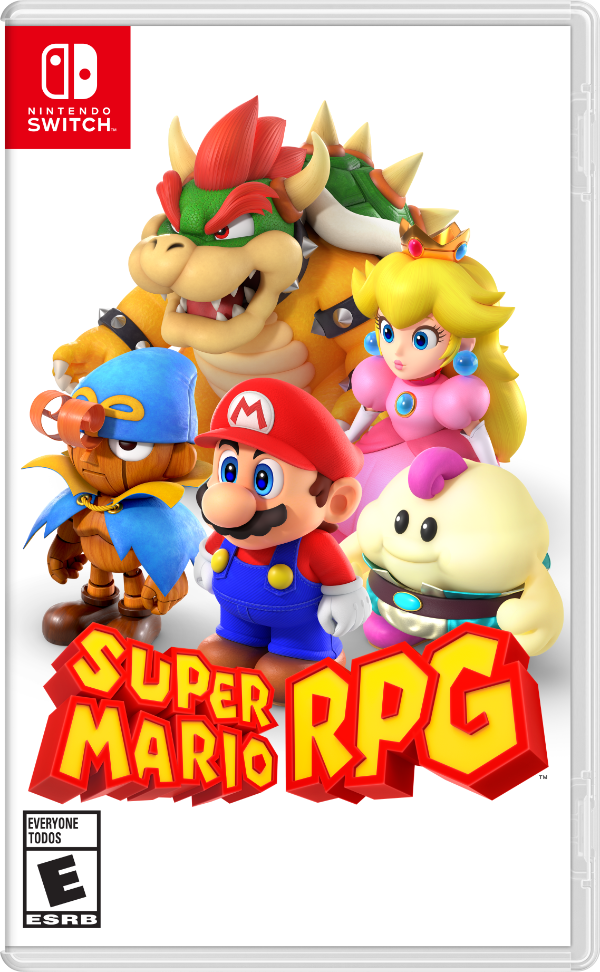
Super Mario RPG (2023 Remake)
Overview

Super Mario RPG on Nintendo Switch is a full 3D remake of the legendary 1996 SNES title Super Mario RPG: Legend of the Seven Stars — the original game that single-handedly invented the Mario RPG sub-genre, and the first ever collaboration between Nintendo and Square (now Square Enix). The remake, released on 17 November 2023 for the Switch, is a careful and faithful reimagining: the original’s plot, dialogue, characters, items, equipment, locations, music tracks, and even bosses are all preserved — lovingly modernised rather than rewritten.
Developed by ArtePiazza (the studio best known for its acclaimed Dragon Quest remakes), the game replaces the original’s pseudo-3D isometric pre-rendered look with full, lush 3D environments and chibi-proportioned character models that keep the SNES original’s charm intact. The score has been re-orchestrated by the original composer, Yoko Shimomura, with the option to toggle between the SNES synth and modern arrangements.
The result is one of the most respectful Mario remakes Nintendo has ever produced — a love letter to the SNES game packed with thoughtful new mechanics (an Action Gauge, three-party Triple Moves, Chain Action-Command buffs), comprehensive post-game content (rematches with every major boss, plus a tougher new fight with Smithy in his true form), and quality-of-life upgrades like autosaves, a Monster List, and a Scrapbook — while honouring everything fans loved about the 1996 original, right down to the secret battle with Culex and his Final Fantasy crystals.
Story — Prologue
The Sword in the Keep
Princess Toadstool sits peacefully on a hill outside Mario’s Pad when she is, once again, abducted by Bowser in his Koopa Clown Car. Mario hears her cry, dashes out, and chases the pair to Bowser’s Keep for the latest in a long line of confrontations.
Mario battles his way through the castle and finally meets Bowser on the chandeliers above the throne room. But just as Mario lands the winning blow, the entire castle begins to shake — a giant sentient sword named Exor falls from the heavens and impales Bowser’s Keep, smashing the Star Road on the way down and scattering its seven Star Pieces across the world.
The crash launches Mario, Princess Toadstool, and Bowser flying in three different directions. Mario lands back at his own house, where Toad has already been searching for the princess. With Bowser’s Keep now completely overrun by the mysterious Smithy Gang, Mario sets out on a brand-new quest — one that will turn this kidnapping caper into a kingdom-wide war.


No Star Pieces yet
Story — Mushroom Kingdom
First Star Piece & Meeting Mallow
Mario heads to the Mushroom Kingdom capital to alert the Chancellor of the kidnapping. On Mushroom Way, he meets Mallow, a fluffy cloud-like creature who believes himself to be a tadpole. Mallow is being robbed by Croco, a recurring thief who steals his coin and runs off. Mario helps Mallow chase down Croco and recovers his coin — the first of many partnerships of the journey.
At Mushroom Castle, the duo discover that the Smithy Gang has moved in. The boss Mack (a giant living knife) and his Shyster minions are bouncing about the throne room. Mario and Mallow defeat Mack, recovering the first Star Piece from him — and learning that the Smithy Gang are after them too.


Star Piece #1: Mack
Story — Pond to Pipes
Frogfucius, Rose Town & Geno Awakens
Mario and Mallow journey through the Kero Sewers and battle Belome, a slobbering dog-like guardian. The sewers flood, sweeping Mario down the Midas River (the famous barrel-jumping minigame) and on to Tadpole Pond — home of Mallow’s grandfather, the wise Frogfucius.
Frogfucius gently reveals that Mallow is not really a tadpole — he was found floating in a basket as a baby. Mallow must travel with Mario to discover his true heritage. They head to Rose Town, where the village is being pinned down by paralysing arrows raining from the sky. Tracing them to the Forest Maze, the duo finds the marksman: Bowyer, a giant wooden bow. They defeat him and recover the second Star Piece.
Most importantly, in the Forest Maze, a wooden doll mysteriously comes to life, possessed by a star spirit who introduces himself as “Geno” (his true name is unpronounceable to mortals). Geno is a celestial warrior sent from Star Road to recover the seven Star Pieces, and joins the party as the third member.


Star Piece #2: Bowyer
Story — Mole Mountains
Bowser Joins, Punchinello & Booster’s Wedding
The party heads to Moleville, where two child Moles named Dyna and Mite are trapped in the Coal Mines after a star fell from the sky. Inside the mines, Mario is knocked unconscious by a faulty trampoline; Croco seizes the chance to steal his coins. After besting Croco a second time, Mario obtains a bomb from him and uses it to access deeper sections, where they confront Punchinello, a vain enemy who summons giant bombs. They defeat him and rescue the kids — along with the third Star Piece.
At Booster Pass, the party encounters Bowser himself, alone and humiliated, having lost his entire army. Swallowing his pride, Bowser joins Mario’s party — his goal is simply to take back his castle from the Smithy Gang, and Mario is heading that way anyway.
At Booster Tower, the eccentric kidnapper Booster has captured Princess Toadstool and intends to marry her. The party pursues them to Marrymore, where the chaotic wedding ceremony is gatecrashed by Bundt and Raspberry — a sentient wedding cake boss — and Toadstool is rescued. She insists on joining the party as the fifth member.


Star Piece #3: Punchinello
Story — Seaside
Star Hill, Sunken Ship & Johnny Jones
Back at Tadpole Pond, Frogfucius tells the party of another Star Piece on Star Hill. Mario finds the fourth Star Piece there — the only one not held by a Smithy Gang lieutenant, simply lying among the falling-star debris.
Mario’s next stop is Seaside Town, where the elder asks him to recover a star that fell into the nearby sea. The party explores grottoes and a sunken pirate ship, defeats the giant Bloober King Calamari, and meets the ship’s captain — the shark-toothed pirate Jonathan “Johnny” Jones, who claims the Star Piece for himself.
After a duel with Johnny, the pirate honours Mario’s strength and surrenders the fifth Star Piece. Returning to Seaside Town, Mario discovers that the “villagers” he’s been talking to are actually the Smithy Gang member Yaridovich and his Mokuras in disguise, having locked up the real townsfolk. Yaridovich is defeated.


Star Pieces #4 (Star Hill) & #5 (Yaridovich)
Story — Land’s End
Belome Temple, Bean Valley & Smilax
The party crosses Land’s End, a mountainous desert region. After taking a detour down whirlpools, they end up at Belome Temple, where they fight Belome a second time. Mario then travels through a Warp Pipe to Monstro Town, a hidden village of reformed monsters, where the wise Monstermama explains that the sixth Star Piece must be somewhere in the clouds.
Monstermama summons Sergeant Flutter and his Sky Troopas to ferry the party up. They land in Bean Valley, where a Shy Away has been growing a giant Piranha Plant called Smilax. Defeating Smilax and Megasmilax opens the path skyward to the great floating realm of Nimbus Land, and yields the sixth Star Piece.


Star Piece #6: Smilax
Story — Nimbus Land
Valentina, Dodo & the True Prince
In Nimbus Land, the royal aide Valentina is staging a power grab. With King Nimbus ill and bedridden, she has been parading her enormous, mute pet bird Dodo through the streets, claiming he is the long-lost prince and that he intends to marry her — thereby making her queen.
The royal sculptor Garro reveals a stunning truth: Mallow is the actual long-lost Prince of Nimbus Land. The cloud-puff orphan that Frogfucius raised was a missing royal child all along. Disguising Mario as a statue, Garro smuggles the party into Nimbus Castle. The party defeats Valentina (and Dodo, who is permanently fought together), reunites Mallow with his parents King and Queen Nimbus, and recovers the seventh Star Piece.


Star Piece #7: Valentina
Story — Smithy Factory
Bowser’s Keep & the Final Foundry
With all seven Star Pieces recovered, only one task remains: storming the now Smithy-occupied Bowser’s Keep. Nimbus Land’s royal bus is the only way to reach the floating castle. Inside, Mario must clear four of six themed corridors — two action courses, two boss gauntlets, and two puzzle rooms guided by the eccentric Dr. Topper — before fighting a brainwashed Magikoopa, who joins the party’s side after his defeat by enchanting a healing treasure chest.
On the chandeliers where the game began, the party defeats the Smithy Gang’s swordsman Boomer (and later Czar Dragon and the Axem Rangers). The chandelier is hoisted to the top of the keep, where Exor’s mouth gapes open — the portal to the Smithy Factory, the dimension Smithy and his weapon-forging army hail from.
Inside the factory, the party finally confronts Smithy, a giant blacksmith who is forging an army of weapons to replace the wish-granting Star Road with a world of armaments. After defeating Smithy’s first form (atop his tank-treaded forge), they pursue him deeper into the factory, where Smithy reveals his true, terrifying form — a final, multi-phase battle.


Smithy: defeated
Story — Conclusion
The Star Road Restored
With Smithy defeated, the seven Star Pieces are returned to the heavens and the Star Road is restored. The world’s wishes can once again travel through it. Geno, his celestial mission complete, returns to Star Road — abandoning the wooden doll body and leaving the party. He says a heartfelt farewell to his friends.
Bowser reclaims his castle, Princess Toadstool returns to Mushroom Castle, and Mallow is reunited with his royal parents at Nimbus Land. In the credits sequence, the entire cast — along with Yoshi, Croco, the Mole children, Boshi, Mallow’s parents, and many more — are parading through a celebration. Mario races against them all in one final cheerful sprint to close the game.

Star Road: Restored
Gameplay
Super Mario RPG is a turn-based role-playing game with real-time platforming traversal between battles — an unusual hybrid that strongly influenced later Mario RPGs.
Overworld
- Map-screen progression — the world is broken into regions accessed via the map. Each region requires Mario to complete an objective before opening the next path.
- Jumping & running — Mario keeps his classic moves on the overworld, used for traversal, hidden coin platforms, and the occasional pure-platforming sequence.
- Visible enemies — unlike many RPGs, foes patrol the overworld in plain sight. Touching one starts a turn-based battle; jumping on one first usually gives the party an opening hit.
- Minigames — occasionally the player must clear a minigame (the famous Midas River barrel-hop, Booster Hill, Yoshi races, etc.) to progress.
Towns, Inns & Shops
- Inns restore HP and FP for a coin fee — essential between dungeon stretches.
- Shops sell items, armour, and weapons. Currency comes in two flavours: regular Coins and rarer Frog Coins for special items.
- Frogfucius at Tadpole Pond runs a special shop and gives lore-rich advice.
- Hidden Treasure Boxes hover throughout the world — some normal, some red “? Box” treasures that float just out of reach to reward platforming.
Battle System

The battle system is the heart of the game. Encounters are turn-based, with party members and enemies acting in order of their Speed stat. Mario commands a party of up to two active fighters alongside himself — the fifth and fourth allies can be swapped in between battles.
The Stats
- HP — hit points; drop to 0 and the character is knocked out (revivable mid-battle by allies). Full-party wipe means a Game Over.
- FP — a shared “Flower Point” pool consumed by every Special move. Resourceful FP management is core to combat.
- Speed — determines turn order; high-speed allies act first.
- Attack & Magic Attack — raw and magical offensive power, scaled by equipment.
- Defense & Magic Defense — mitigate physical and elemental damage respectively.
Action Commands
The game’s signature mechanic, copied by every Mario RPG since: at the exact moment a character lands an attack, the player presses a button to “Time” the hit. A perfectly-timed press deals significant bonus damage. Likewise, perfectly-timed guards as the enemy strikes reduce incoming damage. Every Special move has its own Action Command pattern — a mash, a sustained press, a rhythm, a button-tap on impact — turning every battle into a hands-on rhythm puzzle rather than a passive turn-based slog.
Specials, Items & Equipment
- Specials — each party member learns a roster of FP-consuming attacks and supports (Mario’s Jump & Fireball, Mallow’s Thunderbolt & HP Rain, Geno’s Geno Beam & Geno Flash, Bowser’s Terrorise & Crusher, Peach’s Therapy & Group Hug).
- Items — standard RPG fare (Mushroom, Honey Syrup, Pick Me Up to revive, etc.) plus special items unique to characters.
- Equipment — each character has a unique weapon line (Mario’s hammers, Mallow’s cymbals/froggie sticks, Geno’s hand cannons, Bowser’s claws, Peach’s parasol/frying pan), plus body armour and accessories.
- Lazy Shell & Super Suit — two famously powerful late-game equipment pieces (one offensive, one defensive) hidden in the wild.
The Five Heroes
The party of five is one of the most beloved in Mario history. Two characters are always active in battle alongside Mario; the other two can be swapped in outside combat. Each has their own signature Action Command, weapon line, and Special arsenal, plus a unique Ally Buff contributed to the new Chain mechanic in the remake.

Mario
The Hero · The Hammerer
The hero of the Mushroom Kingdom and the game’s permanent party leader. Mario navigates the overworld; he can never be swapped out of the active battle trio.
In combat, Mario is the well-rounded all-rounder: high HP, balanced offence and defence, and a powerful weapon line of hammers (regular, Master, Super, Ultra). His Specials combine jumping (Jump, Super Jump, Ultra Jump) with fire magic (Fire Orb, Super Flame, Ultra Flame). Jump-type moves are massively boosted against airborne enemies.
Remake Ally Buff: “Action Gauge fills faster” — his presence accelerates the new Action Gauge system, encouraging an aggressive playstyle.

Mallow
The Lost Prince · The Magician
The first ally Mario meets. A small, fluffy creature who thinks he is a tadpole until Frogfucius reveals he’s actually a missing royal child. By the end of the game he is revealed to be the Prince of Nimbus Land, a kingdom in the clouds.
Mallow is the party’s primary magic specialist. His Specials include elemental magic (Thunderbolt, HP Rain, Snowy, Shocker, Star Rain) and the unique Psychopath spell that reveals enemy HP and inner thoughts. His weapon line is whimsical — cymbals, sticks, and frying-pan-like instruments.
Remake Ally Buff: “Status protection up” — boosts the party’s resistance to debuffs.

Geno
The Star Spirit · The Sharpshooter
A celestial warrior sent from the Star Road itself to collect the Star Pieces. His real name is unpronounceable; he adopts the name “Geno” from a wooden doll he possesses in the Forest Maze (originally owned by a boy in Rose Town). He is the deepest and most enigmatic party member.
In battle, Geno wields hand cannons, finger shots, and the iconic Star Gun. He has the highest base Attack of any party member and his Action Commands are particularly damage-rewarding. Specials include Geno Beam, Geno Boost (party buff), Geno Whirl (a notorious 9999-damage one-shot on certain enemies with perfect timing), and the ultimate Geno Flash.
Remake Ally Buff: “Action Command timing window widened” — the party’s Action Commands become more forgiving when Geno is present.

Bowser
The King · The Brawler
Yes, Bowser himself is a party member. Having lost his entire army and his castle to the Smithy Gang, the humiliated Koopa King reluctantly joins Mario — not out of friendship, but because he wants his castle back. He never lets the party forget it.
Bowser is the party’s pure brawler: highest HP, top-tier Attack, and a weapon line of bowser-flavoured weaponry (Chomp, Spiked Link, Magikoopa staffs). His Specials lean into intimidation — Terrorise (frightens enemies), Bowser Crush, Crusher, and the bizarre Mechakoopa summons. He famously refers to himself in the third person throughout the dialogue.
Remake Ally Buff: “Attack power up” — the party’s raw damage gets a boost when Bowser is active.

Princess Toadstool
The Princess · The Healer
Princess Toadstool (called Peach in modern localisations) is the fifth and final party member, joining after Mario rescues her from her chaotic forced wedding to Booster in Marrymore. Despite being the kidnap victim that started the whole game, she insists on joining the party — and immediately becomes one of its most powerful members.
Peach is the dedicated healer and party support, with a weapon line of parasols, frying pans, and a slap glove. Her Specials include Therapy (single-target heal), Group Hug (party heal), Mute, Sleepy Time, the fully-restoring Come Back, and the powerful Psych Bomb ultimate. A correctly-equipped Peach can keep the party alive through anything.
Remake Ally Buff: “Auto-heal at end of turn” — the party receives small passive heals while Peach is in the active line-up.
Action Gauge (New)
The single biggest mechanical addition in the remake is the Action Gauge, a one-meter system that rewards consistent execution of Action Commands.
How It Fills
- Every well-timed Action Command — attack hits, Specials, and even successful guards — fills the Gauge by a percentage.
- The Gauge is shared across the active battle party.
- Every 10 Chain (see below) fills the Gauge by a moderate amount as a bonus.
What It Unlocks
- When the Gauge hits 100%, the current attacker can unleash a Gauge Move — a hugely powerful single-target attack unique to that character.
- If all three active fighters have their Gauge available, the player can instead spend it on a Triple Move — a devastating cinematic combo attack involving the entire active trio (see next section).
- Using either type of Gauge Move resets the Gauge to 0, so it must be built up again before the next use.
Triple Moves & Chains (New)

Each combination of three party members learns a unique Triple Move, unleashed by spending a full Action Gauge. There are ten in total, one for every possible trio (Mario is always one of the three since he can’t be swapped).
Selected Triple Moves
- Star Riders (Mario + Mallow + Geno) — the iconic celestial-themed combo, calling down a star barrage on every enemy.
- Healing Rainbow (Mario + Mallow + Peach) — fully restores HP and FP to the entire party; a lifesaving emergency move.
- Clown Car Barrage (Mario + Mallow + Bowser) — Bowser leaps into his Clown Car and unleashes a hail of attacks on every foe.
- Spitfire Beam (Mario + Geno + Bowser) — a Geno Beam and Bowser fire-breath combination strike.
- Shooting Stars (Mario + Geno + Peach) — calls a rain of celestial damage from above.
- Princess Surprise (Mario + Bowser + Peach) — a heavy AOE finisher where Peach takes centre stage.
Chains
The other new combat layer is the Chain system. Successfully nailing Action Commands across consecutive turns builds a Chain counter, granting escalating stat buffs to the entire party:
| Chain Length | Buff Granted |
|---|---|
| 2 hits | Small Boost — a modest stat buff |
| 3 hits | Regular Boost — a stronger buff |
| 5 hits | Big Boost — a major buff |
| Every 10 | Action Gauge fills by a moderate amount |
The type of buff depends on which party members are present, mapping to each character’s unique Ally Buff (Mario: Gauge fills faster; Mallow: status protection; Geno: wider Action Command timing; Bowser: Attack up; Peach: end-of-turn heal). Combining the right trio for a fight has become a core part of the remake’s strategy.

Bosses
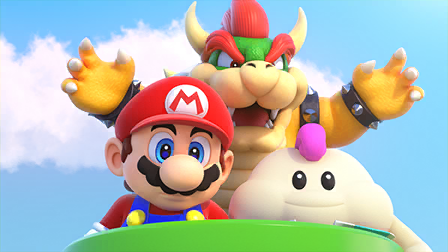
Each of the seven Star Pieces is guarded by a major boss of the Smithy Gang. The party also faces dozens of smaller bosses, recurring rivals, and unforgettable one-offs like the cake-monster wedding crasher Bundt and the giant Bloober King Calamari.
The Seven Star-Piece Holders
Mack
Mushroom Castle
A giant living knife who bounces on a pogo stick of sorts; fought alongside his Shyster minions.
Star Piece 1
Bowyer
Forest Maze
A sentient wooden bow firing paralysing arrows; locks the party out of using specific buttons.
Star Piece 2

Punchinello
Coal Mines
A vain enemy desperate to be famous; summons increasingly large Mezzo Bombs.
Star Piece 3

Yaridovich
Seaside Town
A spear-wielding shapeshifter who disguised himself as the entire population of Seaside Town.
Star Piece 5

Valentina
Nimbus Castle
The royal aide trying to steal the throne by claiming her giant bird Dodo is Mallow.
Star Piece 7

Boomer
Bowser’s Keep
A swordsman wreathed in flames; the gauntlet boss atop the chandeliers before the Smithy Factory.
Pre-Smithy

Croco
Recurring
A crocodile-like thief who appears throughout the game stealing coins and items. A comedic but persistent rival.
Loot Boss
The 6th Star Piece is found on Star Hill itself, without a boss fight, and the 6th-area boss Smilax guards a separate path — making for a total of seven boss-gated and one wild Star Piece.
The Smithy Gang
The villains of Super Mario RPG are not Bowser and his Koopas — it’s the brand-new Smithy Gang, an interdimensional army of sentient weapons who poured out of the giant sword Exor when it crashed through the Star Road and into Bowser’s Keep.
Their Goal
The gang’s leader, Smithy, is a giant blacksmith from another dimension who runs a massive weapon-forging factory. He intends to replace the wish-granting Star Road with a world full of weapons — essentially shutting down hope and wishes in favour of perpetual war. To do this, he and his gang need to control the seven Star Pieces.
Smithy’s Final Forms
The fight against Smithy is the most elaborate in the game. He’s first encountered atop his treaded forge tank — but after defeat, he reveals his true form in a brutal multi-phase battle. In the remake this final fight is even more elaborate, with Smithy’s body cycling through several weaponised “head” transformations:


Other Notable Gang Members
- Exor — the giant living sword who is the literal portal to the Smithy Factory; his “mouth” must be entered to reach Smithy himself.
- The Axem Rangers — a five-member Power Rangers-inspired Smithy enforcement squad (Red, Yellow, Pink, Green, Black) fought as a team on the journey to Smithy.
- Czar Dragon & Zombone — a dragon and its undead second form encountered in Bowser’s Keep.
- The Magikoopa Boomer — a Smithy Gang swordsman, the final pre-Smithy boss.
Culex & Secret Battles

Tucked behind a sealed door in Monstro Town is the most famous secret battle in any Mario RPG: Culex, the “Dark Knight of Vanda” — a deliberate Final Fantasy crossover boss inserted by Square as a love letter to their own series.
How to Reach Him
- In Moleville, give a young Mole girl fireworks (bought from a Mole man in the same town for 500 coins).
- She gives Mario a Shiny Stone in return.
- The Shiny Stone unlocks the sealed door in Monstro Town — inside is Culex.
The Battle
Culex is presented in deliberately 2D, Final-Fantasy-styled pixel-sprite glory even in the 3D remake — visible in his original SNES form in the middle of a 3D arena. He is summoned with his four elemental crystals (Fire, Earth, Water, Wind), each acting as a separate, dangerous enemy. His battle music, “Battle with Culex,” is a remix of the classic Final Fantasy IV boss theme.
Beating Culex rewards Mario with the powerful Quartz Charm accessory — a permanent stat-boosting trinket considered one of the best items in the game.

Locations & Side Activities
The world of Super Mario RPG stretches from familiar Mushroom-Kingdom landmarks to bizarre, original locations conjured by the original Square/Nintendo collaboration. Many feature their own minigames and quirky inhabitants.
Key Locations
- Mario’s Pad & Mushroom Way — the starting region; gentle introduction.
- Mushroom Kingdom & Mushroom Castle — the capital, occupied by Mack and the Smithy Gang.
- Bandit’s Way & Kero Sewers — the route to Tadpole Pond, home of Belome.
- Midas River — a sweeping barrel-jumping minigame for coins and Frog Coins.
- Tadpole Pond & Frogfucius — Mallow’s adoptive home; quest hub.
- Rose Way & Rose Town — the arrow-pinned village leading to the Forest Maze.
- Forest Maze — where Geno awakens in the wooden doll.
- Moleville & Coal Mines — the Dyna & Mite rescue.
- Booster Pass, Booster Tower, Booster Hill — the home and chase course of the eccentric Booster.
- Marrymore — the wedding-cake-monster boss fight.
- Star Hill — a hill of falling-star wishes; holds the 4th Star Piece.
- Seaside Town & Sunken Ship — Johnny Jones’s pirate gauntlet and Yaridovich’s disguise.
- Land’s End, Belome Temple & Monstro Town — the desert mountains, Belome’s second fight, and the hidden village (Culex sealed here).
- Bean Valley — the path to the clouds via Sergeant Flutter.
- Nimbus Land & Nimbus Castle — Valentina’s coup; Mallow’s royal home.
- Bowser’s Keep (Smithy-occupied) & the Smithy Factory beyond Exor.
- Yo’ster Isle — home of Yoshi and the Mushroom Derby racing minigame.




Side Activities & Minigames
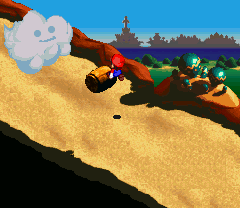
- Midas River course — the famous water-and-barrels coin-collecting platforming sequence after the Kero Sewers.
- Mushroom Derby (Yo’ster Isle) — race Boshi and other Yoshis on Yoshi-back. Win to unlock Yoshi for general use and start betting on races with cookie wagers.
- Melody Bay — a music puzzle where Mario taps tadpoles to play the right tune for Toadofsky.
- Booster Hill — chase Booster up the hill while collecting flowers and avoiding obstacles.
- Goomba Thumping — a whack-a-mole-style minigame for prizes.
- Moleville Mountain — a downhill cart-riding minigame for coins.
- Beetle Race & Beetle Mania — catch beetles on Booster Hill for points.
- Grate Guy’s Casino — a hidden casino accessed via a Bright Card from Knife Guy. Houses Look the Other Way, Bombshell roulette, and the famous Slot Machine.
- Climbing Challenge — timed Booster-Tower ascent.
- Hidden Treasure Boxes — 39 invisible “?” boxes scattered through the world, each containing rare gear.
Post-Game Content
The remake adds a full and substantial post-game that did not exist in the SNES original. After defeating Smithy, the player’s save file gains a star and reopens just before the final fight, with the world filled with new content.
Boss Rematches
The post-game centres on rematches with most of the major bosses, now far tougher. Each rematch offers a fresh reward:
- Rematch wins from certain bosses reward new equipment — stronger weapons, armour, or accessories.
- Three specific rematches grant brand-new ultimate weapons for Mallow, Geno, and Bowser.
- Culex returns in a tougher new 3D Culex rematch — the original 2D Culex must be defeated first to unlock his 3D counterpart, who fights with reimagined elemental crystals.
The Super Smithy Fight
After clearing all rematches, the player unlocks a brand-new battle against a far more powerful version of Smithy in his real form — a true superboss climax exclusive to the remake. He drops the ultimate equipment in the game.
Sound Player & Play Report
- Sound Player — unlocked after clearing the game; lets the player toggle between the original SNES synth and Yoko Shimomura’s 2023 re-orchestration, and listen to every track in the game.
- Play Report — a stats screen showing playtime, totals, and gold medals earned for beating minigame records.
Development
The remake was developed by ArtePiazza — the Japanese studio best known for its remake work on the Dragon Quest series — working with Nintendo and Square Enix. Original composer Yoko Shimomura supervised the audio.
- Announced at the June 2023 Nintendo Direct, with a 17 November 2023 release.
- Faithful approach — the team preserved the original’s pacing, character proportions, and dialogue beats, modernising only the visual presentation and adding mechanics that complement rather than replace the original.
- Yoko Shimomura re-orchestration — every track has been re-recorded with live orchestration and chiptune-flavoured layers; the player can toggle between original and remixed soundtracks in the Sound Player.
- Localisation — unlike the 1996 original (localised by Square), the remake’s text was handled by Nintendo’s international teams. Many lines were retranslated with modernised humour while keeping the original’s spirit intact.
- Pre-rendered cutscenes — the original’s in-engine cutscenes have been replaced with pre-rendered video sequences with dynamic camera work. Bosses get new pre-battle intro animations.
- Mallow and Geno’s return — the remake marks the first appearance of these characters in a Nintendo title in 27 years; the team consulted Square Enix to retain Geno’s rights and design.
Videos & Trailers
Official Nintendo trailers for the Super Mario RPG remake.
Reception
The remake was met with warm critical and commercial success as a heartfelt revival of a beloved classic.
Acclaim
- Metacritic 81 — a clear “great” rating, with reviewers praising the faithful approach above all.
- The new mechanics — Action Gauge, Triple Moves, and Chains — were lauded as well-judged additions that enrich rather than dilute the original combat.
- Yoko Shimomura’s re-orchestration drew universal praise; the option to toggle the SNES synth was a welcome touch for purists.
- Visual presentation — the new 3D character models were widely admired for keeping the chibi spirit of the original sprites.
- Post-game content — the addition of substantial boss rematches and the super-Smithy fight were singled out as the remake’s key value-adds.
- Strong sales — the remake sold over 3 million copies in just over a year, well exceeding Nintendo’s expectations for a turn-based RPG remake.
Criticisms
- Faithfulness has limits — some reviewers wished the remake had taken more risks: the game’s 1996 pacing, brief play length (15–20 hours), and simple battle AI are largely preserved as-is.
- Difficulty — the main story is on the gentle side, particularly for series veterans. The new post-game content addresses this only after the main credits roll.
- Some text changes — a small subset of fans of the original Square localisation took issue with reworded dialogue in the new Nintendo-handled translation.
Trivia & Facts
- The original Super Mario RPG: Legend of the Seven Stars launched on the SNES in March 1996 (Japan/North America) — 27 years before the remake.
- It was the first ever collaboration between Nintendo and Square (now Square Enix), and the studio that would become Square Enix used the experience to inform later Mario games like Super Mario RPG’s spiritual successors, Paper Mario and Mario & Luigi.
- Mallow and Geno had not appeared in any Nintendo game since 1996 — the remake is their first return in 27 years. (Geno had a costume cameo in Super Mario Maker, but no playable role.)
- Geno’s real name is unpronounceable to mortals; he uses “Geno” because that’s the name of the doll he inhabits.
- Bowser is a permanent party member — the only mainline Mario game to date where he is fully playable as a member of Mario’s team.
- The Action Gauge is the headline new mechanic; the maximum Chain count visibly tracked in battle is no theoretical limit.
- Culex, the secret boss, predates Smash Bros. as the first ever in-game Nintendo × Square crossover character.
- Yoko Shimomura, the composer of both the original and the remake, also composed Kingdom Hearts and went on to work on Final Fantasy XV.
- 3 million+ copies sold within roughly a year of launch — a major commercial success.
- The remake supports a three-save-slot system with autosave, replacing the original’s four manual slots.
- The SNES soundtrack toggle is one of the most-praised options — hear the original chiptunes any time.
- The original Smithy Gang weapons include living swords, knives, bows, spears, and a sentient blacksmith forge — entire concept of “weapons replacing wishes” that is unique to this game.
Box Art & Logos
Box art and logos for Super Mario RPG (Nintendo Switch).


Reference / Information
More on Super Luigi Bros.
Media / Downloads
Screenshots and artwork appear throughout the sections above. Additional footage is in the Videos section.