
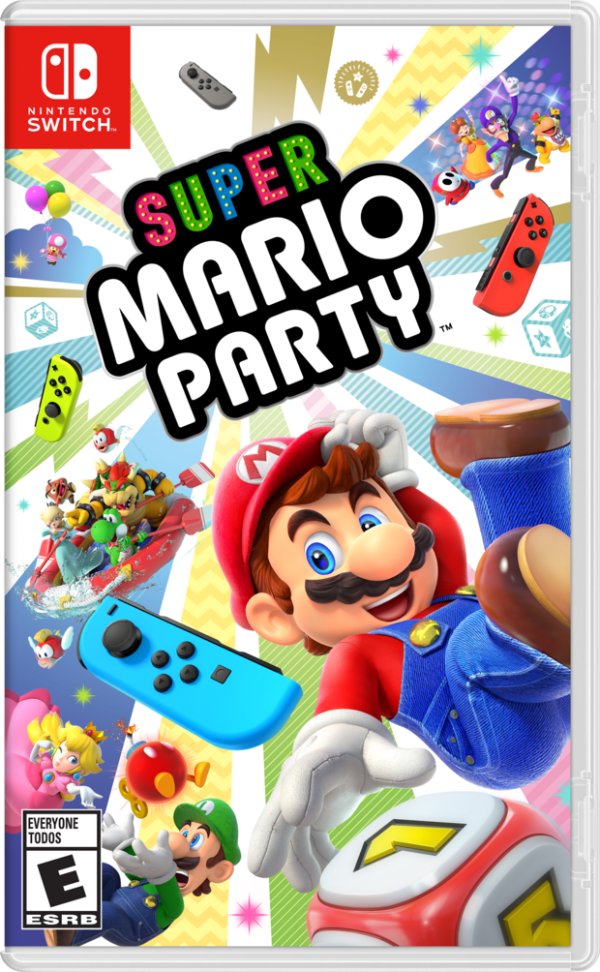
Super Mario Party
Overview

Super Mario Party is the eleventh main entry in the long-running Mario Party franchise and the first developed for Nintendo Switch. Released worldwide on 5 October 2018, it was developed by NDcube (the Tokyo-based studio Nintendo formed in 2010 specifically to continue the Mario Party series after Hudson Soft’s closure) and published by Nintendo. It is, by any measure, the most commercially successful Mario Party game ever made — over 21 million copies sold lifetime, more than triple the best-selling previous entry.
The game is a deliberate return to series fundamentals after the divisive car-based shared-vehicle gameplay of Mario Party 9 (Wii) and Mario Party 10 (Wii U). Each player rolls dice, moves independently around the board, collects coins, buys stars, and competes in minigames at the end of each turn. The classic Mario Party formula is fully restored, with new Switch-specific layers added on top.
The Headline Features
- Classic Mario Party return — 4-player free-for-all board format with individual movement, separate coin/star economies, and end-of-turn minigames. The formula fans had been requesting since 2007.
- Character Dice Blocks — each playable character has a unique 6-sided dice with custom number distributions and special abilities (Bowser’s dice can roll 1–10 but also lose coins; Peach’s dice is reliable but mid-range). The most important new mechanic.
- Ally system — recruit teammates on the board who follow your character, adding their own dice rolls to yours. Up to 3 allies can be recruited per match.
- 4 main boards — Whomp’s Domino Ruins, King Bob-omb’s Powderkeg Mine, Megafruit Paradise, and Kamek’s Tantalising Tower. Each with unique themes, special events, and shortcut mechanics.
- 80 brand-new minigames — the largest fresh minigame library in any Mario Party. Plus 4 added via April 2019 update.
- Seven distinct game modes — Mario Party, Partner Party, River Survival, Sound Stage, Toad’s Rec Room, Challenge Road, and Online Mariothon. Each is a substantial mini-experience.
- Tabletop Mode — the headline gimmick. Two Switch consoles physically dock together (tabletop screens facing each other) and the game uses both displays as a connected playing field. A genuinely novel hardware-software innovation.
- Online Mariothon (added April 2019) — 5-minigame online tournaments. The first online minigame mode in Mario Party history.
Return to Form
Super Mario Party arrived after the most polarising stretch in Mario Party history. The series’ reception had been declining since the Hudson Soft era ended.
The Hudson Soft Era (MP1–MP8)
Hudson Soft developed every Mario Party from the original 1998 N64 title through Mario Party 8 (Wii, 2007). The Hudson era established the iconic formula: 4 players, individual movement, coin collection, stars-cost-20-coins, end-of-turn minigame. Mario Party 1–4 set the template; MP6–MP8 introduced microphone mechanics and dual-screen handheld variants. By 2007 the series had peaked commercially around 3 million copies per entry but the core formula was beloved.
The Closure and Transition (2012)
Hudson Soft was absorbed into Konami and effectively shut down by 2012. Nintendo took the franchise in-house by establishing NDcube (Nintendo Cube), a Tokyo studio specifically tasked with continuing Mario Party. NDcube’s first attempt at reinvention was Mario Party 9 (Wii, 2012).
The Divisive Car Years (MP9, MP10)
Mario Party 9 (Wii, 2012) and Mario Party 10 (Wii U, 2015) replaced the individual-movement model with a shared vehicle system — all four players rode in a single car that moved together around the board. The redesign was intended to speed up matches and reduce frustration from skill imbalances, but it eliminated the strategic positioning, coin-management, and individual player agency that defined classic Mario Party. Critical and commercial reception was lukewarm; series sales declined to ~2 million per entry.
The Switch-Era Restart
Super Mario Party deliberately reversed every controversial MP9/MP10 design choice. The shared car was abandoned. Free-for-all individual movement returned. Star auctions, item shops, and the classic stars-cost-20-coins economy were restored. The familiar end-of-turn minigame structure was reinstated. Character Dice Blocks and the Ally system added new strategic layers without compromising the classic formula.
Gameplay
Super Mario Party’s core loop returns to the classic Mario Party 4 / Mario Party 8 formula with Switch-era refinements. Each match is a structured competition: 4 players, 1 board, 10–20 turns, end-of-turn minigames, the player with the most stars at the end wins.
The Turn Structure
- Rolling phase — each player in turn order rolls their character’s dice block (showing values 1–6, or character-specific custom dice).
- Movement phase — player moves their character around the board by the rolled number, landing on a space.
- Space effect — the landed space triggers its effect (gain coins, lose coins, trigger event, etc.).
- Star purchases — if you reach the Star space and have 20+ coins, exchange for one star.
- End-of-turn minigame — after all 4 players move, everyone competes in a randomly chosen minigame for coin rewards.
The Victory Condition
The player with the most stars at the end of the match wins. Ties broken by coin count. Stars cost 10 coins each in Super Mario Party (a reduction from the classic 20-coin price — a controversial change). The board’s Star moves location each time it’s purchased to keep gameplay dynamic.
The Coin Economy
Coins flow through every interaction: blue spaces add 3 coins, red spaces subtract 3, minigame placement awards coins by ranking (1st = 10, 2nd = 7, 3rd = 5, 4th = 3), event spaces have variable outcomes. Strategic coin management — saving for stars vs spending on items vs gambling on minigames — is the foundational skill layer.
Character Dice Blocks

The Character Dice System
Super Mario Party’s headline new mechanic is the Character Dice Block. Every playable character has a unique 6-sided dice with custom number distributions — instead of the standard 1–6, each character’s dice has its own probability spread, including some sides showing 0, +/- coins, or special effects.
Choosing Your Dice
At the start of each turn, players choose whether to roll the standard dice block (the classic 1–6 dice all characters share) or their Character Dice Block. This choice becomes a recurring strategic decision: take the safer standard roll, or gamble on your character’s unique distribution for potential bigger gains or special abilities.
Example Character Dice
- Mario — 1, 3, 3, 3, 5, 6. Balanced with a slight tilt toward mid-range rolls. The safe all-rounder.
- Luigi — 1, 1, 1, 5, 6, 7. Higher variance — either bad or great. Luck-of-the-Irish flavor.
- Peach — 0, 2, 4, 4, 4, 6. Reliable mid-range, never a 1, occasional 0.
- Daisy — 3, 3, 3, 3, 4, 4. Extremely safe — always 3 or 4. No surprises, no gambling.
- Wario — 6, 6, 6, 6, -2 coins, -2 coins. Massive movement but costs coins on bad rolls. Greedy by design.
- Waluigi — -3 coins, 1, 3, 5, 5, 7. High movement potential with coin-loss risk.
- Bowser — 1, 8, 9, 10, -3 coins, -3 coins. The boldest dice — potential 10 movement but 2 sides lose coins.
- Rosalina — +2 coins, +2 coins, 2, 3, 4, 8. Conservative with coin-bonus potential.
- Boo — 0, 0, 5, 5, 7, 7. Cluster-distribution — either nothing or solid movement.
- DK — 0, 0, 0, +5 coins, 10, 10. Boom-or-bust dice. The biggest jumps in the game.
- Goomba — 0, 0, 3, 4, 5, 6. Below-average movement but harmless.
- Shy Guy — 0, 4, 4, 4, 4, 4. Almost always rolls 4 — the most predictable dice.
Ally System
The Ally Recruitment Mechanic
Super Mario Party’s second major new mechanic is the Ally System. During a match, allies (non-controlled characters from the roster) appear on the board at random locations. Landing on or passing through an ally’s space recruits them to your team — they then follow your character around the board for the rest of the match.
What Allies Do
- Add to your dice rolls — each ally rolls their own character dice every turn alongside yours, with all rolls combined into your total movement.
- Combo coin bonuses — when minigames award coins, having allies multiplies your earnings (up to +1 ally = +5 bonus coins per minigame).
- Pep Rally event — if you recruit enough allies for a “Pep Rally,” all your characters celebrate together for a bonus round.
- Maximum 3 allies — the cap. With 3 allies you roll 4 dice every turn (your own + 3 ally dice).

Pep Rally Showcase


Board Spaces
Each board is divided into spaces, and the type of space your character lands on determines what happens next turn. Super Mario Party’s space system inherits the classic Mario Party design with a few new variants.
Space Types

Start
The starting space at the beginning of each match. Players begin here with 10 coins.

VS Space
Triggers a 1v1 or 2v2 minigame for double-coin rewards. The aggressive option.

Item Space
Gain a random item (Mushroom for extra dice, Dueling Glove, etc). The strategic resource layer.

Lucky Space
Random positive event — coin bonus, free star reroll, ally recruitment. The boom space.

Bad Luck Space
Random negative event — lose coins, lose item, swap places. The bust space.
Other Spaces (Not Pictured)
- Blue space — +3 coins. The basic positive space, most common on every board.
- Red space — -3 coins. The basic negative space, also common.
- Event Space — triggers a board-specific event (each board has its own unique event variants).
- Bowser Space — negative event involving Bowser — lose multiple coins, trigger bad-luck minigame, or worse.
- Bowser Jr. Space — specific to Whomp’s Domino Ruins. Triggers Bowser Jr. fight minigame.
- Ally Space — chance to recruit an ally to your team.
- Star Space — the moveable star. Land here with 10+ coins to buy a star.
Mario Party Mode
Mario Party Mode is the classic mode — the headline 4-player free-for-all board game format that fans had been requesting since 2007. Each match takes 30–60 minutes, supports 1–4 local players (AI fills empty slots), and ends with the player who has the most stars winning.
How a Match Plays Out
- Setup — choose 1 of 4 boards, set the turn count (10/15/20), select characters (including character dice choice).
- Opening turns — players roll, move, collect coins. Allies start appearing around turn 3–5.
- Mid-game — players begin buying stars (10 coins each). Item items become valuable. Bad-Luck spaces drain coin reserves.
- Late game — the leader gets aggressive (VS spaces, Bowser space risk-taking); stragglers chase allies for the comeback mechanic.
- Final turn — bonus stars awarded based on hidden criteria (most coins earned, most allies recruited, most spaces moved). Often shifts the standings dramatically.
- Winner determined — player with the most stars wins. Ties broken by coin count.
The Bonus Stars
At the end of each match, 3 bonus stars are awarded based on hidden criteria:
- Minigame Star — most coins earned from minigames.
- Ally Star — most allies recruited during the match.
- Item Star — most coins spent on items.
- Unlucky Star — most coins lost to bad-luck events.
- Friendship Star — most space tiles moved.
The 4 Boards
Super Mario Party launched with 4 main boards, each themed around a distinct biome with unique board-specific events, shortcuts, and hazards. Boards rotate the moveable Star location each time it’s purchased, ensuring no two matches play identically.
The 4 Mario Party Mode Boards
Whomp’s Domino Ruins

Set in jungle ruins with toppling domino pillars as a dynamic board element. Players can knock over dominos to create new paths or block opponents. Bowser Jr. spaces unique to this board trigger a confrontation minigame.
King Bob-omb’s Powderkeg Mine

A mining cart-themed board with explosive Bob-omb hazards. Activated cart routes let players take shortcuts across the map at the cost of a coin toll. King Bob-omb appears as a board-event boss.
Megafruit Paradise

A multi-island board connected by warp pipes. The 5 sub-islands each have their own micro-economy of fruit-based spaces. Mid-board, the islands physically rotate, changing player connections.
Kamek’s Tantalising Tower

A vertical magical tower with Kamek-themed events that randomly shuffle players, swap items, or change board layouts. The most chaotic of the 4 boards. Heavily favors players with safe Character Dice (Daisy, Shy Guy).
Board-Specific Events
Each board has unique event spaces with bespoke effects:
- Whomp’s Domino Ruins — the giant Whomp boss appears mid-board, dominos topple to change paths, and Bowser Jr. challenges trigger 1v1 duel minigames.
- King Bob-omb’s Powderkeg Mine — mining carts offer paid shortcuts; King Bob-omb explosion events drain all players’ coins; bomb-fuse hazards damage stragglers.
- Megafruit Paradise — the 5 sub-islands rotate mid-match, changing which warp pipes connect; fruit-collection events reward bonus coins.
- Kamek’s Tantalising Tower — Kamek randomly swaps player items; magical “shuffle” events teleport all players; tower elevation changes affect available spaces.

Partner Party

Partner Party Mode
Partner Party is a 2v2 team variant of Mario Party that uses the same 4 main boards but reframes them as grid layouts. Instead of linear board movement, players move freely on a square grid, choosing direction each turn.
How Partner Party Differs from Mario Party
- Team-based — 2v2 with shared coin pool and combined dice rolls per team.
- Grid movement — free directional choice instead of linear path-following. Players choose which direction to move each turn.
- Shared resources — team partners share items, coin pool, and ally pool.
- Strategic positioning — the grid format lets teams “fence in” opponents or coordinate item usage.
- Same boards — uses the 4 main boards but redrawn as 7×7-or-similar grid layouts.

River Survival

River Survival Mode
River Survival is Super Mario Party’s headline cooperative mode — a 4-player co-op raft race down a procedurally-generated river. All players must coordinate paddle strokes (each player uses one Joy-Con as a paddle) to steer the raft past obstacles. Successful coordination unlocks branching river paths and triggers cooperative minigames at junction points.
How It Plays
- 4-player cooperative — all players row together with motion-controlled paddle strokes. Single player not supported.
- Branching river — each match takes a different path through the river based on minigame results.
- Time-limited — reach the goal before the timer expires. Each minigame win adds bonus time.
- Cooperative minigames — at river junctions, 4-player co-op minigames decide which path to take.
- Balloons — collect balloons en route for completion bonuses and score multipliers.


Sound Stage
Sound Stage is Super Mario Party’s rhythm-game mode. 4 players compete in a sequence of music-themed minigames where success requires timing button-presses or motion gestures to the beat.
How Sound Stage Works
- 10-minigame sequence — each Sound Stage round consists of 10 rhythm minigames played back-to-back.
- Timing-based scoring — each input is judged Perfect/Great/Good/Miss based on rhythm precision.
- Cumulative score — total points across all 10 games determines the winner.
- Diverse minigames — drumming, dancing, conducting, jumping rope, marching — each one a distinct rhythm exercise.


Toad’s Rec Room
Toad’s Rec Room is a collection of creative minigames specifically designed around the Switch’s tabletop mode and creative Joy-Con usage. Each game uses the Switch hardware in a unique way — some require two Switch consoles physically connected (the Tabletop Mode feature), others use HD Rumble or single Joy-Con sensors.
The Toad’s Rec Room Games
- Banana Slam — two Switches connect side-by-side; a banana slides between the two screens; players slap their Switches to bounce it back.
- Shifty Smithy — a forging minigame using HD Rumble to feel anvil impact timing.
- Sleight of Hand — motion-controlled cup-shuffling minigame.
- Slaparazzi — a fast-paced photo-taking minigame with characters posing on different Switch screens.
- Star-Crossed Skywalkers — cooperative tightrope walking using Joy-Con balance.
- Bowser’s Big Blast — a tense risk-taking minigame using HD Rumble for bomb-fuse feel.
Challenge Road

Challenge Road Mode
Challenge Road is Super Mario Party’s single-player progression mode. Players move along a winding map, completing minigame challenges with specific objectives (win without missing, beat the time limit, score above X points). Successful completion unlocks the next map node and progressively harder minigames.
How It Works
- Single-player only — the only mode that has no multiplayer.
- Linear progression — a winding map of ~80 nodes (one per minigame, plus boss challenge nodes).
- Specific objectives — each minigame has a unique condition: “win without missing,” “achieve X coins in 30s,” “beat AI in under 20s.”
- Star rewards — each completed challenge awards 1–3 stars based on performance.
- Boss challenges — every 10–15 nodes, a “boss” challenge requires completing a specific minigame at the highest difficulty.
Online Mariothon

Online Mariothon Mode (Added April 2019 Update)
Online Mariothon was added in the April 2019 free update — the first online minigame mode in Mario Party history. Players compete in 5-minigame online tournaments against matchmade opponents from around the world.
How It Works
- Online matchmaking — join a queue and get matched with 3 other players globally.
- 5-minigame sequence — each Mariothon match consists of 5 minigames played back-to-back.
- Cumulative scoring — placement in each minigame (1st = 5 pts, 2nd = 3 pts, 3rd = 1 pt, 4th = 0 pts) totals to the final ranking.
- Leaderboards — weekly and monthly score leaderboards with regional and global rankings.
- Random minigame selection — the 5 minigames in each match are randomly chosen from the full 80-minigame library.
Minigames
Super Mario Party shipped with 80 brand-new minigames at launch — the largest fresh minigame library in any Mario Party. The April 2019 update added 4 more, bringing the total to 84. None are remasters from previous Mario Party titles — every minigame is original to Super Mario Party.
Minigame Categories
Free-For-All
Standard 4-player competitive minigames. Coins awarded by ranking (1st=10, 2nd=7, 3rd=5, 4th=3). The bulk of the minigame library — around 30 of the 80 launch minigames.
Team vs Team
2v2 cooperative team minigames triggered by VS spaces or board events. Both winning team members earn equal coins. ~15 minigames in this category.
One vs Three
Asymmetric minigames where 1 player faces 3 others. The single player typically has stronger abilities to balance the numerical disadvantage. ~10 minigames.
Sound Stage
Rhythm-action minigames in Sound Stage mode. Timing-based scoring with Perfect/Great/Good/Miss judgements. ~12 dedicated rhythm minigames.
Coin Minigames
Coin-focused minigames where players collect coins on a timer. Total coins collected determines placement. The economic-focused subset.
Boss Battles
Boss-specific minigames triggered on certain boards (Bowser Jr. on Whomp’s Domino Ruins, King Bob-omb on Powderkeg Mine, Kamek on Tantalising Tower). Multi-stage encounters with bigger coin rewards.
River Survival
4-player cooperative minigames in River Survival mode. Time-bonus rewards for completion. ~10 minigames in this category.
Toad’s Rec Room
The 2-Switch Tabletop Mode minigames + creative Joy-Con minigames. ~6 minigames showcasing the Switch hardware’s unique capabilities.
Notable Individual Minigames
- Strike It Rich — 4-player FFA bowling minigame. The all-time fan favorite, frequently cited as the best minigame in the game.
- Banana Slam — Toad’s Rec Room game using 2 docked Switches. The internet-famous tabletop-mode showcase.
- Pour to Score — motion-controlled drink-pouring minigame. Demonstrates Joy-Con sensitivity remarkably.
- Slap You’re Out! — 1v3 fast-paced reflex slap game.
- Trike Harder — 4-player tricycle racing with HD Rumble for steering feedback.
- Snack Attack — 2v2 team eating-contest minigame. Classic Mario Party slapstick.
Roster

Super Mario Party shipped with 20 playable characters — no characters were added via DLC. Every character has a unique Character Dice Block with distinct number distributions. The roster spans Mario’s core cast plus several enemy characters promoted to playable status.
The Full 20-Character Roster

Mario
Playable1,3,3,3,5,6

Luigi
Playable1,1,1,5,6,7

Peach
Playable0,2,4,4,4,6

Daisy
Playable3,3,3,3,4,4

Yoshi
Playable0,1,3,3,5,7

Wario
Playable6,6,6,6,-2c,-2c

Waluigi
Playable-3c,1,3,5,5,7

Rosalina
Playable+2c,+2c,2,3,4,8

Bowser
Playable1,8,9,10,-3c,-3c

Bowser Jr.
Playable1,1,1,4,4,9

Donkey Kong
Playable0,0,0,+5c,10,10

Diddy Kong
Playable0,0,0,7,7,7

Boo
Playable0,0,5,5,7,7

Goomba
Playable0,0,3,4,5,6

Shy Guy
Playable0,4,4,4,4,4

Koopa Troopa
Playable1,1,2,3,3,10

Monty Mole
Playable0,3,3,3,4,6

Hammer Bro
Playable3,3,3,3,3,8

Dry Bones
Playable1,1,1,6,6,6

Pom Pom
Playable0,3,3,3,3,8
Roster Notes
- 20 playable characters at launch — no DLC characters were added.
- First Mario Party with Donkey Kong + Diddy Kong as standard playable characters since Mario Party 6 (2004).
- Pom Pom is the only Mario Tennis Aces newcomer appearing in Super Mario Party — her first Mario Party appearance.
- Monty Mole returns to Mario Party after a long absence.
- No Birdo — despite being a frequent Mario Party participant in previous entries, Birdo was omitted from Super Mario Party. She returned in Mario Party Superstars (2021).
- Toad and Toadette are NPCs only — they appear as shop owners and item distributors but are not playable characters.
NPCs and Supporting Cast


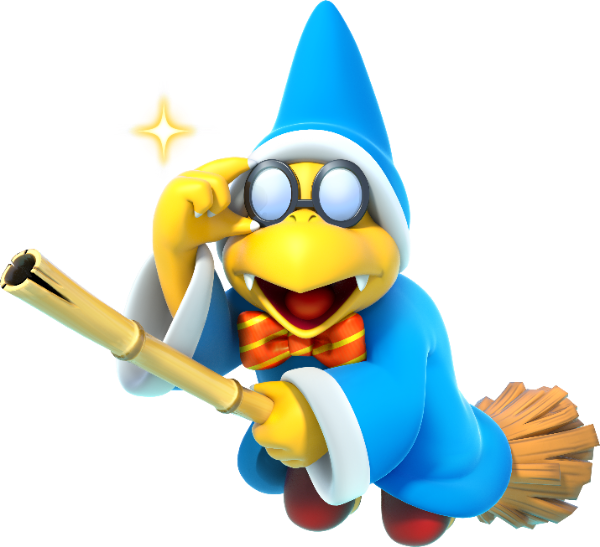
Tabletop Mode

Tabletop Mode — The Headline Innovation
Tabletop Mode is Super Mario Party’s most novel hardware innovation. Two Switch consoles in tabletop mode can be physically docked side-by-side (screens facing up, edges touching), and certain minigames use both screens as a single connected playing field. The screens display content that spans across both Switches, with the gap between them serving as a “boundary” element.
How Tabletop Mode Works
- Two Switches required — each player’s Switch in tabletop mode (kickstand out, screen facing up).
- Wireless connection — the two Switches connect via local wireless. No internet required.
- Coordinated display — both screens display halves of a single game scene. Animations and physics objects pass smoothly between screens.
- Specific minigames — about 5 of the Toad’s Rec Room minigames are specifically designed for Tabletop Mode (Banana Slam, Slaparazzi, etc.).
- Optional — Tabletop Mode is entirely optional. All other modes work fine with a single Switch.
The Iconic Banana Slam
The most famous Tabletop Mode minigame is Banana Slam. A banana physically slides between the two Switches’ screens. Players slap their respective Switches to bounce the banana back toward the opponent’s screen. The first player whose Switch absorbs a “missed” banana loses. The combination of physical slapping, the visual illusion of a single object existing across two devices, and the dramatic moment of “the banana fell off the table” makes Banana Slam one of the most memorable Switch hardware demonstrations Nintendo has ever shipped.
Videos & Trailers
Four verified official Nintendo trailers covering Super Mario Party from E3 reveal through launch.
Other Official Marketing
Beyond the 4 trailers above, Nintendo released:
- Spanish launch trailer (Tráiler de lanzamiento) for Latin American markets.
- Portuguese launch trailer for Brazilian markets.
- Play Nintendo Tips videos covering Tabletop Mode, the Ally system, and the 80-minigame library showcase.
- April 2019 Online Mariothon update trailer introducing the online minigame mode.
- September 2018 Nintendo Direct segment revealing River Survival and Sound Stage modes.
All trailers are available on the Nintendo of America YouTube channel by searching “Super Mario Party.”
Reception
Super Mario Party launched on 5 October 2018 to generally favorable reviews — Metacritic 76, IGN 7.0/10, Game Informer 8.0/10, Nintendo Life 8/10, GameSpot 7/10, Eurogamer “Recommended” — with universal praise for the franchise return to free-for-all format balanced against a small contingent of criticism around board count and lack of online board mode.
Acclaim
- Return to free-for-all format — consistently cited as the headline win. After two car-based Mario Party titles, the restoration of classic individual movement and separate coin economies was universally praised.
- Character Dice Blocks — the new mechanic was singled out as the most clever addition to Mario Party since the original. Praised for adding strategic depth without compromising accessibility.
- Ally system — the comeback mechanic was praised for keeping matches competitive until the final turns.
- Tabletop Mode innovation — the two-Switch docking feature was called “one of the most creative Switch hardware demonstrations Nintendo has shipped.”
- 80 original minigames — the fresh minigame library was praised, with several minigames (Strike It Rich, Pour to Score, Snack Attack) singled out as franchise highlights.
- River Survival mode — widely praised as a standout co-op mode and a creative departure from the competitive Mario Party formula.
- Character roster depth — 20 playable characters with unique dice was the largest mechanical variety in Mario Party history.
Criticisms
- Only 4 boards at launch — the biggest single criticism. Mario Party 7 (GameCube) shipped with 6 boards; Super Mario Party shipped with 4. No board DLC was ever added.
- No online board mode at launch — the classic 4-player board game was only playable locally. Online Mariothon (April 2019 update) added online minigame play, but never online board play. Reviewers felt this was a missed opportunity.
- 10-coin stars vs 20-coin classic — the reduced star price was felt to remove some of the dramatic “save up for a star” tension of classic Mario Party.
- Bonus stars too random — the end-of-match bonus stars frequently flipped the standings in ways that felt unearned to skilled players.
- Toad and Toadette not playable — despite being in the game as NPCs, neither was a playable character, a continuing point of contention for Toad fans.
Sales
Sales Performance
- Launch week (5–11 October 2018) — #1 in Japan launch week (130k physical); UK debut #1; US debut top 3.
- End of December 2018 — 5.30 million copies sold worldwide — the franchise’s best 3-month launch performance ever.
- End of March 2019 — 6.40 million copies. Strong sustained performance.
- End of March 2020 — 11.50 million copies — surpassed Mario Party 8’s lifetime sales (~9M) in just 18 months.
- End of March 2022 — 18.36 million copies — the best-selling Mario Party ever.
- Lifetime (Nintendo 2024 financial reports) — over 21 million copies sold. The franchise’s commercial high-water mark.
Context
For franchise comparison: Mario Party 8 (Wii, 2007), previously the best-selling Mario Party, sold approximately 9 million lifetime. Super Mario Party more than doubled that. The next-best Mario Party performances are: Mario Party DS (Wii era handheld) ~9M, Mario Party Superstars (Switch, 2021) ~10M, Mario Party 7 (GameCube) ~3M.
Within Switch sports/party titles: Super Mario Party’s 21M+ lifetime is the second-best Mario sports title commercially after Mario Kart 8 Deluxe (~57M). It outsold Splatoon 2 (~13M), Super Mario Maker 2 (~7M), and Animal Crossing: New Horizons (~42M) on a per-Mario-sports basis.
Trivia & Facts
- First Mario Party on Nintendo Switch and the 11th main entry in the franchise overall (since 1998).
- NDcube developed Super Mario Party — the studio Nintendo formed in 2010 specifically to continue Mario Party after Hudson Soft’s closure. They’ve developed every Mario Party since.
- First Mario Party since 2007 to return to the classic free-for-all 4-player format. Mario Party 9 (Wii, 2012) and 10 (Wii U, 2015) used the divisive shared-car format.
- 21+ million lifetime sales — the best-selling Mario Party ever, more than 2x the previous record-holder Mario Party 8.
- Character Dice Blocks were the most-discussed new mechanic at launch — NDcube spent months balancing each character’s dice probability distribution.
- Tabletop Mode requires two physical Switch consoles — the only Mario Party feature that requires owning two consoles. Specifically designed for the kind of group party where multiple people bring their Switches.
- 10-coin stars was a controversial price reduction from the classic 20-coin stars of Mario Party 1–8. Mario Party Superstars (2021) restored the 20-coin pricing.
- 80 brand-new minigames at launch — the largest fresh minigame library in any Mario Party. Mario Party Superstars (2021) deliberately took the opposite approach, shipping with 100 remastered minigames from past Mario Party titles.
- Pom Pom’s Mario Party debut — her first appearance in any Mario Party title.
- Donkey Kong + Diddy Kong both playable — the first Mario Party since Mario Party 6 (2004) where both DK family members are standard playable characters.
- No Birdo, Toad, or Toadette playable despite their presence as NPCs — a controversial roster decision reversed in Mario Party Superstars.
- April 2019 free update added Online Mariothon mode + 4 new minigames + balance fixes. The only major post-launch content drop.
- No DLC characters or boards were ever added to Super Mario Party — unusual for a major Switch title.
- Joy-Con required — Super Mario Party requires Joy-Cons (Pro Controller not supported) due to the HD Rumble and motion-control minigames.
- First Mario Party with rhythm-game mode (Sound Stage) — NDcube’s deliberate experiment in genre crossover.
Reference / Information
Related coverage on Super Luigi Bros.