
Super Mario Bros. Wonder
Overview

Super Mario Bros. Wonder is a side-scrolling 2D platformer for the Nintendo Switch, released worldwide on 20 October 2023. It is the twenty-seventh entry in the Super Mario series and — significantly — the first all-new, full-fledged 2D Super Mario game in nearly 11 years, following New Super Mario Bros. U back in 2012.
It marks a deliberate creative reset for 2D Mario. Gone is the long-running “New Super Mario Bros.” house style; in its place is a vibrant, expressive, hand-illustrated art style with bouncy animation and far more personality. The game is set in the brand-new Flower Kingdom, a neighbour to the Mushroom Kingdom, and centres on a magical plant called the Wonder Flower.
The signature idea is the Wonder Effect: touching a Wonder Flower hidden in each course triggers a wild, often surreal transformation of the level — pipes start slithering, the screen tilts, enemy hordes stampede, Mario turns into a Goomba, or the game briefly becomes a top-down musical number. It made every stage unpredictable and gave the game its name.
Story

Mario, Luigi, Princess Peach, Princess Daisy, Blue Toad, Yellow Toad, and Toadette are invited to the Flower Kingdom — a land just beyond the Mushroom Kingdom, ruled by the benevolent caterpillar Prince Florian. Florian shows his guests the kingdom’s treasure, the mysterious Wonder Flower.
The festivities are cut short when Bowser arrives with Bowser Jr. and Kamek. Bowser seizes the Wonder Flower and, with a single touch, fuses himself with Prince Florian’s castle, becoming the airborne, malevolent “Castle Bowser.” His new power spreads chaos across the Flower Kingdom, scattering Wonder Flowers and Wonder Seeds everywhere.
Prince Florian teams up with Mario and friends — riding on the chosen hero’s back and equipping their Badges — as they journey across the kingdom’s worlds, collecting Royal Seeds to build a path to Castle Bowser and free the kingdom. The adventure ends with a climactic showdown against the castle-fused Bowser high above the Flower Kingdom.


Gameplay

Wonder is a 2.5D platformer supporting single-player and up to four-player local and online co-op. It builds on the New Super Mario Bros. moveset — Wall Jump, Ground Pound, Spin Jump — while overhauling the look and feel with new animations and expressions.
Structure
- Open-ended worlds — instead of a strict linear path, players roam each world’s map and tackle courses in a flexible order, gated by Wonder Seeds and Royal Seeds
- Varied course types — standard courses, short “Break Time!” levels, Badge Challenges, Wiggler Races, KO Arenas, “Search Party” hunts, and Poplin Shop stops
- Wonder Seeds & 10-Flower Coins — the game’s collectibles, hidden in every course (each course has a Wonder Seed from its Wonder Effect, plus a second Seed and three large coins)
- Flower Coins — currency spent at Poplin Shops on power-ups, badges, and standees
Co-op & Online
Up to four play together locally, and a unique online mode lets “live ghosts” of other players drift through your game, drop helpful Standees, and revive you — a gentle, asynchronous form of multiplayer that keeps the world feeling alive.
Wonder Effects

The Wonder Effect is the game’s defining mechanic and the source of its name. Hidden in almost every course is a Wonder Flower; touching it triggers a dramatic, time-limited transformation of the level that ends when Mario grabs the resulting Wonder Seed or reaches the Goal Pole.
What Wonder Effects Do
- Warp the environment — pipes come alive and slither, the screen tilts or scrolls on its own, terrain multiplies, the perspective shifts to top-down, or the level floods with hordes of unique enemies (Wonder Bulrush stampedes, swarms of Wonder Piranhas)
- Transform the characters — some turn Mario into a Goomba, a Spike-Ball, a Hoppycat, or a “Wubba” — each with its own movement
- Stage musical & rhythmic set-pieces — famously the singing Piranha Plant numbers, where the whole level moves to the beat
- Surreal surprises — every Wonder Effect is hand-crafted and unpredictable, so players never quite know what a flower will do until they touch it


The Worlds
The Flower Kingdom is divided into eight worlds — six main numbered worlds, the central Petal Isles hub that links them all, and the post-game Special World. Each contains a mix of standard courses and shorter bonus-level types, and each main world ends with a Bowser Jr. palace fight.

Pipe-Rock Plateau
World 1
The grassy, pipe-strewn starting world where players learn the basics — Wonder Effects, badges, and the new movement. A gentle, classic-feeling introduction with rolling hills and warp pipes.

Fluff-Puff Peaks
World 2
A chilly mountain world of snow, clouds, and fluffy terrain, introducing slippery surfaces and aerial platforming higher up the peaks.

Shining Falls
World 3
A lush, watery world of glittering waterfalls and lakes, home to the legendary Wonder Flower lore and aquatic courses.

Sunbaked Desert
World 4
A hot desert world of sand, ruins, and sun — with sand-surfing sections, blazing hazards, and the desert-themed palace.

Fungi Mines
World 5
An underground world of glowing mushrooms, mine carts, and darkness — one of the more atmospheric and tricky later worlds.

Deep Magma Bog
World 6
A fiery volcanic world of lava and magma, the last of the numbered worlds before the assault on Castle Bowser — home to the toughest standard courses.

Petal Isles
Central Hub
The flower-shaped central world that connects all the others, dotted with islands, Wonder Effect challenges, and the gateways unlocked by collecting Royal Seeds. Castle Bowser looms over it.

Special World
Post-Game
A bonus world unlocked after the main story, packed with the game’s most fiendish challenge courses — including the notorious “Final Test” gauntlets that demand mastery of every badge and mechanic.
Characters
Wonder offers the largest standard playable roster in a 2D Mario to date — twelve characters, split into three categories.
Standard Characters

Mario
The hero. Standard, balanced platforming.

Luigi
Mario’s brother. Identical handling.

Peach
Princess of the Mushroom Kingdom. Standard handling.

Daisy
Princess of Sarasaland, fully playable. Standard handling.

Yellow Toad
One of the Toad Brigade. Standard handling.

Blue Toad
One of the Toad Brigade. Standard handling.

Toadette
Standard handling, rounding out the core seven.
Easy-Mode Characters (no damage)

Yoshi
Takes no damage, can Flutter Jump, carry riders, and eat enemies. Great for newer players.

Red Yoshi
A second Yoshi colour with identical abilities.

Light-Blue Yoshi
Another Yoshi colour — four Yoshis in total.

Nabbit
Immune to enemy damage (phases through them). A relaxed option, but can’t use power-ups.
The Yoshis and Nabbit can’t use power-ups, but their damage immunity makes them ideal for younger or less experienced players — and a Yoshi can carry another character on its back in co-op.
Key Supporting Characters
Prince Florian
The caterpillar prince of the Flower Kingdom; rides along and equips your Badge.

Talking Flowers
Chatty flowers that comment on the action — fully voiced in every language.

Poplins
The Flower Kingdom’s residents, who run shops and reward you with Wonder Seeds.

Kamek
Bowser’s loyal Magikoopa, aiding the invasion of the Flower Kingdom.
Power-Ups

Alongside the returning classics, Wonder introduces three brand-new power-ups, each fundamentally changing how Mario plays.
New Power-Ups


- Elephant Fruit → Elephant Mario — the breakout star. Mario becomes a hefty elephant who smashes blocks and enemies with his trunk, scoops up water to spray on dry plants, and is too big to be knocked around easily. The most beloved new transformation.
- Bubble Flower → Bubble Mario — lets Mario blow bubbles that trap enemies and double as temporary mid-air stepping stones for extra height.
- Drill Mushroom → Drill Mario — a drill on the head lets Mario burrow down into the ground or up into ceilings to dodge hazards and find hidden areas.
Returning Power-Ups


The staples return too: the Super Mushroom (grow to Super form), the Fire Flower (throw fireballs), the Super Star (temporary invincibility), and the 1-Up Mushroom. As ever, Small Mario is the most vulnerable form, taken down in a single hit.
Badges

A major new system, Badges are equippable modifiers — inspired by the Paper Mario and Mario & Luigi badges and Yoshi’s Woolly World Power Badges — that let players customise their abilities before a course (or after losing a life). There are 24 badges in three types.


| Badge Type | Count | Effect |
|---|---|---|
| Action Badges | 9 | Grant entirely new movement abilities — e.g. Parachute Cap (glide), Wall-Climb Jump, Grappling Vine, Dolphin Kick, Crouching High Jump, Floating High Jump |
| Boost Badges | 11 | Passive helpers — e.g. extra mid-air jump, auto-grab coins, safety bounce on falling into pits, keep a power-up when hit, sound/timing aids |
| Expert Badges | 4 | Advanced, double-edged skills for skilled players — e.g. Jet Run, Spring Feet, Invisibility (a deliberate handicap challenge) |
Badges are earned from Badge Challenge courses (which teach the badge’s use) or bought at Poplin Shops with Flower Coins. Many courses are designed around a specific badge, and choosing the right one becomes part of the puzzle.
Enemies
Wonder mixes classic Mario foes with a host of brand-new enemies, many designed to behave in fresh ways — and some that only appear during Wonder Effects.

- Classics — Goombas (and Hefty/Big/Bone variants), Koopa Troopas, Piranha Plants, Bullet Bills, Spinies, Munchers, Buzzy Beetles all return with the new art style
- New enemies — the walking Trottin’ Piranha Plants (which sing during Wonder Effects), Melon Piranhas, Hoppos, Maw-Maws, Condarts, Bulrushes, and many more
- Wonder-only enemies — special foes like the stampeding Wonder Bulrush herds, swarming Wonder Piranhas, and even a guest appearance by King Boo, appear exclusively during Wonder Effects
Bosses

Wonder takes a different approach to bosses than most Mario games, with a deliberately small but memorable roster.
Bowser Jr. / Wonder Bowser Jr.
The main recurring boss is Bowser Jr., fought at the end of each world’s palace. He starts with familiar attacks — fireballs and shell spins — but once hit, Castle Bowser uses Wonder power to transform him into Wonder Bowser Jr., who fights using a different Wonder Effect each time: size-shifting, ice-and-honey terrain, floating water blobs, or splitting into copies in the dark.

Castle Bowser
The finale pits Mario against Castle Bowser — Bowser fused with Prince Florian’s entire castle, floating over the Flower Kingdom. The multi-phase climax blends platforming, a rhythmic musical Wonder battle, and a final showdown that’s widely praised as one of the most spectacular set-pieces in 2D Mario history. The Mecha Maker (battleship hearts producing Mechakoopas) also appears as a recurring mini-boss.
Development
Wonder was developed by Nintendo EPD, directed by Shiro Mouri and produced by Takashi Tezuka — a veteran who worked on the original Super Mario Bros. in 1985.
- A deliberate break from the “New” series — the team set out to surprise players again, generating a huge pool of “what if?” ideas that became the Wonder Effects. Reportedly, any developer could propose a Wonder Effect, leading to their wild variety.
- New hand-drawn art style — the expressive look was designed to resemble 2D illustrations by artist Shigehisa Nakaue, giving Mario far more personality and elastic animation.
- First announced at the June 2023 Nintendo Direct, with a dedicated “Super Mario Bros. Wonder Direct” on 31 August 2023.
- Voice change — the first game with Kevin Afghani voicing Mario and Luigi, after Charles Martinet stepped back from the roles.
- No time pressure — the team famously removed the traditional course timer from most levels to encourage exploration.
Videos & Trailers
Official Nintendo trailers for Super Mario Bros. Wonder.
Reception
Super Mario Bros. Wonder launched to universal critical acclaim and was an immediate commercial smash — widely hailed as the best 2D Mario in a generation and a strong Game of the Year contender for 2023.
Acclaim
- Metacritic 92 — one of the highest-rated 2D platformers ever, and a major rebound for the 2D Mario line
- Wonder Effects & creativity — praised as a joyful, constantly surprising reinvention that made every level feel fresh
- Art & animation — the expressive new style and characterful animation drew universal praise
- Badges & accessibility — the customisation and easy-mode characters were lauded for welcoming all skill levels while still offering brutal post-game challenge
- Awards — won Best Family Game at The Game Awards 2023 and numerous platformer-of-the-year honours
Sales
It became one of the fastest-selling Mario games ever, moving over 4.3 million copies in its first two weeks and well over 16 million since — cementing it as one of the Switch’s biggest hits and proving the enduring appetite for 2D Mario.
Trivia & Facts
- The first all-new 2D Super Mario game in nearly 11 years, since New Super Mario Bros. U (2012).
- 27th installment in the Super Mario series.
- Kevin Afghani’s debut as the voice of Mario and Luigi, succeeding Charles Martinet.
- Elephant Mario became an instant fan-favourite and a viral marketing sensation.
- Wonder Effects are entirely hand-crafted and never reused, so each is a one-of-a-kind surprise.
- Talking Flowers are fully voice-acted and dubbed in every supported language — a series first.
- 24 Badges across Action, Boost, and Expert types let players deeply customise their playstyle.
- Daisy is fully playable in a mainline 2D Mario platformer for the first time.
- The standard course timer was removed from most levels to encourage exploration.
- The new art style later carried over to Mario Kart World.
- Metacritic 92, over 16 million copies sold.
- Bowser fuses with Prince Florian’s castle to become the floating Castle Bowser — a novel form for the villain.
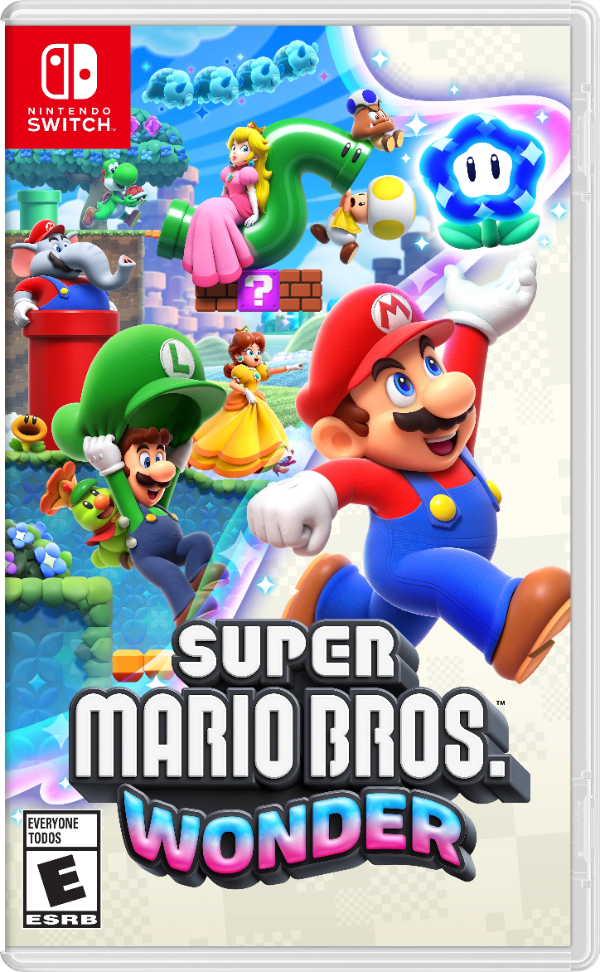
Box Art & Logo
Box art and logo for Super Mario Bros. Wonder.

Reference / Information
More on Super Luigi Bros.
Media / Downloads
Screenshots and artwork appear throughout the sections above. Additional footage is in the Videos section.
Nintendo Switch 2 Edition + Meetup in Bellabel Park
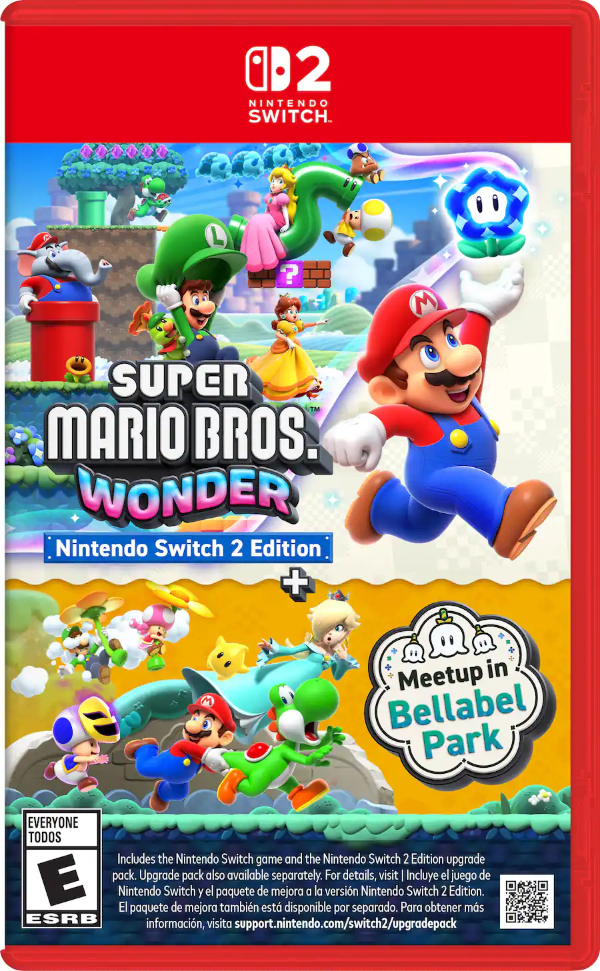
On 26 March 2026, Nintendo released Super Mario Bros. Wonder – Nintendo Switch 2 Edition + Meetup in Bellabel Park as the headline software release for the Super Mario Bros. 40th Anniversary celebration. First announced in the September 2025 Nintendo Direct, the release is an enhanced re-issue of the original 2023 Switch game (covered above) with a major new content expansion and substantially expanded multiplayer support.
The “Switch 2 Edition” half delivers the expected technical upgrades — 4K docked output, smoother framerate, faster load times — plus a new amiibo support layer. The “+ Meetup in Bellabel Park” half is the more interesting half: an entirely new themed social/exploration space called Bellabel Park, several new playable characters, new bosses and enemies, additional power-ups and badges, and new multiplayer modes that scale up to twelve players simultaneously.
New playable characters

The expanded roster is the headline draw for returning players. Rosalina joins the playable cast with Co-Star Luma as her partner — a callback to the Co-Star multiplayer mode from Super Mario Galaxy 2. Several members of the Toad Brigade (Captain Toad, Plucky, Blue Brigade Toad, Mail Toad / Purple Brigade Toad) are also newly playable. The total playable count expands substantially over the original game’s already-generous roster.


Bellabel Park: the new social space
Bellabel Park is the new themed exploration area at the heart of the expansion. The Park is structured as two sub-areas: Attraction Central (a more curated entertainment-park region with set-piece attractions) and Camp Central (a more open social hub for player gatherings). Both sub-areas serve as hubs for the expanded multiplayer modes and host new collectibles, badges, and characters that don’t appear in the original game.

New residents of the Park include the Poplin community in expanded form (Recruit Poplin, Florist Poplin, Curious Poplin, and a marching Poplin Band), Tip-Tap enemies, and a wider supporting cast of NPCs and creatures.


Expanded multiplayer
The Switch 2 Edition substantially expands the multiplayer scope. The original game supported up to 4 players locally; the Switch 2 Edition now supports up to 12 players simultaneously via Local Wireless Play, LAN Play, or Online Play. GameShare enables 2–4 players to play cooperatively over a single owned copy, both locally and online — making it one of the largest-scale GameShare implementations Nintendo has shipped.