
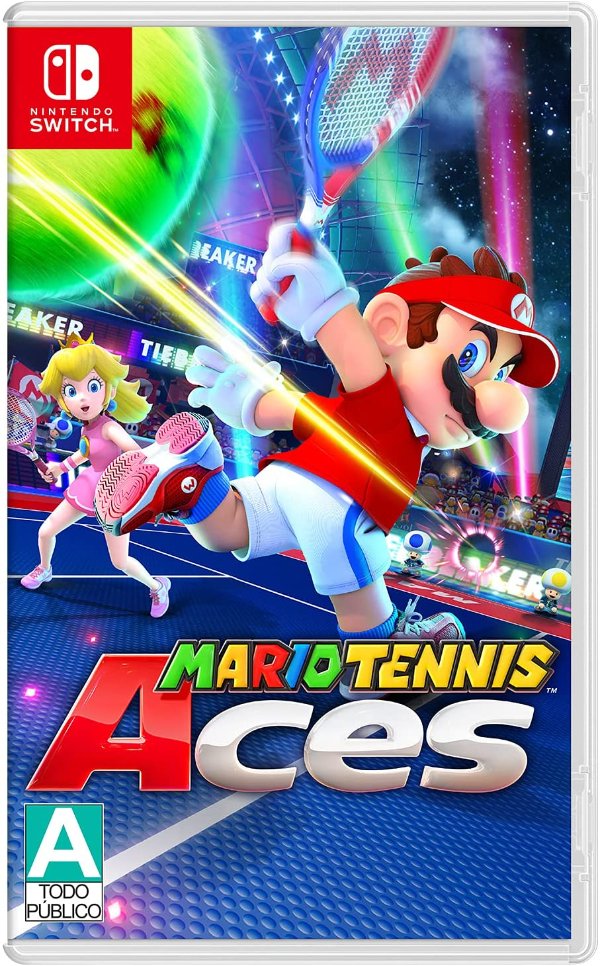
Mario Tennis Aces
Overview

Mario Tennis Aces is the seventh main entry in Nintendo and Camelot Software Planning’s long-running Mario Tennis franchise, released worldwide on 22 June 2018 exclusively for Nintendo Switch. It is the most mechanically deep, content-rich, and successful Mario Tennis ever produced — a direct response to the well-received-but-content-thin Mario Tennis: Ultra Smash (Wii U, 2015) and a deliberate attempt to make Mario Tennis a genuine evergreen Switch sports title.
The game was developed by Camelot Software Planning, the Tokyo-based studio behind every Mario Tennis title since Mario Tennis on the N64 (2000), plus the entire Mario Golf franchise. Camelot’s reputation rests on injecting genuine mechanical depth into sports games that other studios would build as casual party titles — and MTA is the apotheosis of that philosophy.
The Headline Features
- Adventure Mode — a full single-player campaign with story, bosses, racket levelling, and unlockable courts. The first MT campaign mode since Mario Tennis: Power Tour (GBA, 2005).
- Zone Shot system — a slow-motion targeted shot that lets players aim shots at specific spots in the opposing court. A new strategic layer on top of basic tennis.
- Special Shot system — character-unique super moves that can break opponent rackets. Each character has a thematic Special Shot animation.
- Racket durability — rackets take damage from blocked Zone Shots; a broken racket means an immediate loss. Adds a fighting-game-style guard meter to tennis.
- Six character play styles — All-Around, Speedy, Powerful, Defensive, Tricky, Technical — each with different stats and movement quirks.
- 30+ characters via free DLC — 16 at launch, expanded with 12+ free post-launch additions across 2018–2019 online tournament events.
- Swing Mode — motion-controlled play using Joy-Cons as virtual rackets. The “Wii Tennis” mode for casual players.
Story

The Cursed Racket
The Adventure Mode’s narrative centers on a cursed magical racket called Lucien — an ancient artifact with the power to possess anyone who wields it and corrupt them into a dark-energy version of themselves. The story opens with Mario, Peach, and Toad attending the prestigious Tennis Academy when Lucien appears, and Wario and Waluigi are immediately corrupted by it.
The Quest for the Power Stones
The only way to defeat Lucien is to gather the five legendary Power Stones hidden across the Tennis Kingdom — ancient artifacts that grant the wielder enough power to break Lucien’s curse. Mario sets out on a tennis quest across multiple regions, each themed around a different setting and culminating in a boss battle.
The Five Regions
- Piranha Plant Forest — a verdant forest infested with giant Piranha Plants. Boss: Petey Piranha.
- Mirage Mansion — a haunted house full of mirror reflections. Boss: Madame Mirage / a Mario mirror-image.
- Snowfall Mountain — a frozen peak with icy hazards. Boss: a giant snowman-themed adversary.
- Bask Ruins — a desert sand kingdom with ancient ruins. Boss: a sphinx-themed adversary in the Kingdom of Bask.
- Marina Stadium — a beachfront tennis stadium. Boss: an octopus-themed adversary attacking the courts.
The Lucien Showdown
After collecting all five Power Stones, Mario confronts Lucien itself in the final showdown — a multi-phase boss battle against the racket-spirit, which uses Wario’s and Waluigi’s possessed bodies as proxies. Victory frees the corrupted characters, restores peace to the Tennis Kingdom, and unlocks Lucien-possessed character variants for use in other modes.
Gameplay
The core tennis simulation in MTA is Camelot’s most refined ever. The basic rules follow real tennis — serve, return, win games and sets — but everything is layered with Mario-themed power mechanics that have no real-world equivalent.
The Basic Tennis Loop
- Serve — hold the serve button, time the release for power and accuracy. Aces are possible with perfect timing.
- Rally — hit returns with one of 4 base shot types (Topspin/Slice/Flat/Lob), timing presses to add power and direction.
- Movement — standard 8-direction movement with stick-press dashes for emergency reach.
- Score — standard tennis scoring (15, 30, 40, game) or simplified score-to-7 in casual modes.
The Energy Gauge
MTA introduces a charging Energy Gauge that fills as players perform successful actions — hitting clean returns, executing Trick Shots, blocking Zone Shots. A full gauge unlocks Zone Shots, Zone Speed, and Special Shots. Managing the gauge becomes the strategic heart of MTA at high levels.
Difficulty Curves
Adventure Mode’s difficulty scales gradually — early forest matches are beatable with basic tennis, but Bask Ruins and the final Lucien fight require mastery of Zone Shots, Trick Shots, and racket management. Free Play and Online modes scale automatically based on your skill level.
Shot Types
Mario Tennis Aces has four base shot types, plus the three power-shot variants. Mastering when to use which is the foundation of competitive play.
Base Shots
- Topspin — high-arc shot with forward spin. Lands deep but bounces high. Y button on Switch.
- Slice — low backspin shot. Lands short with a low bounce. Good for forcing opponents forward.
- Flat — straight power shot with no spin. Fastest but most predictable. A button.
- Lob — high arching shot that lands deep. Used to push opponents back from the net.
Power Shot Variants

Defensive
Trick Shot
Lunge dive to reach distant balls. Builds energy gauge if successful. Mistimed Trick Shots leave the player stuck on the ground. Peach’s Trick Shot has a signature ribbon animation.

Offensive
Zone Shot
Slow-motion aimed shot. Time slows briefly, an aiming reticle appears, and the shot lands exactly where pointed. Costs energy gauge. The signature MTA mechanic.

Ultimate
Special Shot
Character-unique super move. Full screen animation, racket-breaking power. Costs full energy gauge — a one-shot-kill if it lands, but easily blocked.

Example
Trick Shot (Peach)
Peach’s signature pink-ribbon Trick Shot animation. Each character has a unique Trick Shot pose with bespoke animation.
Zone & Special Shots

Zone Shot — The Signature Mechanic
Zone Shot is MTA’s headline new mechanic. When you have at least half an energy gauge, holding ZL/ZR when receiving a ball triggers a slow-motion sequence: time briefly slows, a precise aiming reticle appears over the opposing court, and you can position the shot exactly where you want it to land. Hold the press to release. The shot lands at your aimed position with extreme speed.
Defending Against Zone Shots
Zone Shots are deadly but defensible. The defender can press the block button at the precise moment of impact to block the shot. If they fail, the ball passes through them and they lose the point. If they succeed, the block deals damage to the defender’s racket (1–2 hits typically) but neutralizes the Zone Shot. Repeated successful blocks against high-energy opponents eventually break the racket.
Special Shot — The Ultimate Move

When the energy gauge is completely full, you can trigger a Special Shot — a character-unique super move with full screen animation. Each character has thematic Special Shot animations: Mario’s involves fire flowers, Luigi’s Poltergust ghosts, Peach’s pink hearts, Bowser’s shell-spin, Rosalina’s cosmic Lumas, Blooper’s ink cloud.
Special Shots can break opponent rackets in 1–2 hits if blocked. If undefended, they’re an instant winner. They’re also visually spectacular — the cinematic moment of any MTA match.
Rackets & Durability
Rackets aren’t cosmetic in MTA — they’re a resource. Each character carries 3 rackets per match, and successful Zone Shot blocks chip away at racket durability. A racket break is a permanent loss of that racket; lose all 3 and you forfeit the match instantly.
Racket Types (Adventure Mode Unlockables)

Mario’s Racket
The default starter racket. Balanced stats. Awarded at game start.

Wooden Racket
Heavier, harder to break. Slightly slower swing speed but greater durability.

Mirror Racket
Reflects opponent Zone Shots more easily. Won from Mirage Mansion.

Ice Racket
Cold-themed power racket. Snowfall Mountain reward.

Shell Racket
Koopa-shell themed defensive racket. Solid block resistance.

Flame Racket
Fire-themed offensive racket. Higher power but lower durability.
Racket Break Visual

When a racket breaks, MTA shows a slow-motion shatter animation — the racket splinters in mid-air, the character reacts in shock, and the match continues with one fewer racket. The visual effect is genuinely satisfying and adds dramatic stakes to high-energy exchanges.
Six Play Styles
Every MTA character belongs to one of six play styles, which determine their base stats, movement quirks, and best-fit playstyle. The play style is the most important factor when choosing a character for competitive play.
The Six Play Styles
- All-Around — balanced stats across the board. No major strengths, no major weaknesses. Mario, Daisy, Luigi.
- Speedy — high movement speed and fast swing animations. Trades raw power for court coverage. Toad, Yoshi, Toadette, Koopa Troopa.
- Powerful — maximum shot power but slower movement. Heavy hitters who turn rallies into one-shot kills. Bowser, Wario, Donkey Kong, Petey Piranha, Chain Chomp.
- Defensive — superior racket durability and long reach. Built to outlast opponents in racket-attrition battles. Waluigi, Rosalina, Birdo, Dry Bowser.
- Tricky — unusual ball physics, deceptive shots that curve, spin oddly, or bounce unexpectedly. Hard to read. Boo, Peach, Pauline, Kamek, Dry Bones, Luma.
- Technical — high precision aim, accurate Zone Shots, refined trick mechanics. The chess players of MTA. Toadette (alt), Diddy Kong, Paratroopa.
30+ Characters

MTA launched with 16 playable characters and expanded to 30+ via free post-launch DLC across 2018–2019. The full roster spans the entire Mario universe: classic heroes, classic villains, supporting cast, and a wide variety of enemy characters promoted to playable status.
Launch Roster (16 Characters)

Mario
All-Around

Luigi
All-Around

Peach
Tricky

Daisy
All-Around

Yoshi
Speedy

Bowser
Powerful

Bowser Jr.
Technical

Wario
Powerful

Waluigi
Defensive

Rosalina
Defensive

Donkey Kong
Powerful

Toad
Speedy

Toadette
Technical

Boo
Tricky

Spike
Powerful
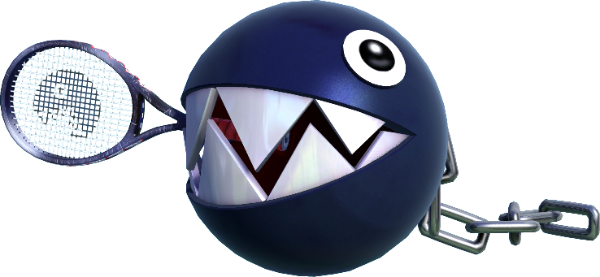
Chain Chomp
Powerful
DLC Characters (~14 Post-Launch Additions)

Blooper
Tricky

Diddy Kong
Technical

Koopa Troopa
Speedy

Birdo
Defensive

Koopa Paratroopa
Technical

Pauline
Tricky

Petey Piranha
Powerful

Shy Guy
Speedy

Boom Boom
Powerful

Dry Bones
Tricky

Kamek
Tricky

Luma
Tricky

Fire Piranha Plant
Powerful

Dry Bowser
Defensive
DLC Waves
MTA received monthly DLC drops through most of 2018 and 2019, each adding 1 new character via a free online tournament unlock event. The full timeline:
2018 DLC Waves
- July 2018 — Blooper (Online Tournament Demo participation reward).
- August 2018 — Diddy Kong (August Online Tournament reward).
- September 2018 — Koopa Troopa (September Online Tournament reward).
- October 2018 — Birdo (October Online Tournament reward).
- November 2018 — Koopa Paratroopa (November Online Tournament reward).
- December 2018 — Petey Piranha (December Online Tournament reward).
2019 DLC Waves
- January 2019 — Shy Guy.
- February 2019 — Boom Boom.
- March 2019 — Pauline (carrying her Super Mario Odyssey momentum).
- April 2019 — Dry Bones.
- May 2019 — Kamek.
- July 2019 — Dry Bowser.
- September 2019 — Fire Piranha Plant.
- December 2019 — Luma (the final post-launch character).
Adventure Mode

Adventure Mode is MTA’s flagship single-player campaign — a structured journey across five themed regions, each with its own court types, hazards, mini-challenges, and a region boss. Adventure Mode takes 10–12 hours to complete on a first playthrough and serves as the long tutorial that teaches all MTA’s systems.
How It Works
- Map navigation — Mario walks across each region’s map, choosing which match/challenge to attempt next.
- Match types — standard tennis matches against story characters, special challenges (hit X targets, win without your racket breaking), boss battles.
- Levelling system — Mario gains experience and levels up; each level increases base stats.
- Racket unlocks — each region rewards a new racket (Wooden, Mirror, Ice, Shell, Flame).
- Court unlocks — each region’s courts become available in Free Play after completion.
Region Structure
Each region has a similar 4-act structure: opening exposition match → 2 mid-region challenge matches → a sub-boss → a region boss with full cinematic. Completing all 5 regions unlocks the final Lucien showdown sequence at the Tennis Academy.
Adventure Bosses
Adventure Mode’s five regions each climax with a distinct boss fight — not a tennis match but a tennis-themed boss encounter against an oversized adversary.

Piranha Plant Forest
Petey Piranha
A giant Piranha Plant boss with rotating leaves. Petey spits acid balls and slams the court with his pots. Players must time blocks against his telegraphed Special Shot patterns.

Mirage Mansion
Madame Mirage
The mirror-mansion ghost boss. Splits into multiple mirror reflections, forcing players to identify the real opponent among illusions. Memorable for its surreal court layout shifts.

Endgame Tennis Academy
Mechakoopa Army
The mechanical Bowser-Jr-piloted Mechakoopa wave waves Mario must defeat before the final Lucien showdown. Multi-phase attrition fight.

Story Mode
Kamek (Side Match)
Kamek appears as a story-driven matched opponent. Magical projectile shots that curve unpredictably. Tests Tricky-shot defence.

Bonus Arena
Petey Piranha (Arena Mode)
Petey’s rematch challenge in non-Adventure content. Higher difficulty, more aggressive AI patterns.
The Final Boss — Lucien


The Lucien finale plays as a multi-phase boss sequence: Mario faces Lucien-possessed Luigi, then Lucien-possessed Wario, then Lucien-possessed Waluigi, with the cursed racket as the actual final form. Each Lucien-corrupted character uses dark-energy variants of their normal Special Shots. After defeating all three, Lucien itself emerges for one last duel.
Courts & Surfaces
MTA features multiple court surfaces that affect ball physics — grass (faster ball, lower bounce), clay (slower ball, higher bounce), hard (balanced, neutral). Adventure Mode adds themed courts with environmental hazards.
Standard Court Surfaces — Marina Stadium
Marina Stadium (Grass)

The default grass court. Faster ball speed and lower bounce. Favors all-around play and fast-paced rallies.
Marina Stadium (Clay)

Clay surface for slower ball physics and higher bounce. Favors defensive players and long rallies.
Marina Stadium (Hard)

The hard court — balanced physics. The neutral choice for competitive and tournament matches.
Adventure Mode Themed Courts
Piranha Plant Forest

A forest court with Piranha Plant hazards that swipe at balls during rallies. Adventure Mode first region.
Mirage Mansion

Haunted-mansion court with mirror illusions. Visually disorienting; opponent reflections appear during gameplay.
Snowfall Mountain

Snow-covered alpine court with ice hazards. Reduced traction and snowdrift obstacles affect movement.
Bask Ruins

Desert ruins court with sand pits. Hot-themed Adventure Mode region with mid-rally environmental shifts.
Kingdom of Bask

The Bask Ruins inner court for region completion. Higher difficulty, full-region hazards.
Hazards in Adventure Courts


Swing Mode

Swing Mode is MTA’s motion-controlled play mode — hold a single Joy-Con vertically as if it were a tennis racket, and swing physically to hit the ball. It’s the “Wii Tennis” mode for casual players, optimized for parties and younger players who find button-based controls intimidating.
Mechanics
- Joy-Con orientation — hold a single Joy-Con vertically. Tilt left/right to position; swing to hit.
- Simplified shots — swing speed determines power; angle determines spin (slice, topspin, lob).
- No Zone Shots in Swing Mode — the advanced power systems are disabled to keep it accessible.
- Multiplayer pass-around — up to 4 players sharing 4 Joy-Cons can play in casual rotation.
Camelot designed Swing Mode as a casual entry point. Despite lacking the advanced systems, it’s a fun party mode that captures the Wii Sports Tennis feel on Switch hardware.
Co-Op Challenge

Co-Op Challenge is MTA’s collaborative survival mode — 2 or 4 players cooperate to keep a tennis rally going as long as possible against escalating AI difficulty. Released as a free post-launch update.
Mechanics
- Rally survival — the team must maintain the rally; dropping the ball ends the round.
- Escalating difficulty — AI opponents get faster, harder-hitting, more aggressive as the round progresses.
- Special challenges — themed sub-modes like the Shy Guy Train Tussle (illustrated above) introduce environmental hazards.
- Leaderboards — online ranking by score; weekly/monthly best-team tracking.

The Shy Guy Train Tussle is one of several themed Co-Op events Camelot added through updates — it adds a moving train backdrop and Shy Guy obstacles that interfere with rallies. Other themed Co-Op events include the Bask Ruins desert challenge and the Snowfall mountain challenge.
Boo Hunt

Boo Hunt was a special Halloween 2018 event mode added via free update. Players hit Boo-themed targets that appear on the court in a high-score challenge format — themed for the spooky season but available year-round after release.
The King Boo Boss Variant

Boo Hunt features King Boo as the climactic boss — once the score threshold is reached, King Boo appears as a giant target and players must defeat him with precise shots to claim victory. A simple but charmingly themed bonus mode.
Videos & Trailers
Two verified official Nintendo trailers covering Mario Tennis Aces.
Other Official Marketing
Beyond the verified trailers above, Nintendo ran an extensive marketing campaign through the first half of 2018:
- E3 2018 Trailer — the pre-launch E3 deep dive showcasing Adventure Mode regions.
- Launch Trailer (22 June 2018) — the launch-day celebration trailer.
- Online Tournament Demo — a free playable demo released in late May 2018, the first time Nintendo released a Mario sports demo of this scale.
- Rafael Nadal cross-promotion — the real-world tennis great appeared in promotional content alongside Mario, including a comedic mock-match video.
- Monthly DLC character spotlight trailers — each post-launch character received its own dedicated trailer through 2018–2019.
All trailers can be found on the Nintendo of America YouTube channel by searching “Mario Tennis Aces.”
Reception

Mario Tennis Aces launched on 22 June 2018 to generally favorable reviews — Metacritic in the mid-70s, IGN 8/10, Game Informer 8.5/10, Nintendo Life 8/10, EuroGamer “Recommended” — with universal acclaim for the Adventure Mode return and mechanical depth, balanced against a small contingent of criticism around online stability at launch.
Acclaim
- Adventure Mode return — consistently cited as the headline win. After 13 years without a substantive campaign mode, the genuine 10–12 hour Adventure was the franchise feature reviewers had been asking for.
- Zone Shot mechanic — the slow-motion aiming system was praised as a fresh, well-implemented new layer that didn’t break tennis fundamentals.
- Special Shot & racket break — the fighting-game-style super move + guard mechanic was called “one of the most original sports mechanics of the year.”
- Roster depth — 16 launch characters spanning 6 play styles gave genuine mechanical variety, not just cosmetic skins.
- Visual presentation — Camelot’s character animations and court designs were widely praised; the cinematic Special Shot animations in particular drew rave coverage.
- Free DLC strategy — reviewers retroactively praised the 18-month monthly free DLC support as the most generous Mario sports model in years.
Criticisms
- Online stability at launch — server issues in the first weeks; lag spikes and dropped matches. Improved significantly with the August 2018 patch.
- Adventure Mode difficulty spikes — the Snowfall Mountain region and Lucien finale were considered punishingly difficult by some players.
- Tournament Mode lacked depth — the offline tournament structure was felt to be thinner than expected given Adventure Mode’s richness.
- Swing Mode imprecise — some reviewers noted Swing Mode’s motion controls lacked the precision of button-based play; better as a party novelty than a serious mode.
Sales
Sales Performance
- Launch week (22–28 June 2018) — strong opening: #1 in Japan launch charts (167k physical first week); UK debut at #2; US #2 behind Mario Kart 8 Deluxe (which was over a year old).
- End of September 2018 (Q2 fiscal report) — 2.18 million copies sold worldwide, per Nintendo’s Q2 financial briefing — the best Mario Tennis launch quarter in 11 years.
- End of December 2018 — 3.50 million copies. Strong holiday performance.
- End of March 2019 — 3.94 million. Consistent long-tail performance through Switch’s installed-base growth.
- Lifetime (as of 2024 Nintendo financial reports) — over 5 million copies sold. The best-selling Mario Tennis ever and one of the strongest Switch sports titles.
Context
For comparison: Mario Tennis: Ultra Smash (Wii U, 2015) sold approximately 700k copies lifetime. MTA outsold its predecessor more than 7x. It also surpassed every previous Mario Tennis title in lifetime sales — a clear commercial mandate for the franchise’s deeper-content direction.
Trivia & Facts
- First Mario Tennis with a campaign since 2005 — the previous Adventure-style Mario Tennis was Mario Tennis: Power Tour (GBA, 2005). MTA’s Adventure Mode ended a 13-year campaign drought.
- Camelot Software Planning developed every Mario Tennis since Mario Tennis (N64, 2000) and every Mario Golf since Mario Golf (N64, 1999) — they’re the Mario sports specialists.
- 16 launch characters, 30+ via free DLC — the largest roster expansion of any Mario Tennis title.
- Rafael Nadal appeared in promotional content as a real-world tennis crossover — Mario vs Nadal was a comedic launch-week marketing piece.
- Online Tournament Demo in May 2018 was Nintendo’s first major Switch sports playable demo — a precedent later followed by Splatoon and other Switch titles.
- Zone Shot mechanic was inspired by Camelot’s love of fighting-game super moves — the studio publicly mentioned Street Fighter and Smash Bros as inspiration for the racket-break mechanic.
- The 6 play styles (All-Around, Speedy, Powerful, Defensive, Tricky, Technical) were borrowed from Camelot’s earlier Mario Power Tennis (GameCube, 2004), but with rebalanced stat distributions.
- Petey Piranha is the only DLC character who is also an Adventure Mode boss — you fight him in the campaign before being able to unlock him as a playable character.
- Lucien-possessed character icons for Luigi, Wario, and Waluigi exist in the game files but are not directly playable in standard modes — they’re Adventure Mode boss variants only.
- Blooper became playable via the post-launch Online Tournament Demo — simply participating in the demo unlocked Blooper permanently.
- Luma was the final DLC character added in December 2019 — after Luma, Camelot moved on to Mario Golf: Super Rush (2021) and Mario Strikers: Battle League (2022).
- Shy Guy has 5 color variants (red, blue, green, yellow, orange, pink) that are pure cosmetic choices.
- Yoshi has 5 color variants (red, blue, yellow, orange, pink) for personalization.
- Chain Chomp has 4 cap color variants (default, red, yellow, green).
- Pre-release Mario art shows Camelot considered Mario in Ultra Smash overalls before settling on his classic tennis whites.
Box Art & Key Visuals
Box art, logos, and key visuals for Mario Tennis Aces.


Reference / Information
Related coverage on Super Luigi Bros.
Media / Downloads
Character renders, court screenshots, Adventure Mode region art, and boss imagery appear throughout the sections above. The 2 verified Nintendo trailers are in the Videos section.