
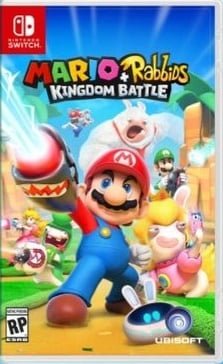
Mario + Rabbids Kingdom Battle
Overview

Mario + Rabbids Kingdom Battle is a turn-based tactical RPG developed by Ubisoft Milan with assistance from Ubisoft Paris, published by Ubisoft and released on 29 August 2017 as a Nintendo Switch exclusive. The game represents one of the most unlikely third-party crossovers in Nintendo history — a marriage of the wholesome Super Mario franchise with Ubisoft’s anarchic Rabbids series, structured as a deep tactical-strategy game in the vein of XCOM and Valkyria Chronicles.
The result was a critical and commercial breakout. Reviewers praised the genre experimentation, the chemistry between Mario’s cast and the Rabbid analogues, the surprisingly deep cover-based combat system, and Grant Kirkhope’s standout soundtrack. Commercially, the game has sold over 10 million copies lifetime — a remarkable performance for a strategy game on a Nintendo console, and a vindication of the Switch’s ability to host genre-experimental third-party titles.
The Headline Features
- Turn-based tactical RPG combat — the first tactics game in the Mario franchise. Cover-based shooting, character positioning, action-point management, and team synergies define every encounter.
- 8 playable heroes at launch — Mario, Luigi, Peach, and Yoshi from the Super Mario cast, paired with their Rabbid analogues (Rabbid Mario, Rabbid Luigi, Rabbid Peach, Rabbid Yoshi). Each hero has a unique weapon, ability, and skill tree.
- 4 distinct themed worlds — Ancient Gardens (forest), Sherbet Desert (frozen tundra), Spooky Trails (haunted swamp), and Lava Pit (volcano). Each with unique enemy types, environmental hazards, and visual identity.
- Beep-0 — the player-controlled robotic assistant. In overworld sections, Beep-0 leads the heroes through puzzles, treasure hunts, and exploration before combat begins.
- Weapon and skill tree customisation — each hero has 2 weapon types (primary + secondary), unlocked through purple-coin currency, plus an extensive skill tree branching into Movement, Health, and Combat upgrades.
- 5 major boss battles — Pirabbid Plant, Rabbid Kong, Phantom of the Bwahpera (a literal Mario opera boss), Icicle Golem, and the Lava Queen, culminating in the Megabug final encounter.
- Grant Kirkhope soundtrack — the composer behind Banjo-Kazooie, GoldenEye 007, and Donkey Kong 64 returned to write the original score. The “Phantom of the Bwahpera” boss theme became one of the most-quoted game music tracks of 2017.
- Donkey Kong Adventure DLC (June 26, 2018) — added DK and Rabbid Cranky as playable heroes, plus an entirely new banana-themed campaign island with original story.
The Unlikely Crossover
The Mario × Rabbids crossover concept began at Ubisoft Paris in 2010 as a pitch for a Mario/Rabbids action-adventure game for the Wii. Nintendo rejected the original pitch. The idea was shelved for several years until Davide Soliani and his team at Ubisoft Milan revived the concept around 2014, repositioning it as a tactical-strategy RPG with Mario’s established cast.
The Development Story
- 2010 — Ubisoft Paris pitches a Mario/Rabbids adventure-platformer crossover for the Wii. Nintendo declines.
- 2014 — Davide Soliani and Ubisoft Milan revive the concept as a tactical RPG. The new pitch wins Nintendo approval.
- March 2015 — Nintendo and Ubisoft enter into a formal development partnership. Ubisoft Milan begins production.
- June 2017 (E3) — The game is publicly revealed during Ubisoft’s E3 press conference. Director Davide Soliani tearfully takes the stage — the now-iconic moment that crystallised the gaming press’s emotional connection to the project.
- August 2017 — Game releases worldwide. Sales and critical reception exceed Ubisoft’s internal forecasts.
- June 2018 — Donkey Kong Adventure DLC releases.
The Leak That Backfired
In May 2017 — one month before the E3 reveal — promotional artwork for Mario + Rabbids Kingdom Battle leaked online. The leaked image showed Mario, Luigi, Peach, and Yoshi alongside their Rabbid analogues, all wielding cartoonish blaster weapons against a Mushroom Kingdom backdrop. The internet response was overwhelmingly negative — critics called the concept a “Mario gun game” and lambasted Nintendo’s creative direction.
The actual E3 2017 reveal one month later — with full gameplay demonstrations, Davide Soliani’s emotional appearance, and Shigeru Miyamoto endorsing the project on stage — completely reversed public opinion. The leaked artwork that had been criticised became iconic marketing imagery for the launch.
Story

Story Setup
The story opens in an alternate present-day Earth. A young inventor known as Genius Girl develops the SupaMerge, a device capable of fusing two objects into a hybrid combination. A washing machine in her workshop functions as an interdimensional portal to the Rabbid world, and a group of Rabbids stumbles through it into her lab.
One Rabbid (later called Spawny) discovers the SupaMerge and accidentally activates it, fusing himself with various Mario merchandise scattered around the workshop. The device’s chaotic energy then merges the entire Rabbid world with the Mushroom Kingdom — creating a corrupted version of Peach’s realm overrun with Rabbid-fused enemies and warped versions of the heroes.
The Heroes’ Quest
Mario discovers the merged Mushroom Kingdom and is joined by Beep-0, a robotic assistant from Genius Girl’s lab. Together they recruit Luigi, Princess Peach, and Yoshi, plus the four “Rabbid heroes” (Rabbid Mario, Rabbid Luigi, Rabbid Peach, Rabbid Yoshi), each of whom is a Rabbid that has fused with one of the Mario cast’s identities.
Beep-0 reveals that the chaos is caused by Megabug, a corrupted form of the SupaMerge energy that has taken physical form as a swarming entity. The heroes must travel through 4 corrupted worlds, defeat the bosses created by SupaMerge’s influence, and reach Megabug’s sanctum to restore the kingdom.


The Antagonist Trio
- Spawny — the rogue Rabbid who triggered the catastrophe. Initially feared as a villain, eventually revealed to be a frightened child of sorts. Recurring motif throughout the campaign.
- Bowser Jr. — unexpectedly aligned with the chaos in the merged Mushroom Kingdom. Acts as a mid-game antagonist commanding Rabbid forces.
- Megabug — the corrupted essence of SupaMerge energy. Manifests as a growing parasitic swarm. The final boss of the main campaign.
Tactical Gameplay
Mario + Rabbids Kingdom Battle’s combat system blends the deepest elements of XCOM-style tactical combat with Mario-franchise accessibility. Each encounter takes place on a grid-based tactical map where the player controls a team of 3 heroes against AI-controlled enemies.
Combat Structure
- Grid-based positioning — the battlefield is divided into hexagonal/square tiles. Movement, cover usage, and attack ranges all depend on tile relationships.
- Action Points (AP) — each hero has a fixed number of actions per turn: 1 movement, 1 attack, and 1 skill. Smart AP usage is the foundation of tactical depth.
- Cover system — partial cover (50% hit reduction) and full cover (100% hit reduction). Knocking down cover with attacks is a key tactical tool.
- Team Jumps — heroes can use teammates as launchpads to leap further across the map. Coordinated team jumps enable rapid map traversal and surprise attacks.
- Dashes — each hero can dash through enemies during movement, dealing damage and pushing them. Strategic dashing chains create combo opportunities.
- Overwatch — heroes can save actions for “Hero Sight” reactive attacks that trigger when enemies move into range. The defensive counterplay.
- Super Effects — enemy weapons cause status effects (Burn, Bounce, Honey, Push, Vamp, Ink, Stone, etc.). Heroes have weapon variants that apply or resist these.
Mission Objectives
- Defeat all enemies — the standard combat mission. ~60% of encounters.
- Reach the goal — navigate the map to a specific tile (often through enemy territory). Mid-game gauntlet missions.
- Escort the chest — protect Beep-0 or an NPC as they navigate the map. Defensive scenarios.
- Survive X turns — endure waves of enemies for a specified duration. Late-game tension-building.
- Defeat the boss — the major encounter format, with multi-phase boss patterns.
The Mario Quartet
Mario + Rabbids Kingdom Battle’s playable roster consists of 8 heroes at launch, organised as 4 Mario-cast paired with 4 Rabbid analogues. Each hero has a unique playstyle, weapon archetype, skill tree, and tactical role within the 3-hero team composition.
The Mario Cast (4 Heroes)

Mario
HeroDual blaster + Hero Sight overwatch — the balanced all-rounder

Luigi
HeroSniper specialist + Steely Stare — long-range threat eliminator

Peach
HeroTriple-Shot blaster + Team Heal — the support healer

Yoshi
HeroAOE Boomshot + Bounce — area damage and crowd control
The Rabbid Quartet
The Rabbid Heroes are the SupaMerge-fused counterparts of the Mario cast — Rabbids that absorbed Mario, Luigi, Peach, and Yoshi’s essence and gained their own twisted versions of those characters’ abilities. Each plays as a counterpart to their Mario equivalent but with chaotic, exaggerated personality and unique tactical flavor.
The Rabbid Quartet (4 Heroes)

Rabbid Mario
HeroMagnet Dance + Rumblebang — close-range melee specialist

Rabbid Luigi
HeroBworb + Vamp Dash — status-effect specialist

Rabbid Peach
HeroBodyguard + Group Heal — selfie-loving healer

Rabbid Yoshi
HeroMecha-rocket Boomshot + Mecha-jump — AOE specialist
Rabbid Heroes — The Breakout Stars
- Rabbid Peach emerged as the breakout character of the game. Her selfie-stick weapon, Instagram-account character beats, and complete obliviousness to danger made her the cover-art mascot for the entire franchise. She would go on to appear in Mario + Rabbids Sparks of Hope, Tour the Marvel Mash-up tournaments, and various Ubisoft promotional material.
- Rabbid Luigi is the most “cowardly” of the Rabbid quartet, mirroring Luigi’s personality but exaggerated. His Vamp Dash ability — drains health from enemies on dash-through — makes him an offensive-defensive hybrid.
- Rabbid Mario is the team’s aggression engine. His Magnet Dance ability pulls in nearby enemies, then his Rumblebang shotgun deals devastating close-range damage. Rabbid Mario specialists love the “lunge into the heart of the encounter” playstyle.
- Rabbid Yoshi is the team’s long-range artillery. His Mecha-rocket weapon launches arcing rocket-bombs over cover, making him a key counter-cover specialist. His Mecha-jump ability lets him traverse otherwise-impossible distances.
Weapons & Skill Trees

Weapon System
Each hero wields 2 weapons in combat — a primary attack-focused weapon and a secondary utility weapon. New weapons are unlocked through purple-coin currency earned from missions and exploration treasures. Each weapon variant has different damage, range, accuracy, ammo, and Super Effect properties.
Weapon Categories
- Blasters — Mario, Rabbid Mario’s primary. Medium range, balanced damage, occasional Burn Super Effect variants.
- Snipers — Luigi’s specialty. Long range, high accuracy, devastating against high-HP enemies.
- Triple-Shots / Triple-Bsts — Peach’s primary. 3-shot burst weapons with reduced accuracy but increased coverage.
- Boomshots — Yoshi, Rabbid Yoshi’s primary. AOE explosive weapons that hit multiple enemies in radius.
- Rumblebang shotguns — Rabbid Mario’s primary. Close-range only, devastating against grouped enemies.
- Yoshimite — Yoshi’s secondary. The Mario reference: a ground-pound device that creates damaging shock waves.
- Bworbs — Rabbid Luigi’s utility. Throwable explosive bombs with status-effect properties.
- Hammers — generic close-combat backup melee weapons available to multiple heroes.
Skill Trees
Each hero has a 3-branched skill tree:
- Movement — increases dash damage, Team Jump count, dash distance, and Team Jump utility.
- Health & Defense — maximum HP, cover bonuses, status-effect resistances.
- Combat Skills — unique to each hero. Mario’s Hero Sight overwatch, Peach’s Bodyguard team-heal, Rabbid Peach’s Bodyguard team-protection, Rabbid Yoshi’s Mecha-jump, etc.
The 4 Worlds
Mario + Rabbids Kingdom Battle’s campaign is divided into 4 distinct worlds, each with its own visual theme, enemy variants, environmental hazards, exploration mechanics, and multi-phase boss encounter. The worlds progress in difficulty from beginner-friendly Ancient Gardens through the tactically demanding Lava Pit.
The 4 Worlds
- World 1 — Ancient Gardens — a forest-themed beginner zone. Tutorialised difficulty curve, introduces all core mechanics. Pirabbid Plant mid-boss, Rabbid Kong final boss.
- World 2 — Sherbet Desert — a frozen tundra zone. Introduces ice-floor mechanics, slippery cover, and the Phantom of the Bwahpera (the musical opera boss). Icicle Golem final boss.
- World 3 — Spooky Trails — a haunted swamp zone. Introduces Peek-A-Boo enemies (invisible until adjacent), darkness mechanics, and ghost-themed encounters. Calavera boss encounter.
- World 4 — Lava Pit — a volcanic island zone. Introduces lava-floor hazards, height-based combat, and Lava Queen final boss. Culminates in the Megabug encounter.
Worldwide Design Patterns
- Hub overworld + battle pockets — each world has an explorable overworld (puzzles, treasure hunts, environmental storytelling) with battle encounters triggered at specific points.
- Beep-0 puzzles — between combat, Beep-0 guides Mario’s team through environmental puzzles. Color-coded blocks, button-sequences, item retrieval.
- Treasure caches — hidden side-paths reward exploration with weapon-purchase coin caches, weapon variants, and concept-art collectibles.
- Easy/Normal/Hard difficulty — per-encounter difficulty selection. Higher difficulties scale enemy HP/AP and turn limits. The “Ultra Hard” mode (added DLC) is for endgame veterans.
World 1 — Ancient Gardens
Ancient Gardens
The Ancient Gardens is the introductory world — a corrupted version of Peach’s Castle gardens, overrun with Rabbid-fused enemies emerging from chrysalises. Visually evokes pre-N64 Mario aesthetics: stone arches, ornamental hedges, and broken statues of past Mario characters. The first world introduces every core combat mechanic: cover, dashes, team jumps, overwatch, and the basic enemy types.
Enemy Roster

Ziggy
Basic ranged attacker

Hopper
Close-range melee strike

Smasher
High-HP heavy attacker
Major Encounters
- Pirabbid Plant — the mid-world boss. A Rabbid fused with a Piranha Plant. Uses spike-spam attacks and emerges from soil tiles around the arena. Tutorial boss — introduces the multi-phase pattern.
- Rabbid Kong — the world finale boss. A Rabbid fused with Donkey Kong’s frame and aggression. The boss arena features destructible cover and Rabbid Kong’s ground-pound attack chain. Multi-phase encounter that uses every mechanic learned in the world.
World Mechanics Introduced
- Basic combat tutorial — cover, attacks, dashes, team jumps.
- Tower switches — Beep-0 puzzles that require routing routes via puzzle-button activations.
- Coin treasure pickups — first encounter with the purple-coin currency for weapon shop purchases.
World 2 — Sherbet Desert
Sherbet Desert
The Sherbet Desert is the frozen tundra world — a corrupted version of an icy mountain region with ice-cream concept art aesthetics. Introduces ice-floor mechanics (where dashes slide further), slippery cover that breaks more easily, and the iconic Phantom of the Bwahpera mid-world boss — a musical opera-themed boss with one of the game’s most-celebrated boss-theme tracks.
Enemy Roster

Sherbet Ziggy
Ranged ice-shot variant

Sherbet Hopper
Slide-jump melee

Sherbet Smasher
Snow-armoured heavy

Sherbet Supporter
Healer / buff enemy

Sherbet Buckler
Shield-bearing tank
Major Encounters
- Phantom of the Bwahpera — the iconic musical boss. A Phantom-of-the-Opera-inspired Rabbid wearing a half-mask and operating a glowing pipe-organ that summons enemy minions. The boss arena is a opera-house stage, and the boss theme (composed by Grant Kirkhope as a full operatic piece, with vocals) became one of the most-quoted boss themes of 2017.
- Icicle Golem — the world finale boss. A massive ice-construct with multi-phase damage states. Uses ice-floor mechanics aggressively — sliding heroes around the arena. Multi-phase encounter spanning ~20 minutes for veteran players.
World Mechanics Introduced
- Ice-floor sliding — dashes and movement continue past their normal limit when on ice tiles. Tactical positioning takes on new dimensions.
- Supporter/Buckler enemy types — introduces enemy variety beyond pure damage — healers and tanks must be prioritised differently.
- Concept-art collectibles — fully-fledged side-content hunting, with the Sherbet Desert ice-pop concept art unlock being one of the most cherished cosmetic rewards.
World 3 — Spooky Trails
Spooky Trails
The Spooky Trails is the haunted swamp world — a graveyard / pumpkin-patch / spooky-forest setting with Beep-0-led environmental puzzles and ghost-themed encounters. Introduces Peek-A-Boo enemies (invisible until adjacent), Valkyrie aerial attackers, and darkness mechanics that obscure enemy positions on the map. Culminates in the Calavera boss encounter.
Enemy Roster

Spooky Ziggy
Spectral ranged

Spooky Hopper
Ghost-jump melee

Spooky Smasher
Tombstone heavy

Spooky Supporter
Spectral healer

Spooky Valkyrie
Aerial flyer

Peek-A-Boo
Invisible until close
Major Encounter — Calavera
Calavera is the Spooky Trails boss — a giant Day-of-the-Dead-themed Rabbid skeleton boss with multi-phase combat. The encounter takes place across multiple connected arenas, with Calavera teleporting between them. Heroes must track him through the map while managing his summoned minion waves.
World Mechanics Introduced
- Peek-A-Boo enemy archetype — the first invisible enemy type. Map awareness becomes critical — enemies pop up adjacent to your heroes if you don’t scout carefully.
- Valkyrie aerials — flying enemies that ignore terrain. Heroes must use ranged weapons and snipers to engage them effectively.
- Tombstone cover — cover that crumbles after taking 2 hits instead of standard 3. Forces dynamic repositioning.
- Darkness vision range limits — limited tile vision creates fog-of-war tension.
World 4 — Lava Pit
Lava Pit
The Lava Pit is the final main-campaign world — a volcanic island setting with lava-flow hazards, height-based combat, and Bowser-themed callbacks throughout. Features the highest difficulty curve of the main 4 worlds, the Lava Queen boss (a Bowser-themed Rabbid queen), and culminates in the Megabug final encounter against the corrupted SupaMerge energy.
Enemy Roster

Lava Hopper
Magma-jump melee

Lava Smasher
Lava-armoured tank

Lava Valkyrie
Fire-attack flyer

Lava Buckler
Volcanic shield tank
Major Encounters
- Lava Queen — the world-finale boss. A Rabbid fused with Bowser’s likeness, wielding a flaming whip. Multi-phase encounter with environmental fire-pillar attacks.
- Megabug — the final main-campaign boss. The corrupted SupaMerge energy manifest as a swarming, multi-form entity. The boss encounter spans multiple combat phases against different Megabug forms.
World Mechanics Introduced
- Lava floors — tiles that deal damage-per-turn. Positioning becomes a constant tactical decision.
- Heat shimmer obscuration — distant tiles become harder to target as battle progresses.
- Multi-tier encounters — the final encounters use elevation, with heroes positioned across multiple height-levels.
- Endgame difficulty curve — Lava Pit encounters demand mastery of every previous mechanic, plus expert team composition and weapon optimisation.
Major Bosses
Mario + Rabbids Kingdom Battle features 5 major boss battles in the main campaign plus 1 additional DLC boss. Each boss is multi-phase with distinct attack patterns, summoned minion waves, and environmental hazards.
The 5 Main Bosses + Megabug Finale
Pirabbid Plant

The first boss — a Rabbid fused with a Piranha Plant. Tutorial boss introducing multi-phase pattern. Spike-spam attacks emerge from soil tiles around the arena.
Rabbid Kong

A Rabbid fused with Donkey Kong. Aggressive ground-pound attacks. Destructible cover throughout the arena.
Phantom of the Bwahpera

The iconic musical boss — Phantom-of-the-Opera-themed Rabbid with a Grant Kirkhope full-operatic boss theme. Pipe-organ summons enemy minion waves.
Icicle Golem

Massive ice-construct boss with multi-phase damage states. Aggressive use of ice-floor sliding mechanics.
Calavera

Giant Day-of-the-Dead skeleton boss. Teleports between connected arenas, summoning minion waves at each location.
Lava Queen

Bowser-themed Rabbid queen with flaming whip attacks. Environmental fire-pillar attacks across the arena.
Megabug

The corrupted SupaMerge energy manifest as a swarming entity. Multi-form final encounter with shifting attack patterns across multiple phases.
Enemy Types
Mario + Rabbids Kingdom Battle features a rich enemy roster scaling across the 4 worlds. Every enemy type appears in multiple world-themed variants, each adapted to that world’s aesthetic and combat mechanics.
Core Enemy Archetypes
- Ziggy — the basic Rabbid grunt. Ranged blaster weapon. Low HP, low damage, found in all 4 worlds.
- Hopper — close-range melee jumper. Uses Team-Jump-style traversal to close gaps quickly. Medium damage.
- Smasher — high-HP heavy attacker. Slow but devastating melee. Tank role.
- Supporter — enemy healer/buffer. Doesn’t attack directly but boosts allies. High-priority elimination target.
- Buckler — shield-bearing tank. Reflects damage when hit from the front. Force positioning around them.
- Valkyrie — flying enemy that ignores ground terrain. Long-range attacks.
- Peek-A-Boo — invisible until adjacent. Tactical surprise threat.
- Bwananas — DK Adventure DLC enemy type. Banana-themed Rabbid variants.
World-Variant Examples
Each archetype appears in 4 world-themed variants (Garden, Sherbet, Spooky, Lava). The Garden Ziggy looks rough-and-ready; the Sherbet Ziggy wears parka clothing; the Spooky Ziggy is spectral; the Lava Ziggy is wreathed in flame.

Donkey Kong Adventure DLC

The Donkey Kong Adventure DLC
Donkey Kong Adventure released on 26 June 2018 as a major paid DLC expansion ($14.99 USD / equivalent). The DLC adds an entirely new campaign island, two new playable heroes, multiple new enemy types, and a new boss — the equivalent of a standalone half-campaign’s worth of content.
New Heroes (2)

Donkey Kong
DLC HeroBanana-throw bombardment + Ground Pound AOE — the heavy bruiser

Rabbid Cranky
DLC HeroCane-based ranged + Stop Time — the grumpy elder support
Story
The DK Adventure story is set on a banana-themed island removed from the main campaign continuity. Spawny and Rabbid Kong (the World 1 boss) have escaped from the main campaign and reformed as Mega Rabbid Kong in an attempt to claim all the bananas on the island. Donkey Kong, alongside the returning Rabbid Peach (joining from the main campaign) and the new Rabbid Cranky character, must stop them.
The Mega Rabbid Kong Final Boss


DLC Features
- Entirely new campaign island — ~8–10 hours of new content beyond the main game.
- 2 new playable heroes — Donkey Kong and Rabbid Cranky, both with full weapon/skill trees.
- Returning Rabbid Peach — the only “carry-over” hero from the main campaign. Continues her selfie-stick / Bodyguard / healer arc.
- New enemy variants — Banana-themed (Bwananas) variants of every existing archetype.
- Mega Rabbid Kong final boss — the evolved-form bonus boss, building on Rabbid Kong’s World 1 design.
- Banana Republic island theme — lush tropical island with banana-tree mechanics and platforming-style overworld puzzles.
The Soliani Story
The story of director Davide Soliani became inseparable from the game’s public reception. Soliani is the lead director of Ubisoft Milan, the studio that ultimately delivered Mario + Rabbids Kingdom Battle.
The Tearful E3 2017 Moment
During Ubisoft’s E3 2017 press conference on June 12, 2017, Davide Soliani took the stage to present the game alongside Shigeru Miyamoto. The presentation included an extended live gameplay demonstration and a public statement from Miyamoto endorsing the project.
Toward the end of the presentation, Soliani became visibly emotional. Standing alongside Miyamoto (whose work he had idolized since childhood), Soliani cried on stage, overwhelmed by the moment. The cameras captured Miyamoto warmly comforting him.
The moment went immediately viral across gaming media. “Soliani crying with Miyamoto” became one of the most-shared E3 2017 highlights, attracting attention not just from gaming press but from mainstream outlets. The emotional vulnerability gave the project a human face that completely changed its public perception.
The Subtext of the Story
Davide Soliani had spent his entire game-development career trying to make a Mario game. Multiple pitches in earlier years had been rejected. Mario + Rabbids Kingdom Battle was, for him, the culmination of a lifelong dream — to direct an officially-licensed Mario title alongside the Mario series’ creator.
His E3 2017 emotional moment became symbolic of the broader Italian developer community’s relationship with Nintendo — a community that had idolised Mario as the franchise of a beloved Italian immigrant character but had never been “let in” to the actual development. Soliani’s success cracked that door open.
Aftermath
Soliani has returned to direct Mario + Rabbids Sparks of Hope (2022), the sequel. He has become one of the most recognised game directors in the Italian developer community, regularly speaking at conferences and game-industry events. His role as a bridge between Nintendo and Ubisoft’s Italian operations is now established and ongoing.
Grant Kirkhope Music
Grant Kirkhope composed the original score for Mario + Rabbids Kingdom Battle — his most prominent video game soundtrack since the late-1990s Rare Studio era. The Kirkhope soundtrack contributed substantially to the game’s critical acclaim.
Kirkhope’s Career Context
Grant Kirkhope is best known as the composer of several legendary Rare Studio Nintendo 64 titles:
- Banjo-Kazooie (N64, 1998) — the seminal Rare platformer soundtrack.
- GoldenEye 007 (N64, 1997) — contributed several tracks to the iconic shooter.
- Donkey Kong 64 (N64, 1999) — including the infamous “DK Rap.”
- Banjo-Tooie (N64, 2000) — the sequel soundtrack.
- Perfect Dark (N64, 2000) — contributed to the Rare spy shooter.
- Viva Piñata (Xbox 360, 2006) — the Rare colony-builder soundtrack.
Kirkhope left Rare after Microsoft’s acquisition and has worked as a freelance composer since the late 2000s. Mario + Rabbids Kingdom Battle was his most high-profile project in nearly a decade.
Standout MRKB Tracks
- “Phantom of the Bwahpera” — the iconic World 2 boss theme. A full operatic piece with vocals, performed in a Phantom-of-the-Opera style. Became one of the most-quoted boss themes of 2017 across gaming media.
- Ancient Gardens Theme — the introductory world theme. Blends Mario nostalgia with new orchestral arrangement.
- Sherbet Desert Theme — the frozen-tundra world theme. Atmospheric and chill.
- Spooky Trails Theme — the haunted-swamp theme. Eerie strings and percussion.
- Lava Pit Theme — the volcanic-finale theme. Intense, brass-heavy escalation.
- Megabug battle theme — the final boss theme with multiple phases reflecting the encounter’s shifts.
- Beep-0’s overworld theme — the overworld-exploration ambient track. Mario-cute and gentle.


Videos & Trailers
Six verified official Ubisoft / Nintendo trailers covering Mario + Rabbids Kingdom Battle from E3 2017 reveal through DK Adventure DLC launch.
Other Marketing
- Regional launch variants — German, French, Italian, Spanish, Korean variants of the launch trailer were released for individual markets.
- Nintendo Direct features — Nintendo highlighted MRKB in multiple Nintendo Direct presentations leading to launch and DLC release.
- Cross-promotional content — Rabbid Peach received her own dedicated Twitter and Instagram accounts run by Ubisoft, building character recognition.
- Soundtrack release — Grant Kirkhope’s score was released on streaming services. The “Phantom of the Bwahpera” track went viral organically.
Reception
Mario + Rabbids Kingdom Battle launched on 29 August 2017 to strong critical reception — Metacritic 85, IGN 9.0/10, Game Informer 9.0/10, Nintendo Life 9/10, GameSpot 9/10, Eurogamer “Recommended” — with universal praise for the unlikely crossover, deep tactical combat, distinct hero identities, Grant Kirkhope soundtrack, and Davide Soliani’s directorial vision.
Acclaim
- Tactical RPG depth in a Mario game — universally praised. Reviewers cited the XCOM-inspired combat as far deeper than any Mario game had ever attempted.
- Hero variety and identity — the 8-hero roster (4 Mario + 4 Rabbid) was praised for unique tactical roles. Each hero played meaningfully differently.
- The crossover surprisingly works — reviewers nearly unanimously remarked that the Mario × Rabbids fusion was tonally cohesive despite expectations.
- Grant Kirkhope soundtrack — the “Phantom of the Bwahpera” theme became a defining single-track moment of 2017 in gaming.
- Davide Soliani direction — critics highlighted the auteur direction. Soliani became one of the most-discussed directors of 2017.
- Comedy timing — Rabbid character beats (particularly Rabbid Peach’s selfie-stick gags) were praised as well-timed and not over-relied-upon.
- Accessibility on Switch — reviewers noted the game ran beautifully in portable mode, making it the first tactical-RPG truly playable on a handheld since the GBA era.
Criticisms
- Difficulty curve uneven — some reviewers found the difficulty inconsistent. World 2 spikes harder than World 3, then World 4 spikes again.
- Beep-0 dialogue can grate — the helper character’s frequent commentary received mixed reactions.
- Story is thin — while the gameplay is deep, the narrative is light. Some reviewers wanted more depth from the antagonist arc.
- Backtracking limited — the linear progression means no late-game backtracking to earlier worlds, missing some optimisation depth.
- Weapon system shallow at endgame — weapon variants become same-y after the mid-game when all the major Super Effects have been unlocked.
Sales & Legacy
Sales Performance
- Launch week (Aug 29–Sept 4, 2017) — #1 in UK launch week; top 5 in US debut; strong Japan launch.
- End of December 2017 — ~1.5 million copies sold worldwide in first 4 months.
- End of March 2018 — ~2 million copies. Strong sustained sales.
- Mid-2018 — Ubisoft reported MRKB as their best-selling Switch title.
- End of 2019 — ~5 million copies.
- End of 2022 (lifetime per Ubisoft reports) — over 10 million copies sold. Among the highest-selling third-party Switch titles of all time.
Context
For franchise context: Mario + Rabbids Kingdom Battle is the best-selling Rabbids game ever made (the previous best, Rabbids Go Home Wii, sold ~3M). It dramatically outperformed Ubisoft’s pre-launch internal expectations, which had targeted ~3M lifetime as a “great result.”
Compared to other Switch third-party tactical RPGs: MRKB ~10M lifetime is far above Fire Emblem: Three Houses (~3M, Nintendo first-party), XCOM 2 Switch port (~1M), Wargroove (~500k), and on par with Pokémon Snap remake (~2M) and the highest-selling Pokémon mainline entries.
Industry Impact
- Mario + Rabbids Sparks of Hope (2022) was directly greenlit by Mario + Rabbids Kingdom Battle’s success. Sparks of Hope launched 5 years later and continued the franchise.
- Rabbid Peach became a Ubisoft franchise mascot independent of the Mario crossover, appearing in promotional content across Ubisoft’s portfolio.
- Davide Soliani’s career — the success made him a recognised director in the industry, with his name attached to multiple subsequent Ubisoft Italy projects.
- Nintendo-Ubisoft partnership — the success cemented the Nintendo-Ubisoft partnership and led to expanded Switch third-party support from Ubisoft.
Trivia & Facts
- First mainline Mario game predominantly developed by an Italian studio — Ubisoft Milan led development. Davide Soliani directed.
- 10+ million copies sold lifetime — the best-selling Rabbids game ever, vastly exceeding the previous franchise high.
- The leaked pre-release artwork caused massive internet backlash one month before E3 2017 reveal. Released artwork showed the same heroes wielding blaster weapons — the negative response was completely reversed by the actual E3 reveal.
- Davide Soliani tearfully presented the game at E3 2017 alongside Shigeru Miyamoto. The moment became viral and is now iconic in E3 history.
- The Mario × Rabbids crossover began at Ubisoft Paris in 2010 as an action-adventure pitch — Nintendo rejected the original concept. The tactical-RPG reinvention by Ubisoft Milan in 2014 won approval.
- Grant Kirkhope composed the score — his most prominent video game soundtrack since the Rare Studio late-1990s era (Banjo-Kazooie, GoldenEye 007).
- “Phantom of the Bwahpera” boss theme became one of the most-shared video game music moments of 2017 — a full operatic piece with vocals.
- Rabbid Peach emerged as the breakout character. She received her own dedicated Twitter and Instagram accounts. She would become a franchise mascot independent of the Mario crossover.
- The opening sequence references Far Cry 4 — Genius Girl opens a magazine showing herself in a posture referencing Pagan Min, the antagonist of Ubisoft’s Far Cry 4 (from that game’s box art).
- The E3 trailer song was “It’s All for Rock N’ Roll” by Airbourne — an unusual choice that contributed to the trailer’s memorability.
- Beep-0’s name is a reference to the “beep” sounds early Mario-franchise robots made (Robotnik’s machines, NES-era processors). The robot was a deliberate Mario homage.
- Mario + Rabbids Kingdom Battle is the first turn-based tactics game in the Super Mario franchise. Previous tactics-adjacent Mario titles (Super Mario RPG, Paper Mario, Mario & Luigi RPG) were action-RPGs, not tactical-strategy games.
- Donkey Kong Adventure DLC released 10 months after launch and added 2 new playable heroes (DK and Rabbid Cranky), a new island, and the Mega Rabbid Kong final boss.
- Mario + Rabbids Sparks of Hope (2022) is the sequel, directed by Davide Soliani again. Released 5 years after Kingdom Battle.
- The game won numerous awards — including the BAFTA Games Award for Best Game Beyond Entertainment 2018, Game Awards Best Family Game 2017 nomination, and Develop Awards Best New IP 2017.
Reference / Information
Related coverage on Super Luigi Bros.