
Super Mario Party Jamboree
Overview

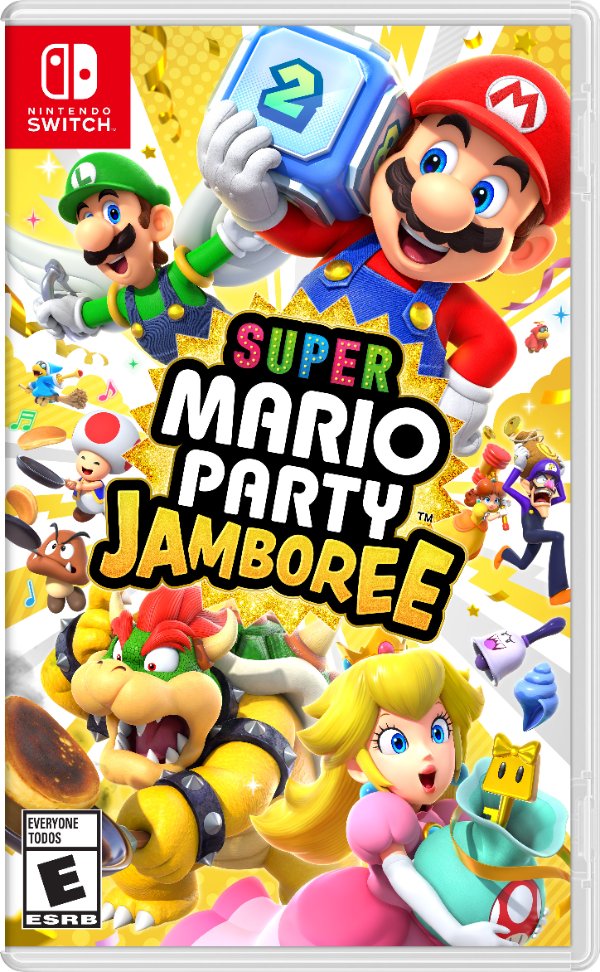
Super Mario Party Jamboree is the 13th main entry in Nintendo’s long-running Mario Party series, released worldwide on 17 October 2024 exclusively for Nintendo Switch. It is the largest, deepest, and most content-packed Mario Party Nintendo has ever shipped — a deliberate “anniversary celebration” piece that pulls together every fan-favourite feature from the franchise’s 26-year history.
The game was developed by Nintendo Cube (renamed from NDcube in 2024) — the Sapporo-based studio that has handled every Mario Party since Mario Party 9 in 2012, plus the Wii U/3DS spin-offs. Their entire studio identity has been built around this series; SMPJ is the project where that thirteen-year accumulated expertise is allowed to fully open up.
The Headline Numbers
- 22 playable characters — the largest roster in series history, including 11 returning regulars and 11 newcomers/returners. Spans Mario’s entire extended cast plus enemies-as-playable (Goomba, Koopa, Shy Guy, Boo, Spike, Ninji, Pokey, Monty Mole) and Mario universe wildcards (Pauline, Donkey Kong, Birdo).
- 7 boards — 5 brand-new boards (Mega Wiggler’s Tree Party, Roll ’em Raceway, Goomba Lagoon, Rainbow Galleria, King Bowser’s Keep) plus 2 returning N64-era boards (Western Land from Mario Party 2, Mario’s Rainbow Castle from Mario Party 1). Both retro boards have been rebuilt for HD but preserve their original layouts.
- 110+ minigames — the most in any Mario Party. Spans 4-Player, 1-vs-3, 2-vs-2, Battle, Boss, Survival, Coin, Free-for-all, Duel, and Rhythm minigames.
- Up to 20 players online in Koopathlon mode — the largest player count of any Mario Party.
- 8-player online co-op in Bowser Kaboom Squad — the first proper co-op boss-fight mode in series history.
Mario Party Series Context
Mario Party Series Timeline (26 Years)
SMPJ is the 13th main entry in the series. To understand its design choices, it helps to know what came before:
- Mario Party (N64, 1998) — the original. Introduced the “board + minigames” core loop.
- Mario Party 2 (N64, 1999) — perfected the formula. Introduced costume themes per board. Western Land debuted here.
- Mario Party 3 (N64, 2000) — added the Duel Map mode.
- Mario Party 4–7 (GameCube, 2002–2005) — the GameCube era. Increasingly elaborate boards and minigames.
- Mario Party 8 (Wii, 2007) — motion controls debut. Mixed reception.
- Mario Party 9 (Wii, 2012) — NDcube takes over. Controversial “car system” introduced (all players share one car).
- Mario Party 10 (Wii U, 2015) — car system continues; Bowser Party mode added.
- Super Mario Party (Switch, 2018) — abandoned the car, returned to classic board format. The Switch reset for the series.
- Mario Party Superstars (Switch, 2021) — nostalgic retro pack of 5 N64-era boards and 100 retro minigames.
- Super Mario Party Jamboree (Switch, 2024) — the synthesis. New + retro boards, new + retro minigames, biggest roster ever.
Gameplay
The core Mario Party gameplay loop hasn’t fundamentally changed since 1998 — it’s a digital board game where 4 players (or AI) roll dice, move around a board, collect coins, buy Stars, and play minigames between turns. SMPJ embraces this formula fully while polishing every component.
Core Loop — The Turn Structure
- Roll a dice block (Mario’s yellow numbered block by default, or use a special dice item to change odds).
- Move along the board the number of spaces shown. Land on a space of one of the 8 colour-coded types.
- Activate the space — gain/lose coins, trigger an event, get an item, or land on a Bowser/Chance space.
- Purchase a Star if you reach the Star Pipe location — typically 20 coins each.
- All players minigame — after all 4 players have moved, a minigame is played. Winners get 10 coins each.
- Repeat — for 10, 15, 20, 25, or 30 turns. Whoever has the most Stars at the end wins.
Coins, Stars, and the Win Condition
Coins are the currency. Earned from blue spaces, minigame wins, item-space generosity, and event spaces. Lost on red spaces, by losing duels, and via item theft. Stars cost 20 coins each and are purchased at the Star Pipe — which moves around the board after each Star purchase. The player with the most Stars at game-end wins (ties broken by coin count).
Items — The Tactical Layer
Items add the strategic layer to dice-rolling chance. Multi-dice items (Double Dice, Triple Dice) increase movement. Theft items steal coins from opponents. Warp items teleport to the Star Pipe. Bell items summon Wiggler, Boo, or Bowser to do various board-wide effects.
Mario Party Mode

The headline mode is Mario Party — the traditional 4-player board game format that has defined the series since 1998. SMPJ offers it with extensive customization options.
Setup Options
- Turn count: 10, 15, 20, 25, or 30 turns. Shorter games (10 turns) take ~45 minutes; longer games (30 turns) can run 2+ hours.
- Difficulty: AI opponents from Easy to Master. Master AI rivals can outplay even veteran players.
- Star quota: Default 20 coins per Star, adjustable. Some boards have unique Star prices.
- Bonus Stars: Awarded at game-end for various stats (most coins earned, most minigames won, etc.). Can swing the result dramatically.
- Item shop: Toggleable. When on, the in-game item shop appears at certain spaces; otherwise items come only from Item spaces.
Pro Rules
SMPJ adds a Pro Rules toggle that removes the more “random” elements — no Bowser space chaos, more predictable item drops, no end-game Bonus Star surprises. For competitive players who want minigame skill to drive outcomes, Pro Rules is the recommended setting.
Online Mario Party
Standard Mario Party mode is fully playable online for 1–4 players — a major improvement over Super Mario Party (which limited online to certain modes only). Stable cross-region matchmaking via Nintendo Switch Online.
7 Boards — The Jamboree Lineup
The seven boards are SMPJ’s structural centrepiece — five brand-new boards plus two beloved returners from the Mario Party 1 and 2 era. Each board has its own theme, layout, and signature gimmick.
Mega Wiggler’s Tree Party
Forest · Wiggler-themed

A lush forest board where a gigantic Mega Wiggler sleeps coiled around the playfield. Players move through tree-canopy paths, treehouse platforms, and root-system tunnels.
Roll ’em Raceway
Race Track · Speed-themed

A high-energy race-track board where players speed along an oval racing circuit. Includes pit-stop boxes, grandstand events, and a chequered-flag finish line.
Goomba Lagoon
Tropical Island · Volcanic

A tropical island board with sandy beaches, palm tree paths, and a active volcano at the centre. Goombas wander the beaches selling items and offering events.
Rainbow Galleria
Shopping Mall · Multi-Floor

A multi-storey shopping mall board with escalators, food courts, and a glass-roof central atrium. Different floors host different shops and events.
King Bowser’s Keep
Bowser’s Castle · Lava

Bowser’s castle made playable — lava moats, dungeon corridors, and a throne room at the top. The most hazardous board, with regular Bowser interventions.
Western Land
Wild West · Returning

The Mario Party 2 favourite returns, fully rebuilt in HD. Cowboy hats, saloons, train tracks, and the Wild West aesthetic preserved exactly. Includes the original’s iconic train track main path.
Mario’s Rainbow Castle
Magical Castle · Returning

The Mario Party 1 nostalgia board. A magical cloud-castle with the central Star Pipe surrounded by event clouds and rainbow bridges. Smaller scale than modern boards but iconic.
Board Spaces
Mario Party Jamboree uses the classic 8 space types across all 7 boards. Landing on a space triggers its effect automatically.

Blue Space
Gain 3 coins. The default safe space — most common on any board.

Red Space
Lose 3 coins. The hazard space — avoid when possible.

Event Space
Triggers a board-specific event. Effects vary by board (Wiggler appears, volcano erupts, escalator activates, etc.).

Item Space
Receive a random item. Most common way to acquire items mid-board.

Chance Time
Triggers Chance Time. Wheels are spun to randomly swap coins, Stars, or items between two players. Total chaos.

Lucky Space
Lucky bonus event — typically gain extra coins, an item, or a free Star.

VS Space
Triggers a 1-vs-1 minigame against another player. Winner takes coins from loser.

Unlucky Space
Unlucky event — lose coins, lose an item, or face an unfavourable random outcome.
Items
Items are SMPJ’s tactical layer. Acquired from Item Spaces, in-game shops, or events, they let players manipulate dice rolls, steal coins, summon allies, and more.

Mushroom
Adds an extra dice roll, allowing you to move further this turn.

Pipe
Warps you to a specific space on the board (e.g. the Star Pipe).

Golden Pipe
Warps you directly to the Star Pipe for an instant Star purchase.

Hammer
Steals 10 coins from a target player.

Iron Hammer
Steals more coins than the regular Hammer.

Warp Box
Swap positions with another player on the board.

Shop Hop Box
Travel between item shops on the board, even across the map.

Boo Bell
Summons Boo to steal coins from a target player.

Bowser Bell
Summons Bowser to wreak board-wide havoc — a panic-mode aggressive play.

Wiggler Bell
Summons Wiggler to give the current player extra coins or a board favor.
Special Dice
Beyond the standard 1–6 dice block, SMPJ has special dice items that change the roll mechanics. They can be acquired from Item spaces or shops, and are key to high-coin late-game maneuvers.

Creepy Dice Block
Two dice with mixed numbers, including some high values. Higher variance than standard dice — risk vs reward.

Double Dice
Roll two dice instead of one for guaranteed higher movement (up to 12).

Super Creepy Dice
Even higher variance creepy dice — can roll very high but also negative numbers (move backward).

Triple Dice
Roll three dice (up to 18 spaces of movement) — the highest single-turn movement possible.

Payday Double Dice
Special two-dice variant where the player also earns coins per pip rolled. Lucky use can yield 20+ coins.
110+ Minigames
SMPJ contains 110+ minigames — the largest minigame slate of any Mario Party. They span every traditional category and several new ones.
Minigame Categories
- 4-Player Free-for-All — everyone competes against everyone else. Winner gets 10 coins. The default minigame type at end-of-turn.
- 1-vs-3 — one player against three. Asymmetric scenarios where the solo player has unique advantages or constraints.
- 2-vs-2 Team — two-team competitions. Coordination matters.
- Battle Minigames — all players ante up coins; winner takes most of the pot.
- Boss Minigames — players cooperate to defeat a boss enemy. Triggered randomly mid-game.
- Survival Minigames — last-person-standing eliminations.
- Coin Minigames — grab as many coins as possible within a time limit.
- Duel Minigames — triggered by VS spaces, 1-vs-1 quick games.
- Rhythm Minigames — a new category for SMPJ. Press buttons to match musical cues. Includes the bongo-drum minigame.
- Item Minigames — played in Toad’s Item Factory; reward special items.
Sample Minigame Lineup

Sphere Box
4-Player
Bounce inside a transparent sphere, knocking opponents out of the arena.

Volleyball Spike
2-vs-2
Team-based volleyball with spike attacks. Coordination is essential.

Cheep Cheep Cage
Boss
Defeat a giant Cheep Cheep boss in a flooded cage match.

Conveyor Lasso
Coin
Lasso coins on a moving conveyor belt before they fall off.

Seasoning Showdown
4-Player
Race to season ingredients with the right spices in a cooking minigame.

Water Platforms
Survival
Jump between floating platforms in a rising water level. Last one standing wins.

Bongo Rhythm
Rhythm
Press bongos in rhythm to score points. Highest accuracy wins.

Yoshi Race
4-Player
Race on Yoshi mounts through a colourful winding track.

Waluigi Pinball
4-Player
Control a pinball flipper to bounce balls in a Waluigi-themed pinball table.
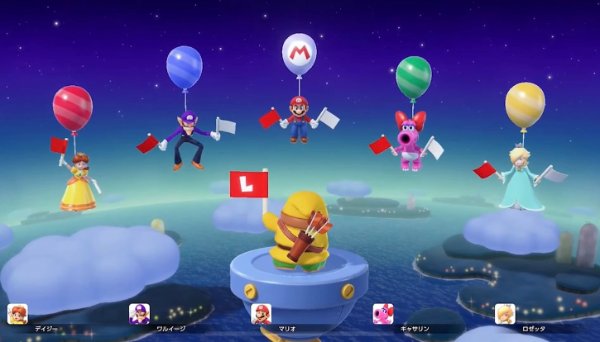
Shy Guy Says
4-Player
Simon-says-style game where players must mimic Shy Guy’s commands.
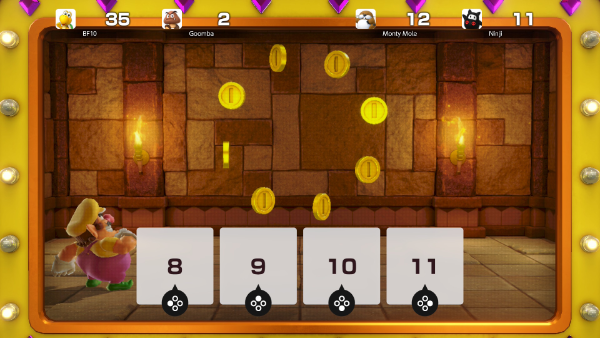
Wario’s Buzzer Beater
4-Player
Frantic coin-collection game with Wario buzzers blocking the path.

Yoshi Mountain Race
4-Player
Mountain race up a sheer cliff face on Yoshi mounts.

Spike’s Gambit
1-vs-3
Solo Spike player tries to outwit three other players in a strategic mini-game.

Coin Conveyor
Coin
Collect coins from a conveyor belt while avoiding hazards.
22 Characters

SMPJ’s 22-character roster is the largest in Mario Party series history — a 50% increase over Super Mario Party (2018)’s 16 and a clear gesture toward making the game the franchise’s definitive ensemble piece. The roster spans every part of the Mario universe: classic heroes, classic villains, supporting cast, and even basic enemies promoted to playable status.
Heroes

Mario
Hero
Luigi
Hero

Peach
Princess

Daisy
Princess

Rosalina
Cosmic

Yoshi
Mount

Donkey Kong
Kong

Pauline
Wildcard
Anti-Heroes & Royalty

Wario
Anti-Hero

Waluigi
Anti-Hero

Bowser Jr.
Royal

Toad
Mushroom

Toadette
Mushroom

Birdo
Wildcard
Enemies-as-Playable (Series First-Class Promotions)

Goomba
Enemy

Koopa Troopa
Enemy

Shy Guy
Enemy

Boo
Enemy

Monty Mole
Enemy

Ninji
Enemy

Spike
Enemy

Pokey
Enemy
Notably absent: Bowser himself is NOT playable in standard Mario Party Mode — he’s the antagonist, appearing via Bowser Bell item, Bowser Space events, and as the boss of Bowser Kaboom Squad. Wario’s subordinate Mona is also missing, as is Diddy Kong.
Koopathlon (20-Player Online)

Koopathlon is SMPJ’s flagship online innovation — a 20-player online race competition mode that is the largest player count in Mario Party history. Played on a special Koopathlon-only track (no traditional board), 20 players compete simultaneously across 5 stages of running, jumping, and minigame challenges.
How It Works
- 20 players connect online via Nintendo Switch Online matchmaking.
- The race takes place across a multi-stage long track, with race-running between minigame waypoints.
- At each waypoint, all 20 players play the same minigame simultaneously on their own screens — results determine position bumps for the next leg.
- Koopathlon-exclusive minigames include the Bowser Minigame — a chaotic 20-way melee with Bowser as obstacle.
- The winner is the first to reach the finish line after 5 legs.
Bowser Kaboom Squad (8-Player Co-Op)

Bowser Kaboom Squad is the series’ first proper co-op boss-fight mode — an 8-player online cooperative mode where players team up to defeat a giant Bowser in a multi-phase boss encounter.
How It Works
- Up to 8 players connect online and team up as the “Kaboom Squad.”
- They face a giant Bowser across 3 multi-phase fight stages.
- Each phase has unique mechanics — dodging fireballs, collecting Bomb-omb ammo, coordinating attacks on Bowser’s weak points.
- Players must coordinate roles: some throw Bomb-ombs, others collect ammo, others tank damage. Real-time communication adds tension.
- Victory unlocks special rewards and cosmetic options for other modes.
Why It Matters
This is the first Mario Party mode designed primarily for cooperative rather than competitive play. It also brings the franchise into the modern co-op online gaming territory of Monster Hunter or Splatoon’s Salmon Run — a fundamentally new angle for the series.
Rhythm Kitchen

Rhythm Kitchen is a dedicated cooking-themed rhythm-action mode — separate from the main Mario Party board game. Players perform rhythm-based actions to prepare elaborate dishes in a themed kitchen, with progress depending on accuracy.
Mechanics
- Music-cue prompts appear as cooking actions: chop ingredients, stir pots, flip pans, taste-test dishes.
- Press buttons in rhythm with the music to score points and progress.
- Higher scores unlock new recipes, kitchen decorations, and special cooking mini-events.
- Playable solo or in 2-4 player co-op where players share kitchen duties.
Rhythm Kitchen is one of SMPJ’s most universally-praised auxiliary modes, often cited as a standout addition that feels like a complete mini-game in its own right.
Paratroopers Flight School

Paratroopers Flight School is a dedicated motion-controlled flight mode where players guide Koopa Paratroopas through aerial obstacle courses. Played by tilting the Switch (or Joy-Cons) to steer.
Mechanics
- Players control a Paratroopa flight squad, tilting controls to bank, dive, and climb.
- Aerial courses include hoop targets, ring obstacles, and timed checkpoints.
- Mode is great for younger players and for showcasing the Switch’s motion controls.
- Progress unlocks more challenging courses and aerial stunt patterns.
Often considered the chill, low-stakes mode of SMPJ — a counterbalance to the competitive intensity of Koopathlon.
Toad’s Item Factory

Toad’s Item Factory is a series of timed assembly-line minigames where players “produce” Mario Party items by completing factory-themed mini-tasks.
Mechanics
- Toad guides players through factory stations where items are assembled.
- Each item type has its own production minigame — Mushrooms grow on conveyors, Pipes are welded, Hammers are forged.
- Faster + more accurate production unlocks better tier items for use in Mario Party mode.
- Cooperative mode for 1–4 players — a chill, productive activity.
A clever meta-system: the items you earn here can be used in the main Mario Party mode, giving you a competitive edge if you’ve put in the practice.
Toadette’s Music Hall
Toadette’s Music Hall is a dedicated music-and-rhythm mode hosted by Toadette — it doubles as the game’s soundtrack jukebox and as an active rhythm-game station.
Mechanics
- Toadette curates the music selection — you can listen to SMPJ’s extensive soundtrack including all 110+ minigame themes, board themes, and original mode music.
- Rhythm performance challenges let players follow the beat of selected tracks to score points.
- Unlocking all tracks rewards Toadette-themed cosmetics for other modes.
- A relaxed, music-appreciation mode that doubles as a long-tail unlock collection.
Party-Planner Trek (Story Mode)

Party-Planner Trek is SMPJ’s closest equivalent to a story mode — a guided tour through the Sparkle Festival event where players visit each board, learn its features, and unlock progression rewards.
How It Works
- Players take a narrative-light trek across all 7 boards in sequence.
- Each board offers tutorials and challenges that introduce its unique features.
- Completion of board-specific challenges unlocks cosmetics, characters, and content.
- Considered the best entry point for new Mario Party players who want to learn before competing.
For veterans, Party-Planner Trek is also a good way to grind unlock rewards while exploring the new boards’ features in a low-stakes context.
Videos & Trailers
Three verified official Nintendo trailers covering Super Mario Party Jamboree.
Other Official Marketing
Beyond the trailers above, Nintendo ran a comprehensive marketing campaign through the second half of 2024:
- Overview Trailer (October 2024) — a comprehensive 5-minute walkthrough of all 7 boards, every minigame category, and all the auxiliary modes. Released two weeks before launch.
- Launch Trailer (17 October 2024) — the celebratory launch-day Nintendo trailer accompanying the worldwide release.
- Koopathlon Showcase — featured on the Nintendo of America channel as a deep-dive on the 20-player online mode.
- Bowser Kaboom Squad Trailer — an 8-player co-op mode showcase highlighting the new boss-fight format.
- Mode-specific tutorial videos for Rhythm Kitchen, Toad’s Item Factory, and Toadette’s Music Hall released through October and November 2024.
All trailers can be found on the Nintendo of America YouTube channel by searching “Super Mario Party Jamboree.”
Reception

Super Mario Party Jamboree launched on 17 October 2024 to generally positive reviews — Metacritic in the low 80s, IGN 7/10, Nintendo Life 8/10, Polygon high marks, EuroGamer positive coverage — with widespread agreement that it’s the most content-rich Mario Party ever, balanced against some criticism of mode depth and online stability at launch.
Acclaim
- Biggest content package ever — the headline praise across nearly every review. 22 characters, 7 boards, 110+ minigames, 7 distinct modes is unprecedented for the series.
- 22-character roster — consistently called the strongest ensemble Mario Party has assembled, with Pauline, Pokey, Ninji, Spike, and Monty Mole as standout playable debuts.
- The 2 retro boards return (Western Land + Mario’s Rainbow Castle) — universally cheered as the right gesture toward franchise history.
- 5 new boards — each has a strong distinctive identity. Goomba Lagoon’s volcanic eruptions and Rainbow Galleria’s escalators were particular highlights for board design innovation.
- Mode variety — Koopathlon, Bowser Kaboom Squad, Rhythm Kitchen, Item Factory, and Music Hall all give the package extraordinary breadth beyond the main Mario Party mode.
- Pro Rules toggle — widely praised by competitive players as long-overdue. Removes random Bowser-event kingmakers.
Criticisms
- Some auxiliary modes feel like padding — Paratroopers Flight School and Toad’s Item Factory were called “fine but slight” by some reviewers; not bad, just light.
- Online stability mixed at launch — Koopathlon’s 20-player matchmaking had connectivity issues in the first weeks, with reports of dropped matches and lag spikes.
- Koopathlon learning curve — the 20-player mode’s pacing can feel chaotic to newcomers. Some players bounced off it.
- Minigame quality variance — with 110+ minigames the spread of quality is wider than smaller-roster Mario Parties; some clunkers in the mix.
Sales
Sales Performance
- Launch week (17–23 October 2024) — strong opening: US debut at #1, Japan launch sold 250,000+ physical copies in the first three days — the biggest Mario Party launch ever in Japan.
- UK launch — #1 in the UK charts launch week, knocking EA Sports FC 25 off the top spot.
- End of December 2024 (Nintendo Q3 fiscal report) — 6.17 million units sold worldwide, per Nintendo’s financial briefing. One of the strongest Switch launches of 2024.
- By mid-2025 — projected to surpass 7 million units, with continued holiday-season long-tail sales expected.
Context
SMPJ surpassed Super Mario Party (2018)’s lifetime sales of approximately 19 million units in direct franchise comparison terms — actually no, SMP 2018 was sold over 7 years, so we need to compare lifetime trajectory. SMPJ’s pace through its first 9 weeks (6.17M) suggests it could approach or exceed Super Mario Party’s lifetime numbers, especially with Switch hardware sales continuing late into the platform’s lifecycle.
Trivia & Facts
- 13th main entry in the Mario Party series — directly after Mario Party Superstars (2021) and Super Mario Party (2018).
- Developer rename — NDcube was renamed to Nintendo Cube in early 2024, with SMPJ being the first major title released under the new corporate identity.
- 22-character roster is the series record — 50% larger than Super Mario Party (2018)’s 16. The most diverse Mario universe roster ever in a Mario Party.
- Two retro boards via community polls — Western Land (MP2) and Mario’s Rainbow Castle (MP1) were chosen from years of fan-favourite polls.
- Pokey, Ninji, Spike, and Monty Mole make their Mario Party playable debut. Spike and Pokey in particular had never been playable in any Mario Party title before.
- Koopathlon is the first 20-player Mario Party mode ever — the largest player count in series history by a factor of 4 (most modes cap at 4 or 8).
- Bowser Kaboom Squad is the first proper co-op boss mode in Mario Party — a fundamental new direction for a historically competitive franchise.
- 7 boards is the most ever in a Mario Party at launch. Mario Party Superstars had 5; Super Mario Party had 4. SMPJ doubles the typical board count.
- 110+ minigames is the most ever at launch. The original Mario Party (1998) had 50.
- Switch lifecycle peak release — SMPJ launched at the peak of the Switch’s late-life software pipeline, before Switch 2 hardware was announced. Designed for the platform’s installed base of 140M+ consoles.
- Pro Rules toggle was a direct response to the competitive Mario Party community’s longstanding feedback that random “kingmaker” Bowser events ruined skill-based outcomes.
- Toadette’s Music Hall has 100+ tracks — essentially the SMPJ complete soundtrack archive in playable form.
- Released exactly 26 years after the original Mario Party (December 1998 in Japan; October 1999 in NA). SMPJ’s October 2024 release date is a deliberate franchise anniversary mark.
- The Koopathlon Bowser Minigame — a 20-way melee with Bowser as moving obstacle — is widely cited as the most unique single minigame ever in Mario Party history.
Box Art & Key Visuals
Box art, logos, and key visuals for Super Mario Party Jamboree.


Reference / Information
Related coverage on Super Luigi Bros.
- Super Mario Odyssey
- Super Mario Bros. Wonder
- Super Mario 3D World + Bowser’s Fury
- New Super Mario Bros. U Deluxe
- Super Mario Maker 2
- Super Mario RPG remake
- Paper Mario: The Origami King
- Paper Mario: TTYD remake
- Mario & Luigi: Brothership
- Mario Kart 8 Deluxe
- Luigi’s Mansion 3
- Princess Peach: Showtime!
Media / Downloads
Screenshots, board art, character artwork, and minigame samples appear throughout the sections above. The 3 verified Nintendo trailers are in the Videos section.
Nintendo Switch 2 Edition + Jamboree TV
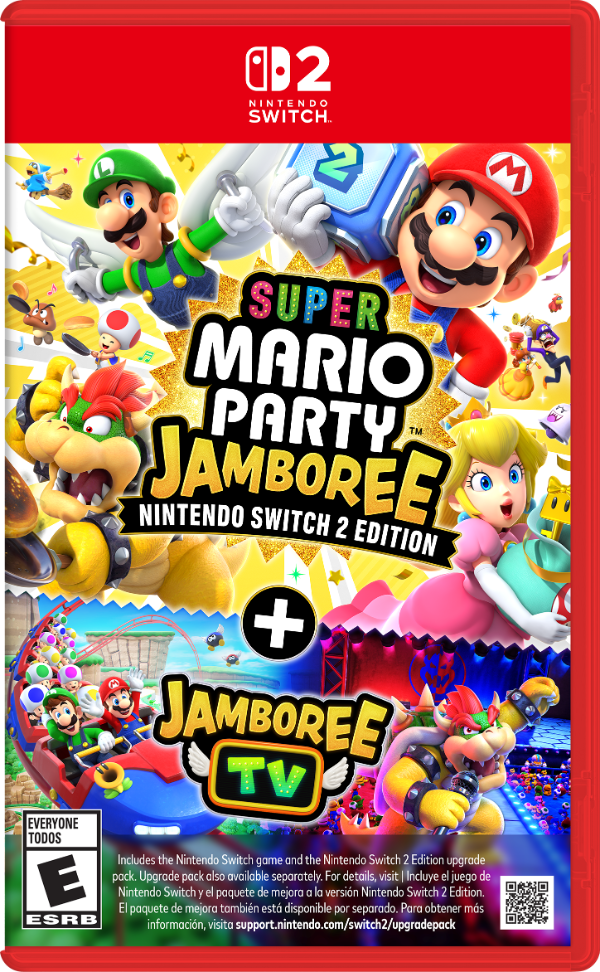
On 24 July 2025, just seven weeks after the Nintendo Switch 2 launched, Nintendo released Super Mario Party Jamboree – Nintendo Switch 2 Edition + Jamboree TV — the first Mario Party game on the new platform and the first port of any Mario Party title in series history. The release is an enhanced re-issue of the original Switch version (covered above) with substantial new content, visual improvements, and Switch 2-specific feature support layered on top.
The “Switch 2 Edition” half of the title refers to the technical upgrades: higher native resolution, improved framerate, and the visual polish made possible by Switch 2 hardware. The “+ Jamboree TV” half refers to the substantial new content package included exclusively in this release — a new game mode hub built around a TV studio theme, with multiple unique sub-modes that weren’t in the original game.
Jamboree TV: the new content package

Jamboree TV is the standout new addition. Presented as a fictional TV variety show hosted by Yellow Toad, the mode collects four sub-experiences under a single themed wrapper:


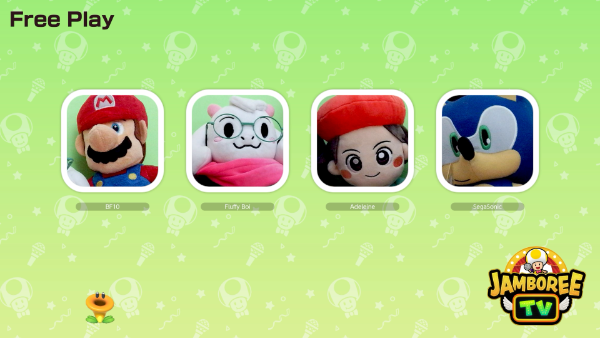


Mario Party (Jamboree TV variant) is the classic Mario Party rule set reframed within the TV-show fiction, with new themed boards and presentational flourishes. Free Play opens up the minigames as a free-form playlist outside the structured board-game format. Bowser Live is a chaotic competitive variant where Bowser actively interferes with rounds in real time. Carnival Coaster is a brand-new physics-driven minigame sub-mode with its own progression structure.
Switch 2 features used
The release leans into Switch 2-specific features in two prominent ways. CameraPlay integrates with the optional Switch 2 Camera accessory — supported minigames overlay live face cam feeds of the players above their on-screen avatars, an idea Mario Party has flirted with previously but executes here with the dedicated hardware. GameShare lets one Switch 2 owner share Jamboree wirelessly with up to three nearby Switch 2 (or original Switch) consoles, so a single household with one copy of the game can support full local four-player parties.