
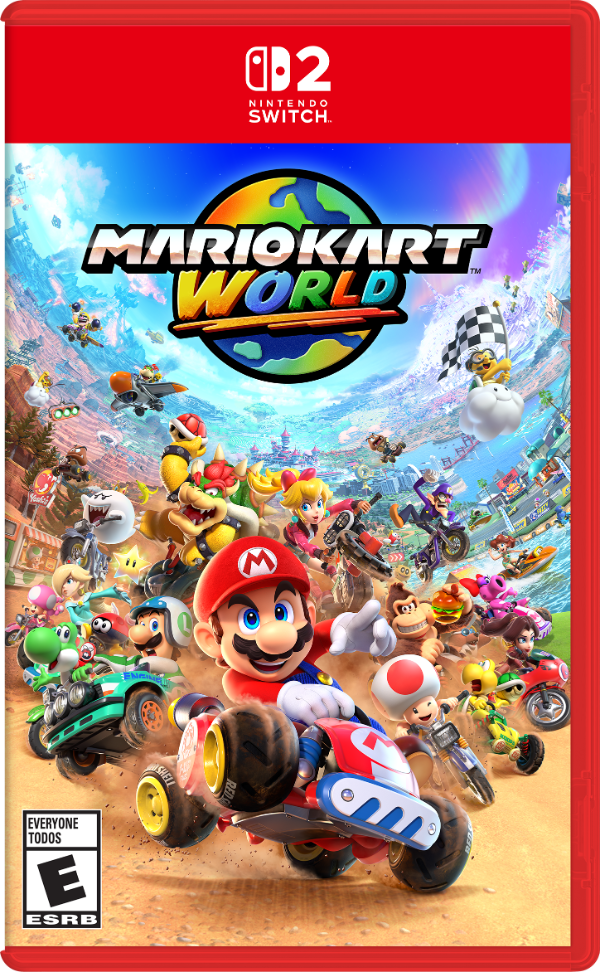
Mario Kart World
Nintendo Switch 2 launch title — the first open-world Mario Kart, with 24-racer grids, full free-roam exploration between courses, wildlife racers, and the new Knockout Tour battle royale mode.
Game Facts
On this page
Overview & significance

Mario Kart World launched worldwide on 5 June 2025 as the flagship launch title for the Nintendo Switch 2, making it the first Mario Kart game in series history to release alongside the console that introduced it. It is the sixteenth entry in the Mario Kart franchise and the first original flagship console Mario Kart since Mario Kart 8 back in 2014 — an eleven-year gap that ended with one of the most ambitious reinventions in the series’ history.
Mario Kart World was developed by Nintendo EPD in collaboration with Monolith Soft (Xenoblade), 1-UP Studio (Super Mario 3D World, Luigi’s Mansion 3), and Bandai Namco Studios (long-running series collaborator). Monolith Soft’s involvement is significant: the studio’s expertise in massive open-world design, honed across the Xenoblade trilogy, directly shapes Mario Kart World’s most radical departure — a single interconnected world map in which every course is a real location you can drive to.
The game was first teased in the Nintendo Switch 2’s reveal trailer on 16 January 2025 with a brief shot of a packed racing grid, and was properly revealed during the dedicated Nintendo Switch 2 Direct on 2 April 2025. From announcement to launch was just over two months, an unusually tight window that signalled Nintendo’s confidence in the project as the platform’s flagship.
Open-world racing concept

The headline feature of Mario Kart World is that every course in the game lives within a single shared open world. Where previous Mario Kart entries treated each course as an isolated environment loaded individually, Mario Kart World presents a unified continent crossed by roads, waterways, mountain passes, and railway lines. Courses are no longer destinations selected from a menu — they are real places connected to every other place by drivable terrain.
This restructure has cascading effects on how the game plays. In Grand Prix mode, races no longer start and end in isolation: between cup tracks, the field actually drives the connecting route from one course to the next, transforming the traditional menu transition into a continuous race. The Knockout Tour mode (covered below) takes this concept to its logical conclusion with a single long route across the entire world map.
Another major change is the racer count: where previous flagship entries supported 12-racer grids, Mario Kart World doubles this to 24 racers per race. The larger field changes the racing feel substantially — traffic is denser, item chaos is more frequent, the leader is more vulnerable, and dramatic comebacks are far more achievable. Knockout Tour leans on this expanded grid for its elimination structure.
Earlier Mario Kart games treated tracks as islands. Mario Kart World makes the spaces between tracks part of the game. This means a deep change in how the series treats geography — racing isn’t just about going fast on a fixed loop anymore, it’s about traversing a real place where every road you see has meaning. Free Roam mode (covered below) lets you explore that geography purely for its own sake.
New mechanics: wall riding, grinding, and charge jumps
Beyond the open world itself, Mario Kart World introduces three significant new traversal mechanics that change how races flow:
Wall riding lets the kart climb and ride on near-vertical surfaces. Approach a wall at speed and you can stick to it briefly, opening up shortcut lines that were physically impossible in earlier entries. Skilled players treat the world’s vertical surfaces as alternative race lines, particularly on courses like Acorn Heights and Starview Peak where ramped terrain rewards aggressive wall use.
Grinding turns rails, fences, pipes, and similar thin structures into ridable rails — the kart locks onto the rail and slides along it, much like Sonic’s rail grinding. Combined with wall riding, the system gives Mario Kart World a much more vertical and aerial flavour than previous entries, with skilled lines weaving across multiple surface types.
Charge jumps are a new defensive and offensive tool. Tapping the brake button while accelerating builds a charged jump that releases when held — useful for clearing hazards, evading shells, and reaching upper paths. The mechanic adds a layer of moment-to-moment decision-making that wasn’t present in earlier Mario Kart games, where the only jump option was a manual drift.
Mario Kart 8’s anti-gravity mechanic let karts cling to walls and ceilings on specifically-designed track sections. Mario Kart World generalises that principle: instead of designated anti-gravity zones, virtually every surface in the world is usable, and the player chooses where to ride. The shift is from scripted route variety to player-driven route variety.
Grand Prix mode

Grand Prix remains Mario Kart’s flagship single-player mode and Mario Kart World’s default starting point. Cups still organise courses into themed groups of four — returning favourites like the Mushroom Cup, Banana Cup, and Star Cup are present alongside new arrangements.
The key difference from previous Grand Prix experiences is that races no longer reset between courses. After finishing a course, the field continues into the next via the connecting route, with positions, items, and momentum carrying through. The transition becomes a mini-race in its own right, often packed with shortcuts and item box clusters along the route. Place poorly on a track and you can recover positions on the road between tracks; finish well and you may still lose ground in transit if you’re not paying attention to the connector.
Engine classes are still selectable (50cc, 100cc, 150cc, and 150cc Mirror), and the new Golden Rally series serves as a high-difficulty endgame challenge unlocked after completing the main cups.
Knockout Tour

Knockout Tour is Mario Kart World’s headline new mode and the clearest expression of the game’s design philosophy. It is a long-form elimination race across the entire world map: 24 racers start the race, and at fixed checkpoints along the route, the racers at the back of the pack are eliminated. The race continues with a steadily shrinking field until a single winner crosses the final finish line.
The mode is essentially a battle royale grafted onto Mario Kart, and it changes the racing calculus in fundamental ways. Lap time is irrelevant. Position on the field at the moment of each checkpoint is everything. A racer can play conservatively for the first half, then push aggressively as the field thins. Item usage becomes brutal at the bottom of the pack — the eliminated zone is where defensive items keep you alive, while leaders can afford to burn items offensively.
Knockout Tour leans heavily on the open-world structure. Because the race route is a continuous chain of connected courses rather than four-lap loops, players need geographical knowledge of the entire map — not just track memorisation. A player who knows where the route narrows, where shortcuts diverge from main paths, and where item boxes cluster has a significant advantage.
Most “Mario Kart but harder” attempts (200cc, Mirror Mode) add difficulty without changing the underlying loop. Knockout Tour changes the loop entirely: it converts the social, comeback-friendly chaos of Mario Kart into a survival exercise where consistency matters more than peak performance. The result feels meaningfully different from anything in series history.
Free Roam
Free Roam is a no-objective exploration mode that lets a player simply drive around the Mario Kart World map without competition. There is no race, no timer, no opponents — just the kart, the road, and the geography of the game’s world. Off-route terrain that is closed during competitive modes is opened up in Free Roam, marked in green on the world map. Hidden shortcuts, scenic routes, and out-of-bounds vistas are all explorable.
Free Roam scatters the map with challenges: time-limited driving objectives (reach this checkpoint within 30 seconds), collectable rings to chain together, hidden coin caches in difficult-to-reach locations, and stunt jumps that test driving skills. Completing these challenges unlocks new content elsewhere in the game — driver outfits, kart parts, and unlockable racers including some of the wildlife characters.
The mode functions as a meta-tutorial: the geography players learn in Free Roam directly translates to Knockout Tour and Grand Prix performance, because they’re racing on the same map. Time spent exploring is time spent learning routes that will matter competitively.
Time Trials & VS Race
Time Trials retains its traditional role: pick a course, set the fastest possible time, race against ghost data from yourself, top players, and Nintendo staff. The mode supports leaderboards both globally and among friends. Each course has a staff ghost set by a Nintendo employee, and unlocking the entire ghost set is one of the game’s recognised achievements.
VS Race is Mario Kart World’s customisable lobby mode. Players configure the rules (item set, CPU difficulty, course selection, race length, racer count) and play either solo, with local friends, or online. VS Race is the casual social mode — it’s how groups of friends play together, swapping settings to keep races fresh, and it supports up to 24 players in online lobbies just like Grand Prix.
Battle Mode
Mario Kart World ships with five dedicated battle courses and three battle game types. Battle is a distinct branch of the game with its own set of arenas separate from the racing tracks (the battle courts are listed in their own section further down).
Balloon Battle is the classic Mario Kart battle mode: each racer starts with three balloons, items pop opponent balloons, last one with balloons wins. It returns essentially unchanged from Mario Kart 8 Deluxe with some Switch 2 polish.
Coin Runners challenges players to collect more coins than opponents within a time limit. Coins are scattered across the arena, and hitting opponents causes them to drop coins. The mode rewards aggressive but careful play — collecting coins is the goal, but getting hit costs you.
Bob-omb Blast is a new addition: all items in this mode are Bob-ombs only. Throw them, dodge them, and try to be the last one standing in a chaotic explosion-fest. The mode is brutal, fast, and works best with the maximum player count.
Online Play
Mario Kart World supports up to 24 players online in any of the main modes (Grand Prix, Knockout Tour, VS Race, Battle). Lobbies are searchable by region or restricted to friends. Cross-region matchmaking helps fill smaller-region lobbies. A Nintendo Switch Online subscription is required for online play.
Switch 2-exclusive online features include GameChat integration — voice chat and even screen-sharing with friends during races, accessed via the new “C” button on Joy-Con 2 controllers — and GameShare, which lets a Mario Kart World owner share the game wirelessly with up to three other nearby Switch 2 owners who don’t own the title themselves. GameShare is particularly useful for local-party situations where one person bought the game but everyone wants to race.
Online matchmaking uses a skill-based system that adjusts opponent quality based on player performance over time. Casual players are matched with casual lobbies; competitive players climb into faster, tighter racing environments. Friends list integration with the Switch 2 OS means setting up a private race with people you know is a single-menu operation.
Driver roster
Mario Kart World ships with an enormous starting roster covering virtually the entire Super Mario universe — Mario, Luigi, Princess Peach, Princess Daisy, Yoshi, Toad, Toadette, Rosalina, Wario, Waluigi, Donkey Kong, Bowser, Bowser Jr., Birdo, Pauline, and many others are available from the start or unlocked through standard play. A subset of unlockable racers — including the wildlife-based characters covered separately below — are gated behind specific achievements in Free Roam and Grand Prix modes.


Driver statistics still play a role — heavier characters (Bowser, DK, Wario) have higher top speeds at the cost of acceleration, while lighter characters (Toad, Yoshi, Toadette) accelerate fast but cap lower. The stat differences are smaller than in some earlier games, keeping character choice closer to a personal preference than a competitive necessity.
Character outfits
One of Mario Kart World’s genuinely new systems is the character outfit mechanic. Most major characters have multiple selectable outfits unlocked through play, ranging from classic racing gear to wildly thematic costumes. Mario alone has variants including Pro Racer (classic kart suit), Mechanic (overalls and tools), Dune Rider (desert/off-road gear), and several special editions tied to in-game milestones.
Outfits are purely cosmetic — they don’t affect stats — but they unlock through specific challenges, giving Free Roam exploration and Knockout Tour mastery tangible visual rewards. Characters like Koopa Troopa (sailor outfit, full classic shell, formal wear) and Peach (Touring couture variants, racing leathers) have some of the more elaborate cosmetic options.
The system has a meta benefit: it gives every character a reason for repeated play even after primary unlocks are complete. Want to see Bowser in his Pro Racer Alt suit? Win a Mirror Mode cup. Want Mario’s Dune Rider variant? Complete a specific Free Roam stunt challenge. The outfit list is long enough that completionists have a target measured in dozens of hours.
Wildlife racers

Easily Mario Kart World’s most surprising new feature: a roster of wildlife and enemy species as fully playable racers. Where previous entries restricted the driver pool to humanoid Super Mario characters (Mario, Toad, Bowser, etc.), Mario Kart World breaks that convention by adding actual animals, enemies, and minor recurring creatures as selectable drivers.
These wildlife racers are unlocked through specific Free Roam achievements and Grand Prix milestones. They handle differently from standard racers — each has its own stat profile and visual signature — and several drive vehicles uniquely designed to fit their species (the Cow drives sitting upright, the Wiggler’s body curves around its kart, the Dolphin uses an aquatic-themed mobile). The full wildlife roster covered with renders below is a sampling of what’s available.


Why does this matter? Functionally, it expands the roster by a significant margin. Thematically, it folds the world of Mario Kart World into a fuller Mario universe expression — enemies and inhabitants you encountered in Super Mario games as obstacles or background fauna are now your competitors. It also gives Free Roam a tangible meta-goal: explore the map enough and you’ll find characters you didn’t know were even available.
Vehicle classes
Mario Kart World offers four vehicle classes, each with its own handling profile. Karts are the standard four-wheeled vehicles with balanced statistics. Bikes are two-wheeled, tighter-cornering, and trade some top speed for agility — a returning class from Mario Kart Wii and 8. Trikes are three-wheeled, slower but more forgiving on uneven terrain. Mobiles are the new class — small, scooter-like vehicles and stranger one-off designs that suit lighter characters and specific course types.

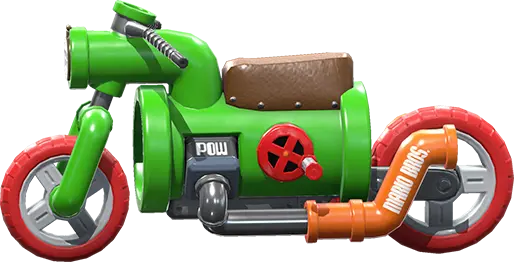
As in previous Mario Kart games, players further customise their vehicle by selecting wheels and glider parts, each of which adjusts the base statistics. The resulting combinatorial space is large enough that competitive players spend significant time experimenting to find their preferred kart-character-wheels-glider combinations for specific courses and modes.
Items
Mario Kart World retains the classic item set — Mushrooms (single, triple, golden, mega), Bananas, Shells (green, red, spiny), Bob-ombs, Bullet Bills, Stars, Boos, Lightning, and so on — with a few new additions and a major tweak to mega-class items.


The standout new item is King Boo, a chaos item available to mid-pack racers. King Boo follows the user invisibly for several seconds, then automatically targets and steals the held item of the leading racer. Unlike the Boo from earlier games, King Boo prioritises high-value steals — a leader holding a Golden Mushroom or a Star is a prime target. The item dramatically changes risk calculations for the leader, who must decide whether to hold a powerful item (risking the King Boo theft) or use it immediately (losing its strategic value).
The Mega Mushroom also returns from earlier games, growing the user’s kart to massive size for a brief window. Mega racers crush opponents on contact (shrinking them like a Lightning hit) and gain ramming damage — a strong but situational defensive item that works best in dense packs.
Grand Prix courses
Mario Kart World’s Grand Prix circuit covers a mix of brand-new courses built for the open-world map and returning retro courses from earlier Mario Kart games, rebuilt to fit into the new connected world. Here’s a sample of the course set available at launch:




Each course connects directly to others via the world map, and players will often recognise the transition routes between cups as themselves containing distinct racing opportunities. The full course list grows over time through free updates and the Golden Rally challenge series.
Battle courses
The five dedicated battle courses are distinct from the racing tracks above and serve only the Battle modes (Balloon Battle, Coin Runners, Bob-omb Blast). Each is a self-contained arena designed for free-form combat rather than circular racing.


Critical reception & legacy

Mario Kart World launched to broad critical acclaim and is widely considered the standout software title of the Nintendo Switch 2 launch lineup. Reviewers praised the open-world concept as a meaningful structural reinvention, singled out Knockout Tour as the most exciting new Mario Kart mode in over a decade, and noted that the visual upgrade to Switch 2 hardware (4K docked, 120fps support, vastly improved draw distances) gave the game a generational-leap presentation lift.
The 24-racer grids drew the most divided opinions. For some, the expanded field is the most fun Mario Kart has been in years, with the chaos elevating the social character of multiplayer play. For others, the larger fields make individual racing technique less impactful, with luck and item randomness mattering more than driver skill. Most reviewers landed somewhere in the middle: the larger grids are a feature for some modes (Knockout Tour, Battle) and an acquired taste for others (purist Time Trials).
Commercially, Mario Kart World was the bestselling Switch 2 launch title and one of the fastest-selling video games of all time. It singularly drove a substantial portion of the Switch 2’s launch hardware sales — a familiar pattern for the Mario Kart series, which has historically attached at remarkably high rates to Nintendo platform launches.
The game also re-established Mario Kart as Nintendo’s premier multiplayer franchise after the long Mario Kart 8 Deluxe shadow. With Switch 2 backwards-compatible support keeping MK8 Deluxe playable on the new hardware, Mario Kart World now sits alongside it as the modern flagship rather than replacing it — the two together represent over a decade of continuous Mario Kart presence on Nintendo consoles.