
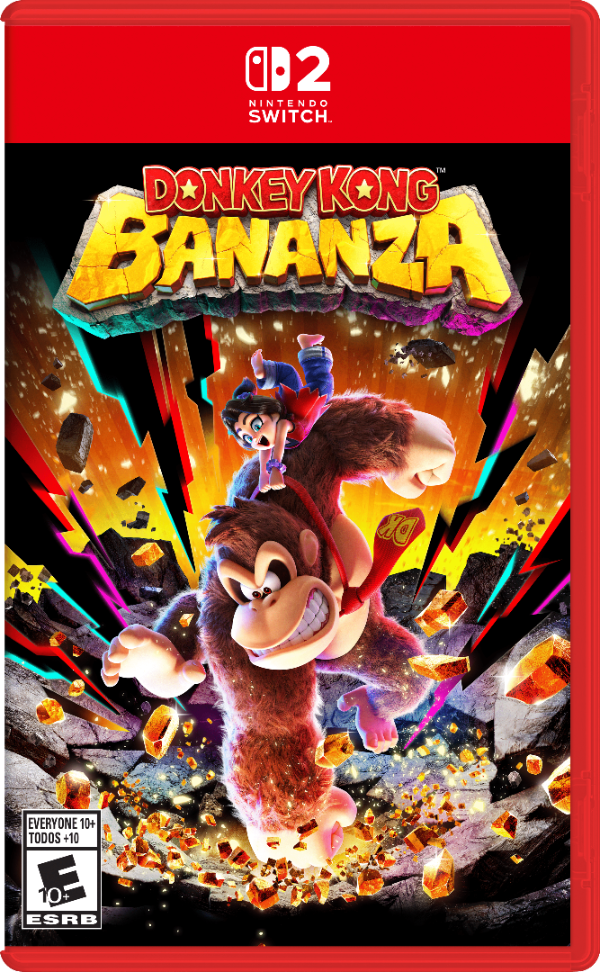
Donkey Kong Bananza
Nintendo Switch 2’s second exclusive Mario-family release — a 3D destruction-platformer starring Donkey Kong and a young Pauline, set in the Underground World, with five animal “Bananza” transformations and fully destructible terrain. The first 3D Donkey Kong platformer in over 25 years.
Game Facts
On this page
Overview & significance

Donkey Kong Bananza released worldwide on 17 July 2025, six weeks after the Nintendo Switch 2’s 5 June launch — making it the platform’s second flagship exclusive after Mario Kart World. It is a 3D action-adventure platformer that returns the Donkey Kong franchise to genre territory it hasn’t occupied in over a quarter century: the first 3D Donkey Kong platformer since Donkey Kong 64 in 1999, a 25½-year gap. It is also the first original Donkey Kong game of any kind since 2014’s Donkey Kong Country: Tropical Freeze, 11½ years prior.
The game was developed by Nintendo EPD Tokyo in collaboration with 1-UP Studio (Super Mario 3D World, Luigi’s Mansion 3) and tri-Crescendo (Eternal Sonata, Baten Kaitos). Nintendo EPD Tokyo’s involvement is the most significant fact about Bananza’s pedigree: this is the team responsible for the modern 3D Super Mario games (Galaxy, 3D World, Odyssey), and their 3D-platformer DNA is unmistakable throughout the game. Bananza shares Super Mario Odyssey’s direct lineage in animation feel, exploration loop, and “find the hidden thing” reward structure — reframed entirely around destruction rather than acrobatics.
The release sits within a broader Donkey Kong revival that began with The Super Mario Bros. Movie (2023), where DK was a major secondary character voiced by Seth Rogen, and continued with the Mario vs. Donkey Kong Switch remake (2024). Bananza adopts the same modern young-DK character design used in those projects — less hunched, more athletic, more expressive — and positions DK as a solo lead carrying his own marquee 3D adventure for the first time in a generation.
Story: The Underground World
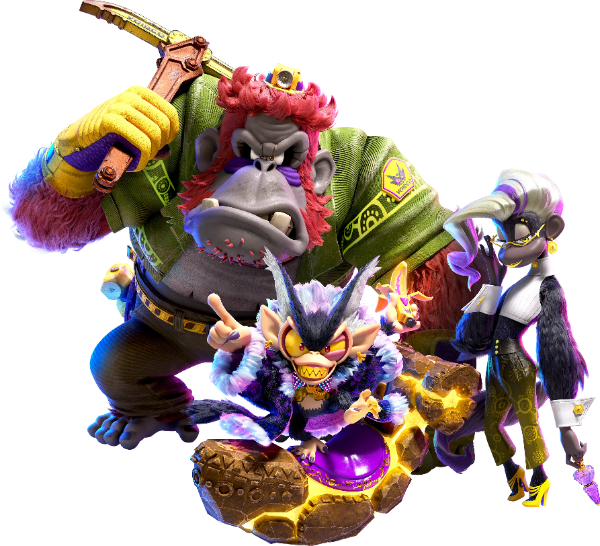
Bananza’s story is set on DK Island, where DK and a young Pauline live in a remote community alongside Banandium Gems — luminous, banana-shaped crystallised energy deposits that occur naturally in the island’s rock strata. The Gems are a focal point of the island’s ecology and culture.
A mining corporation called Void Company (also “VoidCo”), made up of primates who have industrialised gem extraction, arrives at the island and begins stripping it of Banandium at unsustainable scale. Their excavations destabilise the surface, eventually causing a massive cave-in that shears off chunks of the island and exposes the Underground World — a previously-unknown system of vast subterranean realms stacked beneath the surface in distinct layers.
DK and Pauline are dragged underground by the collapse. Pauline, separated from her home, joins forces with DK to descend through the Underground World’s layers in pursuit of Void Company and the stolen Gems. Along the way they meet the four Elders — ancient beast-spirits (Zebra Elder, Ostrich Elder, Elephant Elder, Snake Elder) who teach them the Bananza transformations that turn DK into beast forms when Pauline sings. The dual mechanic of Pauline’s music and DK’s raw strength becomes the throughline of the entire game.
The conflict resolves at the deepest layer of the Underground World, where Void Company’s real goals are revealed. Without spoiling the climax, the game has a substantial postgame that opens up after the main story concludes, expanding the explorable area significantly.
Destructible terrain: the core mechanic

The single most important fact about Donkey Kong Bananza’s design is that virtually every surface in the game is destructible. Where previous 3D platformers presented terrain as a fixed sculpture that the player traversed, Bananza’s terrain is a working material that DK breaks, lifts, throws, and reshapes in real time. Walls have substance. Floors can be punched through. Ceilings can be torn down. The world isn’t a stage — it’s clay.
This single design choice cascades into nearly every gameplay system. Pathfinding becomes player-authored: rather than following a level designer’s intended route, players carve their own path by smashing where they want to go. Combat is environmental: enemies can be defeated by hurling pieces of the level at them. Puzzles are physical: barriers, switches, and gates are usually solved by literal demolition rather than abstract logic.
Technically, Bananza pushes the Switch 2 hardware substantially. Sustained, high-detail terrain destruction with persistent physics is computationally expensive, and Nintendo EPD Tokyo built the game specifically around the Switch 2’s upgraded CPU and memory bandwidth. Pre-release demonstrations explicitly contrasted Switch 1 vs Switch 2 versions of the same destruction sequences, making clear that this game could not have been a cross-platform release.
3D Mario games are about where you can stand. Donkey Kong Bananza is about what you can break. The conceptual gap between those framings is huge, and Bananza is the first 3D platformer of its scale to fully commit to the destruction-first design. The closest comparison points are Red Faction Guerrilla’s destruction systems and Teardown’s voxel demolitions — neither remotely a Nintendo platformer, neither aimed at the same audience.
DK’s abilities
DK’s base moveset gives him several distinct ways to interact with terrain and enemies:
Punch — DK’s primary attack and his primary terrain-destruction tool. A standard punch breaks through soft materials (dirt, sand, light wood); a charged or directional punch can break through harder substances (rock, ice, reinforced wood). Punches also affect enemies directly.
Tear — DK can grip a piece of terrain and rip it free, holding the resulting chunk as a tool. The held terrain can then be thrown at enemies, used as a temporary shield, used as a platform that can be stacked, or smashed against other terrain to multiply destruction. Different materials have different weights and weapon properties.
Dig — DK can punch directly downward into soft terrain to dig vertical tunnels. The dig is one of the few ways to reach the deeper layers of the Underground World, and the dig system effectively lets players choose their own vertical route through environments.
Climb — DK retains his series-traditional climbing ability, but here it interacts with the destruction system: climbable surfaces can be punched away, and previously-unclimbable surfaces can be modified by tearing them into climbable shapes.
Roll — a fast horizontal traversal move borrowed directly from the Donkey Kong Country tradition. The roll moves DK quickly across flat terrain and can be used as an attack or as a means of clearing distance without engaging the destruction system at all.
Bananza forms: Pauline’s power

The Bananza forms are the game’s signature mechanic and the source of its name. Throughout the game, DK encounters the Elder spirits at specific layers of the Underground World. Each Elder teaches the duo a unique transformation that DK can adopt when Pauline sings the corresponding song. Each Bananza grants DK fundamentally different traversal and combat capabilities, dramatically reshaping how a layer can be navigated.
Activating a Bananza requires both DK and Pauline: she sings, he transforms. The form lasts as long as a power gauge permits, then DK reverts to his base form. This dual-actor activation system is unusual in 3D platforming — most games of this scale give one character one moveset — and is the strongest mechanical argument for Pauline as a true co-protagonist rather than a sidekick.
Unlocking new Bananzas is gated by progression: each Elder requires completion of specific layer challenges before they teach their transformation. This means the player’s movement vocabulary expands meaningfully throughout the game, and previously-explored layers can be revisited with new Bananzas to reach areas that were inaccessible the first time through — a Metroidvania-style backtracking loop atop the 3D platformer foundation.
The five Bananzas
There are five Bananza forms unlockable across the main story (with additional forms hinted at in the postgame). Each gives DK a specific traversal and combat profile:




Kong Bananza (the first form, taught implicitly) is the baseline upgrade: a more muscular, beefier DK with stronger punches and greater carry capacity. It’s the brute-force option for layers that demand maximum destruction throughput.
Zebra Bananza trades strength for speed. The form sprints at much higher velocity than base DK and can run across water surfaces. Best for the open horizontal layers (Lagoon, Canyon) where ground coverage matters more than demolition.
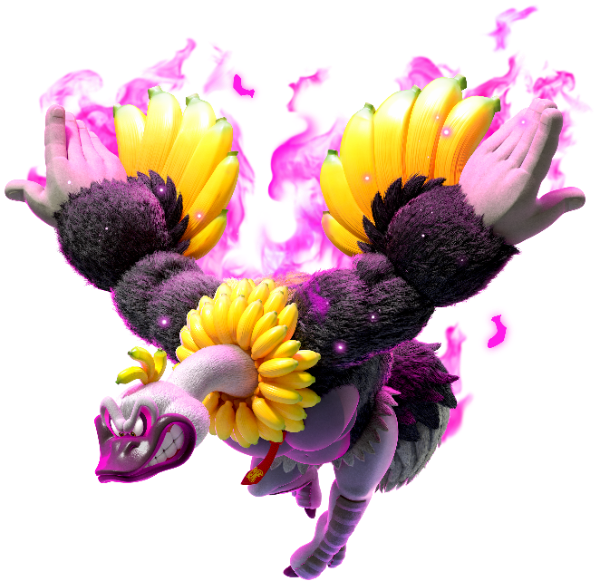
Ostrich Bananza grants flight-adjacent traversal: an extended glide and slow descent, perfect for the vertical layers where falling damage and aerial routing matter. The Ostrich form is essential for several deep-layer Banandium puzzles.
Elephant Bananza is the heaviest form, with more destructive power than Kong at the cost of mobility. The trunk also functions as a water sprayer, used in the Freezer Layer for melting ice and in puzzle sections requiring water flow control.
Snake Bananza is the most exotic: DK’s body becomes elongated and flexible, capable of climbing any surface regardless of climbing affordances, stretching across gaps, and accessing hidden routes obscured to other forms. Snake is the postgame access key for several Banandium caches.
The Elders
Each Bananza form is taught by an Elder — an ancient beast-spirit residing in a specific layer of the Underground World. The Elders are unique characters with their own personalities, dialogue, and visual designs. They function both as story characters (representing the lost knowledge of the Underground World) and as gameplay gating elements (each layer’s main Elder unlocks a Bananza needed to access the next layer).


The Elders represent the cultural memory of the Underground World — each tied to a specific layer and the wildlife that historically lived there. Their dialogue fills in the lore of how the Underground came to be sealed, why the surface and underground civilisations lost contact with each other, and what role the Banandium Gems play in the layer ecology.
Co-op: Pauline as Player 2

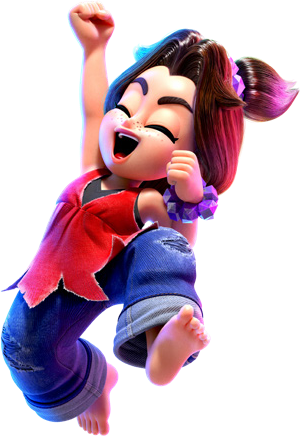
Bananza supports two-player local cooperative play, with Player 1 controlling Donkey Kong and Player 2 controlling Pauline. In single-player, Pauline rides on DK’s back as an AI partner who triggers Bananzas on player input. In co-op, Player 2 directly controls Pauline’s position, aim, and abilities — turning her into a more proactive partner with her own range of actions.
Pauline’s co-op moveset is meaningful rather than tokenistic. She can use her singing to point-and-shoot stunning projectiles at enemies, stagger groups of foes to give DK clean attack windows, mark Banandium Gems and collectibles for both players to track, and trigger Bananzas at the optimal moment. Skilled co-op play often involves precise coordination — Pauline stunning a boss while DK closes for a Kong Bananza super-punch, for example.
The co-op mode supports both local two-player (single Switch 2 with two Joy-Cons) and GameShare: one Switch 2 owner of Bananza can share the game wirelessly with a nearby second Switch 2 (or original Switch) console, with Player 2 running the game on the second device without owning their own copy. This is one of the most prominent demonstrations of GameShare in any first-party Switch 2 title.
The Layers

The Underground World is structured as a series of Layers stacked vertically beneath DK Island. Each Layer is a distinct biome with its own environmental theme, wildlife, hazards, and aesthetic identity. Progression through the game is fundamentally downward: complete one Layer, descend to the next, until eventually reaching the deepest Layer where Void Company’s base of operations resides.
The Layers are not strictly linear — backtracking is encouraged and often required to collect all Banandium Gems and complete optional challenges. Each Layer hides multiple Banandium caches, hidden routes accessible only with specific Bananzas (or only with two players in co-op), and side characters who offer further missions. A complete playthrough collecting all postgame content can extend well beyond the main story’s runtime.
Visually, the Layers progress from earthy and familiar (the upper-canyon and forest layers) through stranger, more abstract environments deeper down (volcanic, frozen, and ultimately surreal). The deepest Layers introduce visual and physical phenomena that don’t exist on the surface — floating debris, reversed gravity sections, bioluminescent flora.
Featured Layers
A sample of the early-to-mid game Layers that players will encounter in the first half of the campaign:


Multiple additional Layers exist deeper in the game, with more thematic variety and increasing structural ambition. The full Layer list expands further in the postgame.
Supporting characters
Beyond DK, Pauline, the Elders, and Void Company, Bananza features a strong supporting cast of returning Donkey Kong franchise characters and original creations:


Diddy Kong returns in a supporting role with several plot-significant appearances throughout the campaign, including racing-style sequences (Rambi Rumble) that hark back to the Donkey Kong Country tradition. Diddy isn’t playable in the main game but features prominently in optional side activities.
Trustytone is a recurring underground merchant character who appears at various Layer waypoints. He functions as the game’s shopkeeper and lore-dispenser — trading Banandium Gems for cosmetic outfits, hints, and tool upgrades.
Odd Rock is a notable side character whose backstory unfolds gradually across the game. Without spoiling: Odd Rock’s arc is one of the more emotionally weighted threads in the campaign, and his presence on the game’s pre-release box art (in early versions, replaced by Pauline in the final box art) reflects how central the character originally was to the project’s pitch.
Void Company
Void Company (also known as VoidCo) is Bananza’s primary antagonist organisation. The company is a corporate mining and gem-extraction operation staffed by an extensive primate workforce. They are responsible for the cave-in that exposes the Underground World, the theft of the surface’s Banandium Gem reserves, and the broader environmental damage being inflicted on DK Island.
The presentation of Void Company is one of Bananza’s sharper creative choices. They are not depicted as cartoonish villains in the traditional Mario sense — their iconography is corporate (uniforms, employee ID cards, branded equipment, a literal helmet with the company logo). The aesthetic situates them as a recognisable industrial polluter rather than a Bowser-style power-mad despot. Pre-release marketing leaned into this with a “VoidCo is Hiring” faux job application posted by Nintendo of America’s social channels.
The company’s rank structure becomes more visible as the player descends deeper. Lower-ranked employees are encountered as routine enemies in the upper Layers; mid-management figures function as Layer-end bosses; the company’s actual leadership is reserved for the final stretch of the campaign.
GameShare & multiplayer

Bananza is one of the most prominently positioned GameShare titles in the Switch 2 launch lineup. A single owned copy of the game can be shared wirelessly with one nearby additional Switch 2 console (or one nearby original Nintendo Switch), with the second player joining as Pauline in cooperative play. This works without the second console owning the game and without internet connectivity — a local-mesh broadcast feature unique to Switch 2.
For families with multiple Switch consoles in the home (a Switch 2 plus a Switch 1, for example), GameShare effectively turns Bananza into a two-console cooperative experience without requiring a second purchase. The mode supports the full campaign — not just a demo level — and progress persists for both players within the shared session.
For online play, GameShare also has an internet-broadcast mode: a host console can share the game over the internet with up to three other Switch 2 owners, with all four playing cooperatively in a shared session. This is the most generous configuration of GameShare and positions Bananza as one of the more shareable Switch 2 titles.
Updates & post-launch content
Donkey Kong Bananza launched with substantial content at version 1.0.0, but Nintendo has supported the game with free post-launch updates expanding playable scope:
Version 1.0.1 (late July 2025) was a launch-period stability and balance update addressing minor framerate dips in the most demanding destruction sequences and adjusting some Banandium drop rates.
Version 2.0.0 (late 2025) introduced new postgame content including DK Island & Emerald Rush — a new surface-based mode that opens up the originally-shown surface portion of DK Island as an explorable area, with new challenges, new outfits, and additional Bananza-themed cosmetic content. The 2.0.0 update is the most substantial post-launch addition and is widely regarded as a meaningful expansion rather than a routine patch.
Version 2.0.1 and 2.0.2 (subsequent months) refined the 2.0.0 content, addressed late-detected exploits, and added quality-of-life improvements such as a smarter waypoint system and a Banandium tracker that surfaces which collectibles remain available in each Layer.
The game has also been positioned as a long-term live title with seasonal cosmetic events, in-game social calendar events around real-world Nintendo holidays, and the now-famous “K. Rool Bananza” fakeout logo that appeared as part of an in-game credit sequence and triggered intense speculation about a possible King K. Rool playable cameo — still neither confirmed nor denied at the time of writing.
Critical reception & legacy

Donkey Kong Bananza launched to broad critical acclaim and was widely treated by reviewers as the most exciting first-party Switch 2 release of summer 2025. The destruction-first design earned particular praise for delivering an experience that genuinely couldn’t have existed on the original Switch hardware, and for using its expanded computational budget on something more conceptually ambitious than a simple resolution bump.
Reviewers consistently flagged three standout strengths: Pauline as co-protagonist (her singing-as-Bananza-activation mechanic was singled out as one of the most original co-op designs in years); the Bananza form variety (each transformation feels mechanically distinct rather than cosmetic); and the Layer-by-Layer pacing (the descent structure gives the game a strong narrative momentum that 3D platformers often lack).
The most common criticism was around visual readability in high-destruction sequences — some reviewers noted that the visual chaos of dense terrain destruction occasionally made platforming distances and enemy attacks harder to read than they should be. The post-launch updates have addressed some of these through better visual feedback on hazards and clearer enemy telegraphs.
Commercially, Bananza performed strongly enough to anchor a second wave of Switch 2 hardware sales in the August–October 2025 window. It is one of the bestselling Donkey Kong games in series history. Its commercial and critical success has fed direct speculation about a follow-up entry, with Nintendo neither confirming nor denying plans for a sequel.
For the Donkey Kong franchise specifically, Bananza is a watershed: it ends a 25-year drought of 3D DK platformers, establishes a modern visual and mechanical identity for the series that aligns with the Super Mario Bros. Movie aesthetic, and demonstrates that Nintendo is willing to commit major first-party resources to DK as a flagship-tier franchise rather than a supporting fixture in the broader Mario ecosystem.