


Yoshi’s Cookie
It’s a Snack Attack!
Overview
In the sequel to the Game Boy’s Yoshi, Mario and Yoshi have set aside their adventures to live the simple life of cookie factory workers — but all is not well. The ovens have gone crazy and are firing out baked goods at alarming speed. Mario and Yoshi must sort and stack all the cookies quickly before the factory is overwhelmed!
Yoshi’s Cookie is a tile-matching puzzle game — similar in spirit to Tetris — released across four platforms between 1992 and 2003. The objective is to clear the playfield by aligning matching cookies into complete rows or columns. The game features three modes — Action, VS and Puzzle — and was notable for the depth of its VS multiplayer, which supports up to four players on the GameCube version.
The SNES version is the most feature-rich release, developed by Bullet-Proof Software and including the exclusive Puzzle mode. The game was later collected in Nintendo Puzzle Collection for GameCube in Japan — bundled with Dr. Mario 64 and Panel de Pon — which added a full Story mode. This compilation never received a Western release.

Official promotional artwork for Yoshi’s Cookie
Story
The SNES and GameCube versions include story context. The core premise has Mario and Yoshi working as cookie factory workers when the ovens run wild and produce cookies faster than they can be sorted.
The Nintendo Puzzle Collection (GameCube) version adds a full Story mode: Mario and Yoshi fall asleep after a hard day of cookie deliveries — and the nefarious Bowser sneaks in to steal their cookies. Mario and Yoshi must battle through rounds of enemies to recover the stolen goods, ultimately facing Bowser himself.
The Story Mode opponents across three difficulty levels are:
Gameplay
Cookies appear from the top and right edges of the screen. To clear them, the player selects a cookie and slides its entire row or column in any direction — the goal is to form a complete horizontal or vertical line of identical cookies, which then disappears. The longer a player spends on a stage, the faster new cookies arrive.
The key strategic element is the Yoshi Cookie — a wildcard shaped like Yoshi’s head that counts as any cookie type and allows the player to complete rows that would otherwise be impossible to clear. Clearing 15 of any one cookie type in a single stage generates a Yoshi Cookie automatically.

Action Mode gameplay (Famicom/NES version)
If any row or column ever contains more than seven cookies, the game ends. The game over condition forces the player to act fast — especially in later rounds where cookies pile up rapidly.
Game modes
Action Mode
The main single-player mode. 10 rounds × 10 stages each. Before starting, the player chooses their round, speed and music. Stages must be cleared completely before moving on — as time passes, new cookies drop in faster. Completing each round rewards a short cutscene featuring Mario and a rolling Yoshi Cookie.
Hidden rounds 11–99: Unlockable by setting music to Off, speed to Hi and round to 10, then holding Up + Select at the round select. In these rounds the cookie tiles are replaced by Mario enemy sprites (from the original Yoshi game), and Koopa Shell tiles are added — these can only be cleared using Yoshi Cookies.

The distinctive background of SNES Round 4
VS Mode
A competitive 2-player mode (SNES and Game Boy also support vs. CPU). Each player has a 5×5 board and must reach 25 match points before their opponent. Matches must be made within a time limit — if the bar fills (or the fuse burns out), that player loses the round. First to win three rounds takes the match.
Players choose from four characters, each with different attributes:

Balanced — no particular strengths or weaknesses. The best starting character.

Stronger defence — effects received from opponents last half as long.

Weaker defence — effects from opponents last longer. High-risk, high-reward.

Stronger attacks, but the timer drains faster — aggressive playstyle.
Yoshi Cookie special effects in VS Mode — aligning a row of Yoshi Cookies triggers a random special effect on the opponent:
- Blind — opponent temporarily cannot see the middle 9 tiles of their board
- Panic — opponent’s board is shuffled and they cannot act during the shuffle
- Slave — opponent temporarily loses control; their board mirrors your moves exactly
- −3 / +3 — subtracts or adds three match points
- −7 — subtracts seven match points (the most powerful effect)
Beating all four CPU opponents in the SNES version unlocks four palette-swap opponents: a green Mario (Fire Luigi colours), a red Yoshi, a light-blue Princess and a blue Bowser — each with different attributes.
Puzzle Mode (SNES exclusive)
100 puzzles across 10 rounds, each requiring the player to clear the field using a limited number of moves. Puzzles range from beginner to highly complex. A password system lets players save and resume progress.

Puzzle Mode — SNES exclusive
Cookie types
Six types of cookies appear in the game. Five standard types must be matched like-for-like; the Yoshi Cookie is a wildcard:
Standard red heart-shaped cookie
Standard flower-shaped cookie
Standard diamond-shaped cookie
Standard chequered-pattern cookie
Standard round cookie
Wildcard — counts as any type; clears any row
Characters
The four VS Mode characters also appear in the Action Mode cutscenes. Mario’s design differs between versions — he wears a chef outfit in the NES/GBA versions but his standard look on SNES and Game Boy.

The main protagonist, controlling the cookie rows throughout the game. Wears a chef’s outfit in the NES and GBA cutscenes — one of the very few times Mario appears as a chef in an official Nintendo game.
The other protagonist, appearing alongside Mario in most cutscenes. On Game Boy and SNES he helps control the cookie rows and is a VS Mode character.
Celebrates with Mario, Yoshi and Bowser in the ending cutscenes. Playable in VS Mode on SNES and Game Boy.
In one of his earliest non-villainous roles, Bowser joins the celebration in the ending. Playable in VS Mode on SNES and Game Boy. Known as “Koopa” in the SNES version’s credits.

A seemingly sentient Yoshi Cookie that Mario chases through most of the cutscenes, usually in comedic slapstick fashion. Eventually revealed (in the SNES version) to be a piece of the Yoshi Cookie shop sign that fell off.

Chef Mario as depicted in Super Mario-kun
Cutscenes
Action Mode rewards a short cutscene after clearing each round — all featuring Mario chasing the mischievous rolling Yoshi Cookie. The tone is slapstick throughout:
- Mario chases the cookie and catches it, striking a pose.
- Mario grabs the cookie but ends up rolling with it.
- Mario is chased away by a larger bouncing cookie — implied to be the rolling cookie’s parent.
- The cookie bounces off a wall and rolls backwards into Mario, knocking him over.
- The cookie spins erratically — then Yoshi eats it, to Mario’s shock.
- Mario chases the cookie down a slope but ends up overtaking it in speed.
- Mario jumps over the cookie, then lands and accidentally squishes it.
- Mario finds he’s standing on the cookie and trips as it rolls away.
- The cookie rolls off a cliff and floats up as an angel. Mario looks sheepishly at the player.
- Mario and Yoshi close in from both sides and grab the cookie together, striking a pose. (SNES version adds Peach and Bowser joining the credits celebration.)
The NES and Game Boy versions also feature a title screen cutscene where Mario tries to open a cookie jar, fails, leaves — Yoshi swallows it whole — then Mario returns with a hammer to find it empty. This intro was originally created for the SNES prototype but cut from the final SNES version.
Scoring system
Points are earned by clearing cookie rows. The key mechanic is chaining — if clearing one row causes the remaining cookies to immediately form another row, that triggers a chain. Chains double points repeatedly:
| Cookies in row | Base points | ×2 chain | ×4 chain | ×8 chain |
|---|---|---|---|---|
| 2 cookies | 10 pts | 20 pts | 40 pts | 80 pts |
| 3 cookies | 20 pts | 40 pts | 80 pts | 160 pts |
| 4 cookies | 40 pts | 80 pts | 160 pts | 320 pts |
| 5 cookies | 80 pts | 160 pts | 320 pts | 640 pts |
| 6 cookies | 160 pts | 320 pts | 640 pts | 1280 pts |
| 7 cookies | 320 pts | 640 pts | 1280 pts | 2560 pts |
Chains can continue beyond ×8 — the multiplier keeps doubling as long as consecutive matches occur. Getting combos (two rows clearing simultaneously) and chains together is the key to high scores.
Development — from Hermetica to Yoshi’s Cookie
Yoshi’s Cookie has an unusual origin. The game began life as an arcade title called Hermetica (later renamed Archimedes) developed by the company Home Data. This version of the game featured alchemy-themed graphics rather than cookies. It was location-tested at arcades in Kansai and Tarumi in Japan — and received a very poor reception. Home Data abandoned the project and sold the rights to Bullet-Proof Software.
Bullet-Proof Software had previously developed a generic version of the game engine called Inaro in 1991. After acquiring the Hermetica rights, they reworked the concept — replacing the alchemy theme with Yoshi and cookie imagery — and brought in Alexey Pajitnov, creator of Tetris, to design the puzzle challenges for the SNES version.
Nintendo then licensed the Mario characters and the Yoshi’s Cookie branding from Bullet-Proof Software. The NES and Game Boy versions were developed separately by Nintendo R&D1 with Gunpei Yokoi as producer. This split ownership is why the NES/GB and SNES versions were developed by different companies — Bullet-Proof Software retained the SNES rights throughout.
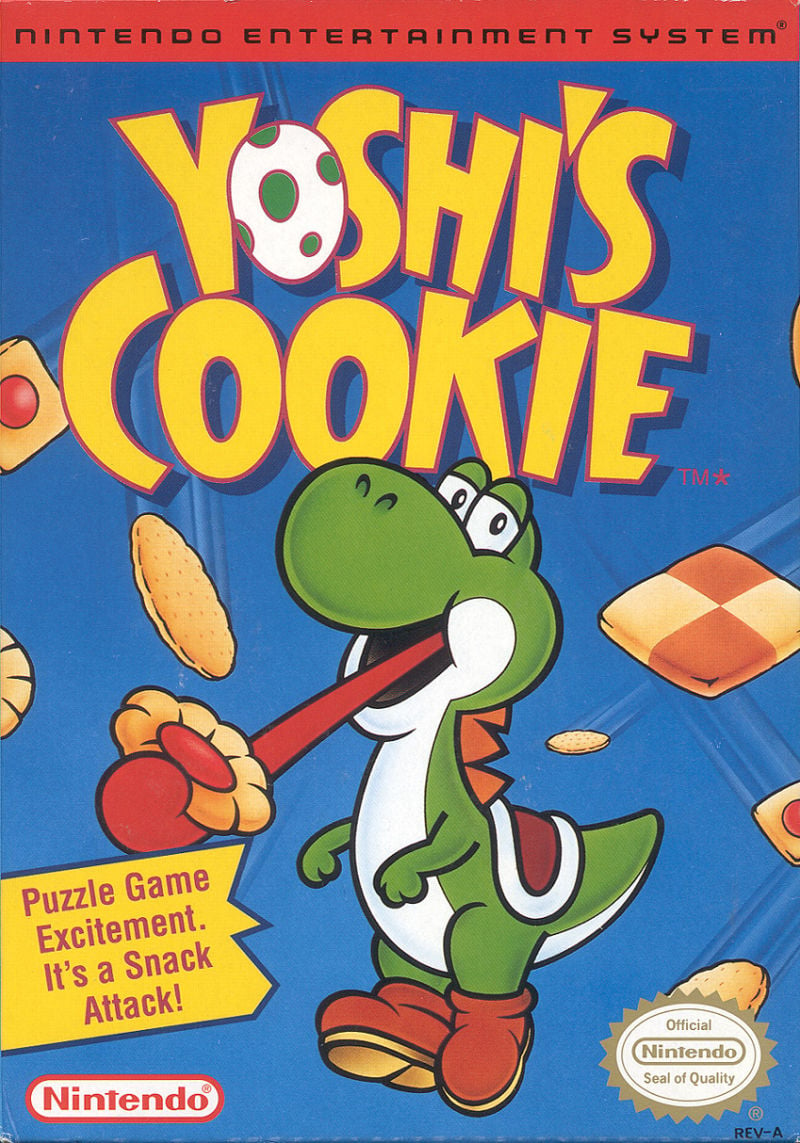
NES box art

Game Boy box art

SNES box art
Per-platform differences


Nintendo Power coverage
Nintendo Power covered Yoshi’s Cookie across two issues in 1993 — first a full feature on the NES and Game Boy versions, then a dedicated SNES preview:
Videos — gameplay, trailers & commercials
SNES gameplay demo
Japanese TV commercial
A beautifully animated Japanese TV commercial from Nintendo of Japan — featuring Mario and Yoshi cooking up trouble in the cookie factory. NOJ’s commercials of this era were known for their high-quality animation.
Reception
Yoshi’s Cookie received mixed to positive reviews on release. Critics praised the addictive puzzle gameplay and VS Mode depth, while some noted the game’s simplicity compared to contemporaries like Tetris.
Tom Lenting of Defunct Games awarded the NES version an A grade, writing that it was one of the best puzzle games he had played — accessible yet challenging, addictive and fun. The SNES version was similarly praised for its improved visuals and the addition of Puzzle Mode.
Despite a modest commercial profile, the game proved successful enough that Nintendo and Bullet-Proof Software released the SNES version after the GB/NES launch, and the game later received the GameCube remake treatment in Nintendo Puzzle Collection. The Wii Virtual Console re-release in 2008 confirmed its enduring appeal, though it was delisted in 2013.
Trivia & interesting facts
- Known in Japan as Yoshi no Cookie (ヨッシーのクッキー)
- The NES/GB title screen features an animated sequence: Mario tries to open a cookie jar, fails and leaves — Yoshi swallows it whole — Mario returns with a hammer to find it empty
- The SNES Puzzle Mode was designed by Alexey Pajitnov, creator of Tetris — one of the few Mario-related games with a direct Tetris lineage
- The game originated as an arcade title called Hermetica by Home Data, featuring alchemy graphics — it flopped in location testing and was sold to Bullet-Proof Software
- Bullet-Proof Software retained the SNES rights independently — which is why the SNES version was published by BPS rather than Nintendo
- In the Action Mode, the Type A music was on the original soundtrack shortlist for Super Smash Bros. Brawl — but like many tracks, never made it to the final game
- The cookie sprites from Yoshi’s Cookie reappear in Game & Watch Gallery 3 in a minigame called Egg
- Tetris DS (2006) included a Puzzle Mode component widely acknowledged as being based on Yoshi’s Cookie’s Puzzle Mode
- Hidden rounds 11–99 are unlockable (Music Off + Speed Hi + Round 10 + hold Up+Select) — featuring Mario enemy sprites instead of cookies
- The rolling Yoshi Cookie in the cutscenes is revealed in the SNES version to be a sign that fell off the Yoshi Cookie shop
- The GameCube version supports up to four players simultaneously — the only release in the series to do so
- The Wii Virtual Console version (2008) includes copyright references to Inaro — Bullet-Proof Software’s pre-Yoshi’s Cookie prototype of the same game engine
Reference & downloads
Guides & reference
Nintendo Power coverage