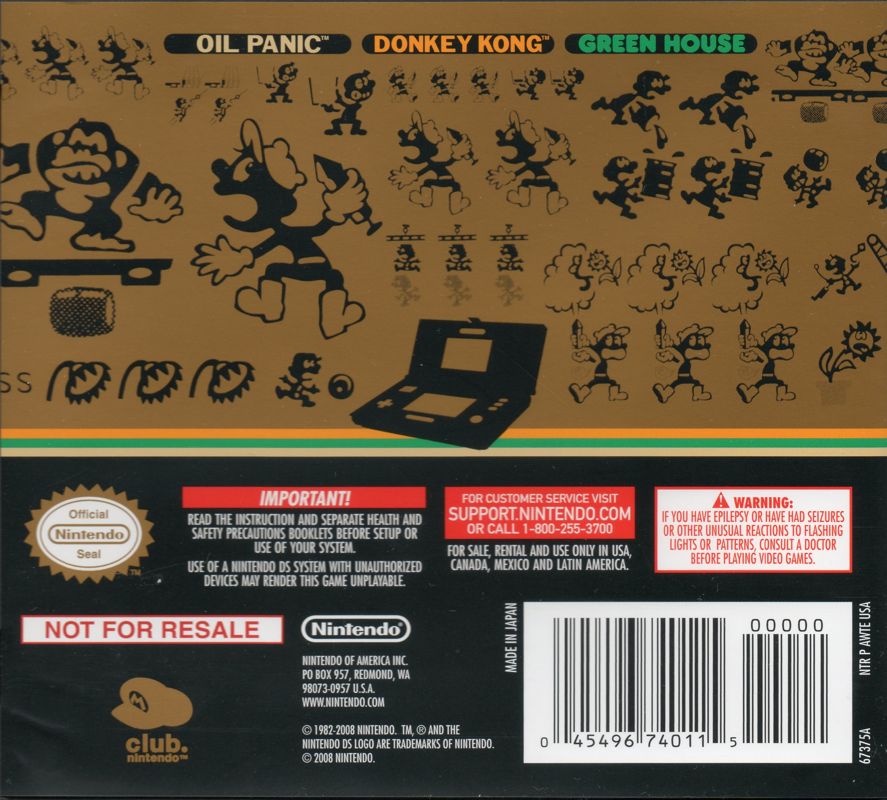
Game & Watch Collection
Three classic Game & Watch Multi Screen titles — Donkey Kong, Oil Panic and Green House — faithfully ported to the Nintendo DS and made available exclusively through Club Nintendo. A lovely little piece of gaming history in your pocket.
Overview

Game & Watch Collection is a limited-edition Nintendo DS game containing three faithful ports of classic Game & Watch Multi Screen titles: Donkey Kong, Oil Panic, and Green House. It was developed by Nintendo EAD and distributed exclusively through the Club Nintendo loyalty programme — you couldn’t buy it in a shop.
The game launched in Japan on July 28, 2006 as one of the first Club Nintendo rewards. When Nintendo expanded Club Nintendo to North America in December 2008 and Europe in December 2009, Game & Watch Collection was one of the available redemption rewards in those regions too. Australia received it at an unconfirmed date.
The three included games are played in their original dual-screen Multi Screen configurations — exactly as they were on the original Game & Watch handhelds — with the Nintendo DS’s two screens mapping naturally to the top and bottom screens of the hardware. The original real-time clocks are retained, Game A and Game B difficulty modes are present, and high score tracking works as per the original devices. The only visual change is that colours are more contrasted and brighter than on the original grey LCD Game & Watch screens.
A sequel, Game & Watch Collection 2, was also released through Club Nintendo, but its included games — Donkey Kong II, Ball, and Vermin — are not part of the Super Mario franchise.
The Three Games

Donkey Kong (1982)
The original Multi Screen Game & Watch from 1982 — one of the most iconic handhelds of the era. Mario (here still called “Jumpman”) must climb a construction site to rescue Pauline from Donkey Kong, who throws barrels from above. The bottom screen shows the ground level with oil drums; the top screen shows the upper girders. It was the first Game & Watch to feature two screens, and is widely credited with inspiring the design of the Nintendo DS itself.
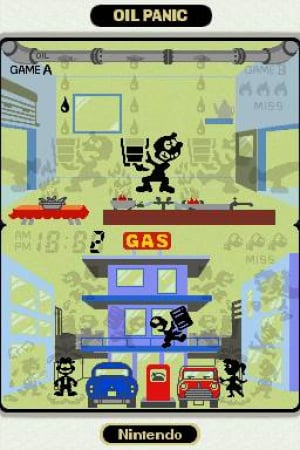
Oil Panic (1982)
Released the same year as Donkey Kong, Oil Panic was the first Multi Screen Game & Watch. A mechanic at a petrol station must catch oil dripping from a leaking machine on the top screen using a bucket, then tip that bucket into the waiting barrel held by his father on the bottom screen — without spilling. Miss too many drops or spill on the father and it’s game over. Simple, satisfying, and surprisingly tense.

Green House (1982)
Mario tends a greenhouse full of plants, fighting off bugs that approach from both screens. He carries a pump-action spray can and must eliminate the insects before they reach and destroy his flowers. The top screen features spiders descending from above; the bottom features worms crawling along the ground. Green House is the least well-known of the three games here but holds up well as a pure reflex challenge.
Features & Presentation

The ports are intentionally minimal — there are no added gameplay modes, no new content, and no remixes. Each game is presented exactly as it originally appeared, making this a straightforward preservation effort rather than a reinterpretation.
- Dual screen layout — all three games are Multi Screen originals, so they map directly onto the DS’s two screens exactly as intended.
- Original real-time clocks retained — the games use the DS’s built-in RTC, so the in-game clock displays the actual time. Note: the alarm function does not work on a Nintendo 3DS due to differences in the hardware.
- Game A / Game B — both difficulty modes from the originals are present.
- High score keeping — personal best scores are saved.
- Brighter colours — the palette is more vivid than the original Game & Watch LCD screens, making the games easier to read on the DS display.
- Control explanation — a brief control guide appears in each game’s mode selection menu, which was not present on the original hardware.
- Alarm function — the collection includes a menu for setting an alarm using the DS’s RTC. This feature is non-functional on a 3DS.
- Movement posture shadows — character shadow animations are more visible than on the originals, similar to the Classic mode in Game & Watch Gallery 4.
Screenshots
Game selection screenDonkey Kong — dual screen gameplayGreen House — bug-spraying actionTrivia & Facts
- Game & Watch Collection was never sold at retail — it was exclusively available through the Club Nintendo loyalty programme in each region.
- All three included games — Donkey Kong, Oil Panic and Green House — are Multi Screen Game & Watch titles originally released in 1982.
- Donkey Kong (1982) was the very first Multi Screen Game & Watch game ever made, and is often cited as a direct inspiration for the Nintendo DS’s dual-screen design.
- Oil Panic (1982) was released the same year as Donkey Kong and was technically the first Multi Screen G&W to go on sale, though both are from 1982.
- The collection retains the original real-time clocks — the in-game time display shows the actual current time using the DS hardware clock.
- The alarm function uses the DS’s built-in RTC and cannot sound on a Nintendo 3DS due to hardware differences.
- Colours are deliberately more contrasted and brighter than the original devices to improve readability on the DS backlit screen.
- A sequel — Game & Watch Collection 2 — was also released through Club Nintendo, featuring Donkey Kong II, Ball and Vermin. None of those games are Super Mario franchise titles.
- Japan received the collection on July 28, 2006 — over two years before North America (December 15, 2008) and three years before Europe (December 2009).
Videos
Box Art